
Workers’ Comp Captive Insurance
A workers’ comp captive lets employers fund their own work-injury losses inside an insurance company they own — usually a group captive shared with other selectively underwritten employers, with reinsurance above it for the rare catastrophic claim — so that safer operations lower their cost over time. Injured employees receive the same statutory benefits either way. What changes is who funds the losses and who keeps the results.
For many businesses, workers’ compensation is the largest insurance line they buy and the one most directly shaped by their own decisions: hiring, training, supervision, and how quickly an injured worker gets care. That is why it is often the first line a group captive is built around. This piece walks through how the claim moves, how state rules shape the structure, who fits, and the trade-offs.
Why workers’ comp suits a captive
Workers’ comp losses are frequent enough to be measured. An employer with a meaningful workforce has loss history that shows how often injuries happen and how costly they tend to be. That predictability is what makes the line fundable and priceable inside a captive.
It is also the line where safety pays most directly. In the commercial market, your premium reflects your industry’s results as well as your own, and the carrier keeps the margin in a good year. In a captive, a better safety record means lower losses in your own loss fund, and more of the result stays with the owners. Our explainer on how group captive insurance works covers the general model; this piece focuses on workers’ comp specifically.
How a work-injury claim moves through a group captive
The best way to understand a workers’ comp captive is to follow a claim.
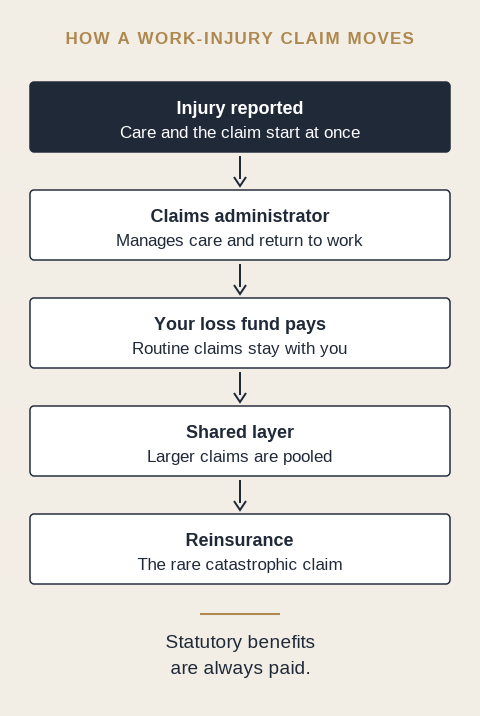
Injury reported. The employee is injured, care begins, and the claim is opened. Prompt reporting matters: claims handled early tend to go better for everyone.
Claims administrator. A professional claims administrator investigates, manages medical care, coordinates return to work, and pays benefits from the captive’s funds.
Your loss fund pays. Routine claims are paid from your own loss fund — the part of your premium set aside for your expected losses. This is where your safety record shows up most clearly.
Shared layer. Larger claims above your loss fund are pooled across the members.
Reinsurance. The rare catastrophic claim is covered by reinsurance above the captive, so a single event cannot overwhelm the pool.
Throughout, the injured worker receives the benefits state law requires. The structure behind the employer does not change what the employee is owed.
How state rules shape the structure
Workers’ compensation is regulated state by state. Each state sets the benefits, the rules for how employers must secure coverage, and the agency that oversees it. The U.S. Department of Labor maintains a directory of state workers’ compensation officials for each state’s program.
Those differences affect how a captive participates:
- Fronting. In many states, a licensed carrier issues the statutory workers’ comp policy and the risk is then reinsured to the captive. Our post on what a fronting carrier is explains how that works.
- Monopolistic state funds. A few states require employers to buy workers’ comp from a state-run fund, which limits what a captive can do for employees there.
- Multi-state employers. If your employees work in several states, the structure has to work in each of them.
How a captive can participate for your workforce is confirmed in a feasibility study, state by state, before anything is formed.
Group captive, self-insurance, or a single-owner captive
Workers’ comp can be financed several ways, and it helps to see where a captive sits.
A self-insured employer retains its losses directly under its state’s self-insurance rules. A group captive is a licensed insurer that the members own: each funds its own losses, shares larger ones, and buys reinsurance above that. Our comparison of captive insurance, self-insurance, and traditional coverage covers the full spectrum.
A single-owner micro-captive is generally built for different risks — enterprise exposures the commercial market excludes or prices out of reach — rather than statutory workers’ comp. For most employers looking at this line, the group captive route is the natural fit.
Where the results are made: reporting, care, and return to work
Most of what an employer controls in workers’ comp happens after an injury, not just before it. Prevention keeps claims from happening; claims management keeps the claims that do happen from growing. In a captive, both show up in your own loss fund.
Prompt reporting. An injury reported the same day is easier to manage than one reported weeks later. Delays tend to make claims harder to investigate, slower to treat, and more likely to end up in a dispute.
Medical care that fits the injury. Getting the injured worker to appropriate care quickly helps the worker and tends to keep the claim on track. The claims administrator coordinates that care within the state’s rules.
Return to work. A worker who can come back to suitable, modified duties while recovering often returns to full duty sooner. Employers with a real return-to-work program — supervisors who know how to offer modified work, and a culture that welcomes people back — tend to see shorter, smaller claims.
Close attention from the members. Because routine claims are paid from your own loss fund, members of a workers’ comp captive usually get closer visibility into their claims than in the commercial market, and a reason to care about every one.
What a feasibility study looks at for workers’ comp
Before anyone can say whether a workers’ comp captive fits, a feasibility study has to look at the employer’s actual risk. For this line, that usually means:
- Loss history, line by line and year by year, to see how often injuries happen and how they have developed.
- Payroll by job type, because workers’ comp exposure is driven by what employees do, not just how many there are.
- The states where employees work, to confirm how a captive can participate in each.
- The safety and return-to-work programs as they actually operate, not as written.
- Financial capacity to fund the loss fund and post the capital or collateral the captive requires.
The study can conclude that the commercial market is the better answer for now, and a sound one says so plainly.
Who fits a workers’ comp captive
An employer tends to fit when:
- Its safety program is real, documented, and supported by leadership.
- Its workforce is large enough to produce measurable loss history.
- It can fund its own losses and post the capital or collateral the captive requires.
- It intends to stay for several years, through a bad year as well as good ones.
Our post on group captive insurance for mid-market businesses covers the membership model in more detail. For contractors in particular, our post on construction captive insurance puts workers’ comp alongside the other working lines, and our guides for trucking companies, staffing companies, and restaurant groups cover industries where comp is often the largest line.
The trade-offs to weigh honestly
A workers’ comp captive asks more of an employer than a conventional policy.
Your results are your results. A bad year costs more than it would under pooled commercial pricing, and a good year rewards you. Returns of unused loss funds, when they happen, are conditional and come only after an underwriting year’s claims have developed — never guaranteed. Our post on captive dividends and distributions explains how that works.
Commitment. A captive works over years, not a single renewal. Members that leave after one hard year rarely see the benefit.
Engagement. Members are expected to take loss control and claims seriously. That is the point of the model, but it is real work.
Collateral and cash flow. Funding a loss fund and posting capital or collateral ties up money that would otherwise stay in the business. That cost belongs in the decision from the start, alongside the potential long-term benefit, so it does not surprise you in the first year.
Tax is not the reason to form any captive. Where tax treatment is involved, it follows from genuine insurance. This is general information, not legal or tax advice — see our disclosures.
Where to start
Whether a workers’ comp captive fits your business depends on your loss history, your safety program, the states your employees work in, and your capacity to commit. A feasibility study works through those questions before anything is formed, and it can conclude that your business is better served by the commercial market for now. If you are new to captives, start with what a captive insurance company is.
Frequently asked questions
Do injured workers get different benefits under a captive?
No. Workers’ compensation benefits are set by state law, and an injured employee is entitled to them however the employer finances the coverage. A captive changes who funds the losses and who keeps the results, not what the worker receives. A sound workers’ comp captive puts real effort into prompt care and return to work, because good claims handling serves both the worker and the employer.
Can a captive write workers’ comp in every state?
Not in the same way everywhere. Workers’ compensation is regulated state by state, and a few states run their own monopolistic state funds that employers must use. In many states, a licensed fronting carrier issues the statutory policy and the risk is reinsured to the captive. How a captive can participate for your employees depends on the states where they work, which a feasibility study confirms.
Is a workers’ comp captive the same as self-insuring?
No. A self-insured employer retains its workers’ comp losses directly under its state’s self-insurance rules. A captive is a licensed insurer, and in a group captive each employer funds its own losses while sharing larger ones with other members and buying reinsurance above that. Both keep more of the result than conventional coverage, but a group captive adds pooling that a single self-insured employer does not have.
Who handles the claims?
Usually a professional claims administrator, often called a third-party administrator. It investigates claims, manages medical care and return to work, and pays benefits from the captive’s funds. Because your own loss fund pays your routine claims, members of a workers’ comp captive tend to get closer visibility into claims than they would in the commercial market — and a reason to care about every one.
What kind of employer fits a workers’ comp captive?
Employers with a strong, documented safety culture, a workforce large enough to produce measurable loss history, financial stability to fund their own losses and post the required capital, and a commitment to stay for several years. A captive rewards safety over time; it does not repair a poor loss record. A feasibility study is how you find out whether you fit.
Feasibility Study
See whether a captive fits your business.
Every engagement starts with a feasibility study — an honest read on whether a captive is right for you before anything is formed.