
Captive insurance, explained
What is a captive insurance company?
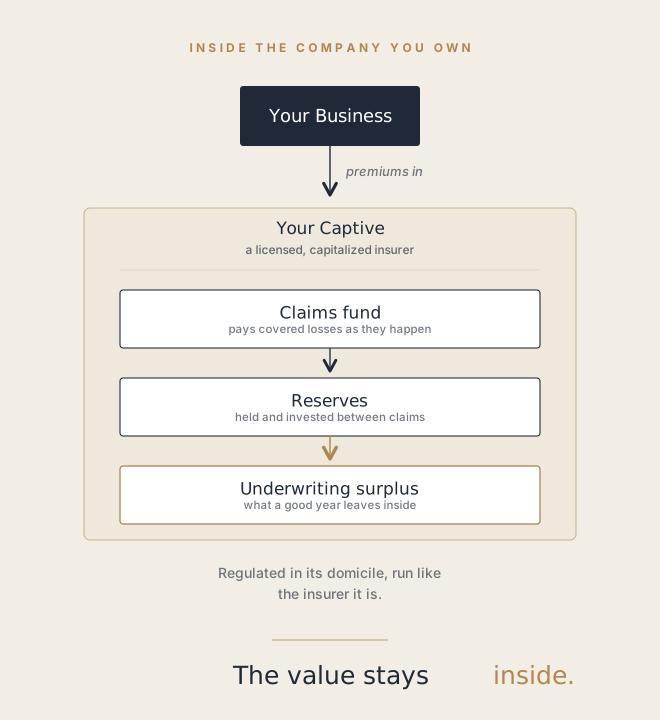
A captive insurance company is a licensed insurer that a business forms and owns to insure its own risks. Instead of paying premiums to an outside carrier, the business pays them to its own captive — which underwrites real coverage, pays claims, and keeps the underwriting profit a commercial insurer would otherwise retain.
The core idea
A captive is insurance you own
At its simplest, a captive flips the usual relationship with insurance. Instead of being the customer of an insurance company, you become the owner of one.
Every business pays to manage risk. Normally that means buying policies from a commercial carrier: you hand over premiums, and in a good year — few claims — the carrier keeps the difference as profit. A captive is a risk-financing tool that lets you capture that dynamic instead of surrendering it. You form your own licensed insurance company, it insures risks you understand well, and the money that would have left your business stays inside an entity you control.
That is the whole idea: a captive is not a product you buy, it is a company you build. It is insurance first — real coverage for real risk — and the financial and tax advantages, where they exist, follow from operating it as genuine insurance.
How it works
How a captive actually works
The mechanics are more ordinary than they sound. A captive does the same things any insurance company does — just for an owner who is also, in effect, its main customer.
- Form and capitalize it. You establish a licensed insurance company in a chosen domicile (a U.S. state or an offshore jurisdiction with a captive statute) and fund it with enough capital to pay the claims it will insure.
- It underwrites your risks. The captive issues real policies covering specific exposures of your business, with terms and pricing set for the actual risk.
- You pay premiums. Your operating business pays premiums to the captive — generally deductible business expenses, the same as premiums paid to any insurer.
- It pays claims and holds reserves. When a covered loss happens, the captive pays the claim. Between claims, it holds and invests reserves, like any insurer.
- You keep the results. In good years, the underwriting profit and investment income build value inside a company you own rather than padding an outside carrier’s margin.
The two ideas that make it insurance
Risk shifting and risk distribution, in plain English
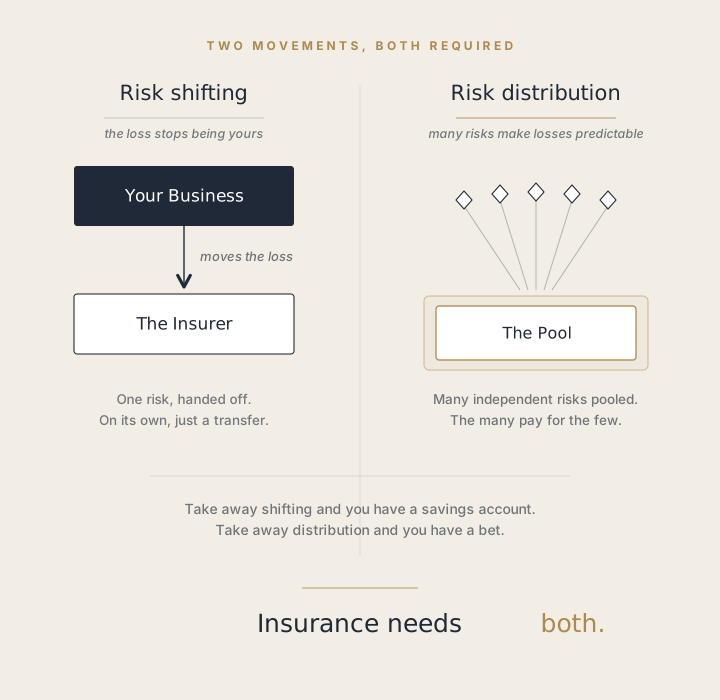
For something to count as insurance — captive or not — two things have to be true. They are worth understanding from the ground up, because they are what separate real insurance from simply setting money aside.
Risk shifting: the loss stops being yours
Risk shifting means moving the financial consequence of a possible loss off your own shoulders and onto an insurer, in exchange for a premium. Picture a bakery with one delivery van. If the van is wrecked, replacing it could be a painful, unplanned expense. Insure it, and the cost of that loss now lands on the insurer instead — you have traded an unpredictable big expense for a small, predictable premium. The risk has shifted. In a captive, your operating business shifts its risk to the insurance company you own.
Risk distribution: many risks make losses predictable
Shifting one risk to one party is not yet insurance, though — it is just moving a gamble around. Insurance needs distribution: many separate, independent risks pooled together so the handful of losses that actually occur are paid for by the premiums of the many that do not. Think of a thousand homeowners in a town. In any given year only a few have a serious fire, and nobody can predict which houses. But across all thousand, the number of fires is fairly steady — so the premiums everyone pays comfortably cover the few claims. The pool makes the unpredictable predictable. A captive has to insure enough independent risk for that same effect to hold.
Genuine insurance requires both: shift the risk, and distribute it across a real pool. Take away shifting and you have a savings account; take away distribution and you have a bet. A legitimate captive is built to satisfy both — and how regulators and the courts actually test that is the subject of our compliance page.
What it is good for
The risks a captive is built to handle
A captive is not a fit for every risk or every business. It earns its keep on a particular kind of exposure.
Captives tend to make sense where one or more of these is true:
- You carry real risks that are uninsured or underinsured because the commercial market excludes them, sublimits them, or prices them out of reach.
- Your premiums are high relative to your actual losses — a sign you may be subsidizing the carrier’s margin and the market’s worse risks.
- You want coverage tailored to your business that off-the-shelf policies do not offer.
- You have a clean loss history and the financial stability to fund and stand behind an insurance company.
Where none of that is true — where the commercial market already covers you well and cheaply — a captive usually is not worth the effort. Knowing the difference is most of the value of asking the question properly.
The main types
Types of captives
“Captive” is an umbrella term. A few structures exist; here is the short version, and then the two Tessera focuses on.
For completeness: a single-parent (pure) captive is owned by one company and insures only that company and its affiliates. A cell captive lets a business rent a legally separated “cell” within a larger sponsored structure rather than form its own company. And under the tax code, larger captives are generally taxed under Section 831(a), while smaller ones may elect Section 831(b). These are real options, but they are not where Tessera works — so we will not pretend to cover them in depth.
Tessera focuses on two structures, each with its own page:
The Section 831(b) reference above is general information, not tax advice; tax treatment depends on your facts. See our disclosures.
Is it right for you?
Is a captive right for my business?
The honest answer is that it depends — and that the only way to know is to look at your actual numbers.
A captive can be a powerful tool for a profitable, well-run business carrying genuine risk it cannot finance well in the commercial market. It is the wrong tool for a business chasing a deduction, one without real uninsured exposures, or one that cannot commit to funding and running an insurance company over the long term. Most of the work is figuring out which description fits you.
That is what a feasibility study is for: a structured, honest look at your risk, loss history, and goals that answers whether a captive makes sense before anything is formed. If it does, you have a clear path; if it does not, you have saved yourself the trouble.
Common questions
Captive insurance: common questions
Is a captive insurance company legal?
Yes. Captive insurance is a long-established, legitimate way for businesses to finance their own risk, used for decades by companies of every size. Legitimacy is not automatic, though: a captive has to operate as genuine insurance — real risk transfer, real risk distribution, arm’s-length pricing — rather than existing only to produce a tax result. We cover how that legitimacy is established and tested on our compliance page.
How much does it cost to start a captive?
There is no honest single number. Cost depends on the structure you choose, the domicile where the captive is licensed, the lines and limits it writes, and the professional work involved — capitalization, actuarial pricing, legal, audit, and ongoing management. A small shared structure looks very different from a standalone company. Rather than quote a figure that would not fit your situation, we model the real economics for your business during a feasibility study.
How is a captive different from self-insurance?
Self-insurance, in its simplest form, means keeping a risk on your own books and paying losses out of pocket as they happen — no separate company, no formal structure. A captive turns that instinct into a real, licensed insurance company you own: it issues policies, holds reserves, is regulated in its domicile, can access reinsurance, and — when it qualifies as genuine insurance — is treated as insurance for tax purposes. It is a more formal, more capable way to finance risk you are already carrying.
Do I need a captive manager?
In practice, yes. A captive is an operating insurance company with ongoing obligations — policy issuance, claims handling, actuarial pricing, financial statements, regulatory filings and exams, and tax compliance. A captive manager runs that machinery so the company behaves like the insurer it is. Letting those functions lapse is one of the fastest ways to undermine a captive’s standing.
What is the difference between a micro-captive and a group captive?
A micro-captive is owned by a single business and is small enough to elect Section 831(b) tax treatment; it tends to insure a company’s enterprise and uninsured risks. A group captive is co-owned by many unrelated businesses that pool their working-layer risks — commonly workers’ compensation, general liability, and auto. The two solve different problems; each linked page walks through who it fits.
How do I know if a captive is right for my business?
It depends on real factors: whether you carry genuine uninsured or underinsured risk, the quality of your loss history, whether your premiums are high relative to your losses, and whether you can fund and commit to an insurance company over the long term. The honest way to find out is a feasibility study, which tests whether a captive makes sense for you before anything is formed — and tells you plainly when it does not.
Feasibility Study
Ready to see whether a captive fits?
A feasibility study is the honest first step — insurance first, the answer in writing. Or keep reading about micro-captives and group captives to see which path looks like yours.