

Captive Insurance for Restaurant Groups and Franchisees
Multi-unit restaurant groups and franchisees use captives — usually group captives, sometimes a captive sponsored by the franchise system — to finance their frequent, familiar claims: kitchen and floor injuries, customer slips and falls, and delivery driving accidents. Their own loss fund pays the routine claims, reinsurance caps the severe ones, and well-run operators keep more of the results of their own safety habits instead of paying the restaurant industry’s average price.
Restaurants generate a steady stream of small claims. Cooks get burned and cut, servers slip on wet floors, customers trip in parking lots, and delivery drivers have accidents. Those claims are individually modest and collectively expensive, and they are heavily influenced by how each location is run. That combination — frequent, predictable, and controllable — is exactly what a captive is built to finance. This piece explains how a restaurant captive works, who fits, and what it takes to succeed.
Why restaurants fit the captive model
A captive works best on risk that is frequent enough to measure. A multi-unit restaurant group produces enough claims across its locations that its loss history tells a real story, and an actuary can price it. The same frequency means that good habits — dry floors, cut-resistant gloves, careful drivers — show up in the results quickly.
In the commercial market, a restaurant operator’s premium reflects its own record, but also the market’s view of restaurants generally. Operators who invest in training and supervision carry part of the cost of competitors who do not. In a captive, more of the difference stays with the owners. Our explainer on what a captive insurance company is covers the basic idea.
How a restaurant group’s captive works
The structure follows the same layered model as other group captives.
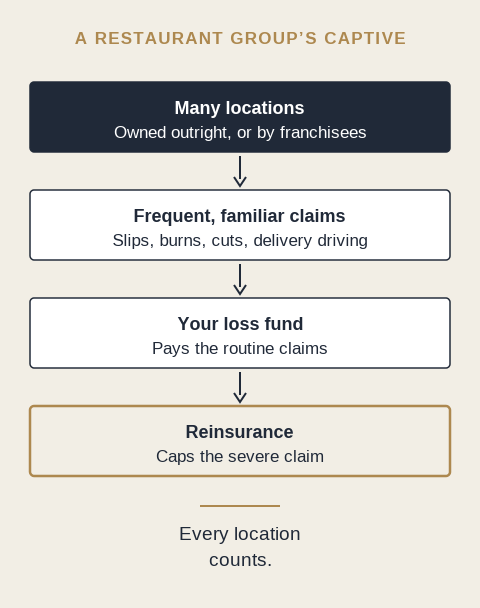
Each operator funds a loss fund for its expected claims. In a group captive, larger claims are shared among members in a pooled layer, and reinsurance protects the captive from the rare severe loss. A licensed fronting carrier usually issues the policies that landlords, lenders, and franchisors require, with the risk reinsured to the captive. Our post on how group captive insurance works explains the layers in detail.
The lines that fit
Workers’ compensation is often the largest line for a restaurant group, driven by burns, cuts, strains, and slips in the kitchen and on the floor. Our post on workers’ comp captive insurance follows a claim through a captive.
General liability covers customers hurt on the premises — slips on wet floors, trips in parking lots, and similar incidents.
Auto liability matters for groups with delivery or catering vehicles, and for groups whose employees drive on company business.
Property, especially the large kitchen fire, usually stays in the commercial market, where catastrophic losses are spread across a much larger pool. A captive may still fund the property deductible, which turns a cost the operator was absorbing anyway into a planned, funded layer. Our post on deductible reimbursement explains how.
Which lines go into the captive is a decision for the feasibility study, based on each line’s claims history. A group with steady, well-documented workers’ comp results but volatile auto results might start with workers’ comp alone and add lines later.
Franchise systems and sponsored captives
Franchise systems are a natural home for group captives because the locations share similar operations, menus, equipment, and training. Some franchisors sponsor a captive for their franchisees, offering a common program with shared standards. In other systems, groups of franchisees organize one themselves.
Either way, a franchise captive works only if its members genuinely share standards and enforce them. One franchisee’s poor results affect everyone in the pool, so strong programs hold members accountable for training, maintenance, and incident reporting.
Franchise agreements usually set insurance requirements for franchisees, often including minimum coverages and naming the franchisor on policies. A captive has to satisfy those requirements, which is another reason a fronting carrier is common in franchise programs. A franchisee considering a captive outside the system’s own program should confirm with the franchisor that the structure meets the agreement before committing.
Safety habits at every location
In a restaurant captive, results are made one location at a time. The habits that tend to matter most are ordinary but consistent:
- Floors. Spills cleaned immediately, wet-floor warnings used, non-slip mats and footwear required.
- Knives and heat. Training on safe cutting and handling hot equipment and oil, with protective gear available and used.
- Lifting. Help and equipment for heavy deliveries, so strains do not become long claims.
- Drivers. Screening, training, and clear rules for anyone driving for the business.
- Onboarding. New employees get trained before they are put in harm’s way, because they are hurt more often than experienced staff.
Incident reporting belongs on the list too. A burn or a fall reported the same day, with the employee sent to appropriate care, is far easier to manage than one that surfaces weeks later. Managers who know the reporting routine, and a culture where reporting is expected rather than discouraged, keep small claims small.
OSHA’s restaurant safety guidance on general hazards covers many of these. Operators that build them into every location’s routine — not leaving them to each manager — tend to do well in captives.
Who fits
A restaurant group tends to fit a captive when it operates multiple locations with consistent standards, has loss history credible enough to price, can fund its own losses and post the capital or collateral a group requires, and is prepared to stay for several years. A single-location restaurant is rarely large enough for a captive of its own, though some can participate through a group. Our post on group captive insurance for mid-market businesses explains how membership works.
What a feasibility study looks at for a restaurant group
Before anyone can say whether a captive fits, a feasibility study has to look at the operation location by location. For restaurants, that typically means:
- Loss history by line and by location. A group whose claims are concentrated at a few poorly run locations tells a different story from one with steady results across the portfolio.
- Payroll and staffing patterns. Kitchen versus front-of-house mix, the share of newer employees, and how shifts are staffed all affect injury risk.
- Delivery and catering operations. Who drives, in what vehicles, and under what rules.
- Safety practices as they actually run, including training, floor care, and how incidents are reported.
- Lease, franchise, and lender insurance requirements, which shape whether and where a fronting carrier is needed.
- Financial capacity to fund a loss fund and post collateral without straining operations.
The study can conclude that the group should standardize its safety program across locations first and revisit a captive once the results show it.
Questions to ask before joining a restaurant captive
- Who else is in the group? Members with similar concepts and standards make a healthier pool than a mix of very different operations.
- How are members selected and held to standards? Look for real underwriting and consequences for members whose results slip.
- How is the shared layer built? Know where your loss fund ends and pooled risk begins.
- Who handles claims, and what will you see? Visibility into your own claims is what lets you manage them.
- How does leaving work? Exit terms belong in the decision on the way in; our post on captive exit strategy explains why.
The trade-offs
A captive asks more of an operator than a conventional policy. A bad year costs more than pooled commercial pricing would, and a good year rewards you. Any return of unused loss funds is conditional and comes only after an underwriting year’s claims have developed. Collateral and loss funding tie up cash, which matters in a business with thin margins. Our post on captive dividends and distributions explains how money comes back. Workers’ compensation rules vary by state; the U.S. Department of Labor keeps a directory of state workers’ compensation officials.
Tax is not the reason to join. Where tax treatment applies, it follows from genuine insurance. This is general information, not legal or tax advice — see our disclosures.
Where to start
A feasibility study looks at your locations, your loss history by line, your safety practices, and your capacity to commit, and it can conclude that your current program serves you better for now. Our page on group captives explains the structure we work in.
Frequently asked questions
Can franchisees of the same brand form a captive together?
They can, and franchise systems are a natural fit for group captives because the locations share similar operations, menus, and risks. Some franchise systems sponsor a captive for their franchisees; in others, groups of franchisees organize one themselves. Either way, members need common safety standards, enough combined loss history to price the risk, and long-term commitment.
What restaurant risks fit best in a captive?
The frequent, predictable ones: workers’ compensation for kitchen and floor staff, general liability for customer slips and falls, and auto liability for delivery and catering vehicles. Large property losses such as a kitchen fire, and the rare severe liability claim, usually sit above the captive in the commercial or reinsurance market.
Is a single restaurant too small for a captive?
Usually, for a captive of its own. A single location rarely has the scale to justify a captive’s fixed costs. Multi-unit operators are a better fit, and smaller operators can sometimes participate through a group captive alongside other restaurant owners. A feasibility study answers whether your operation is large enough and disciplined enough to benefit.
How does high employee turnover affect a restaurant captive?
It matters. New employees tend to be injured more often, so turnover puts pressure on training and supervision. Restaurant groups that do well in captives treat onboarding and safety training as routine at every location, not something left to each manager’s discretion. A captive makes the cost of turnover visible in your own loss fund.
Feasibility Study
See whether a captive fits your business.
Every engagement starts with a feasibility study — an honest read on whether a captive is right for you before anything is formed.