
Captive Insurance for Trucking Companies: How It Works
Trucking companies with strong safety programs use captives — almost always group captives — to finance their auto liability, cargo, and workers’ compensation risk in an insurance company they co-own, so that safer miles lower their cost over time instead of disappearing into the commercial market’s average price. A licensed fronting carrier issues the policy regulators and shippers require, the fleet’s own loss fund pays routine claims, and reinsurance sits above for the catastrophic crash.
Few industries feel the commercial insurance market as sharply as trucking. Auto liability is the line that keeps fleet owners up at night: a single serious crash can produce a claim far larger than a year of premium. Carriers price that uncertainty into every fleet, including the ones that invest heavily in drivers, training, and technology. A captive is one way for a well-run fleet to stop subsidizing the industry’s worst operators. This piece explains how a trucking captive is put together, who fits, and where it goes wrong.
Why trucking is a natural fit for a captive
A captive works best on risks that are frequent enough to measure and serious enough to matter. Trucking checks both boxes. Fender-benders, cargo claims, and driver injuries happen often enough that a fleet’s own loss history tells a real story, and the severe claims are large enough that how they are financed changes the economics of the business.
In the commercial market, your premium reflects your loss history, but it also reflects the market’s view of trucking as a whole. When liability verdicts rise or carriers leave the class, good fleets pay for it too. Inside a captive, the fleet funds its own expected losses, and when its losses come in better than expected, more of that result stays with the owners. Our explainer on what a captive insurance company is covers the basic idea; the rest of this piece is specific to fleets.
How a trucking captive is layered
A trucking captive is built in layers, so that no single crash can sink the insurer.
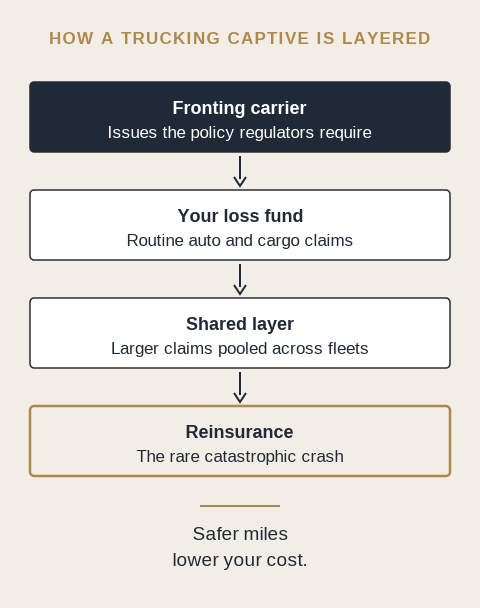
The fronting carrier. A licensed insurer issues the auto liability policy, makes the filings regulators require, and provides the certificates shippers and brokers ask for. The risk is then reinsured to the captive. Our post on what a fronting carrier is explains how that arrangement works.
Your loss fund. The part of your premium set aside for your own expected losses. Routine auto, cargo, and physical damage claims are paid here, which is where your safety record shows up most directly.
The shared layer. Larger claims above your loss fund are pooled across the member fleets. This is what makes the structure insurance rather than a savings account: the members genuinely share risk.
Reinsurance. The rare catastrophic crash is covered by reinsurance above the captive, so one event cannot overwhelm the pool.
The federal filing question
For-hire motor carriers must maintain minimum levels of financial responsibility and keep proof of it on file. The Federal Motor Carrier Safety Administration describes those obligations on its insurance filing requirements page, and they vary by type of operation.
That is why almost every trucking captive works behind a fronting carrier. The fronting carrier’s policy and filings satisfy the regulator and your customers; the captive takes on the risk through reinsurance. The arrangement has to be right for your specific authority and operation, so confirm it before you rely on it.
Which fleets fit a trucking captive
A fleet tends to fit a captive when:
- Its safety program is real. Driver hiring standards, training, telematics, and a culture where safety is managed from the top, not delegated to a binder.
- Its loss history is credible. Enough history, line by line, for an actuary to price the risk.
- It can fund its own losses. Members fund a loss fund and post capital or collateral, which ties up cash the fleet would otherwise keep.
- It is in for the long run. Captives reward fleets over several years, through a bad year as well as good ones.
A captive is usually the wrong answer for a fleet hoping to hide a poor loss record, chasing the cheapest first-year price, or unwilling to invest in safety. Our post on whether captive insurance is worth it covers the honest trade-offs in more detail.
Why safety is the whole model
In a trucking captive, safety is not a compliance exercise; it is the economics. Fewer and smaller claims mean lower losses in your loss fund. Prompt reporting and good claims handling keep the claims that do happen from growing. Groups typically expect members to engage on loss control, because one member’s poor results affect the pool.
The same discipline that keeps drivers safe keeps a captive healthy: careful hiring, consistent training, maintenance, and attention to the habits that cause crashes. Fleets that already run that way are the ones that tend to benefit. Fleets that do not are better served fixing those habits first and revisiting a captive once their record shows the change.
Workers’ comp and the dock
Drivers and dock workers get hurt too, and workers’ compensation is a significant line for many fleets. Some trucking groups write workers’ comp alongside auto; others leave it to a separate program. Workers’ comp brings its own state-by-state rules, which our post on workers’ comp captive insurance walks through.
What a trucking captive costs you upfront
Joining a group captive asks more of a fleet than buying a policy. Expect to fund a loss fund, post capital or collateral, pay your share of the captive’s operating costs, and commit for several years. The return, when it comes, is conditional: it depends on your losses and the group’s, and it arrives only after an underwriting year’s claims have developed. Our post on captive dividends and distributions explains how money comes back, and our post on how group captive insurance works covers the membership model.
Tax is not the reason to join. Where tax treatment is involved at all, it follows from genuine insurance. This is general information, not legal or tax advice — see our disclosures.
What a feasibility study looks at for a fleet
Before anyone can say whether a captive fits a trucking company, a feasibility study has to look at the fleet as an insurer would. For trucking, that usually means:
- Loss history by line and by year. Auto liability, physical damage, cargo, and workers’ comp each tell a different story, and an actuary needs enough history on each to price it.
- The operation itself. Radius, commodities hauled, owner-operators versus company drivers, and the lanes the fleet runs all change the risk.
- Safety and driver management. Hiring standards, training, telematics, maintenance practices, and how the fleet responds when a driver’s record slips.
- Claims handling. How quickly accidents are reported and investigated, and who manages them.
- Financial capacity. Whether the fleet can fund a loss fund and post the capital or collateral a group requires without straining operations.
The study can conclude that the fleet is not ready, or that the commercial market serves it better for now. That is a useful answer, not a failed one.
Questions to ask a trucking group before you join
Not every group captive is built the same way, and the group you join matters as much as the decision to join one. Before signing, ask:
- How are members selected? A group is only as strong as its weakest members. You want to see real underwriting standards, applied consistently.
- How is the shared layer split? Understand where your loss fund ends, where the pooled layer begins, and how reinsurance sits above it.
- What are the loss control expectations? Strong groups expect participation in safety programs and hold members to it.
- How are claims handled? Ask who administers claims and how members see their own claim activity.
- How does leaving work? Exit terms belong in the decision on the way in. Our post on captive exit strategy explains why.
Our post on questions to ask before choosing a captive manager covers the manager side of that diligence.
Where to start
Whether a captive fits your fleet depends on your loss history by line, your safety program, your filing obligations, and your capacity to commit. A feasibility study works through those questions before anything is formed, and it can conclude that the commercial market is the better answer for now. Our page on group captives explains the structure we work in.
Frequently asked questions
Will a trucking captive satisfy my federal insurance filing?
It can, when it is built for it. For-hire carriers must keep minimum levels of financial responsibility on file with the Federal Motor Carrier Safety Administration, and shippers and brokers expect certificates from a licensed insurer. Trucking captives usually work behind a fronting carrier that issues the required policy and filings, with the risk then reinsured to the captive. Confirm the arrangement meets your own filing obligations before relying on it.
Can a small fleet join a trucking captive?
Sometimes. Group captives are designed for fleets that are too small to own an insurer alone, but each group sets its own standards for safety record, loss history, financial strength, and commitment. Fleet size matters less than whether you run a disciplined safety program and can fund your own losses. A feasibility study tells you whether your fleet fits a group you would want to join.
What happens after a bad crash in a trucking captive?
The claim is paid. Your loss fund absorbs the first part, the shared layer takes the next part, and reinsurance protects the captive from the rare catastrophic loss. A severe year will cost you more than it would in the commercial market’s pooled pricing, and it reduces what, if anything, comes back to you later. That trade only makes sense for fleets confident in their safety program.
Do trucking captives cover cargo and physical damage?
Many do, alongside auto liability, and some groups also write workers’ compensation for drivers and dock staff. Which lines a particular group writes, and how each is layered, varies from group to group. The feasibility study looks at your loss history by line and recommends what belongs in the captive and what should stay in the commercial market.
Feasibility Study
See whether a captive fits your business.
Every engagement starts with a feasibility study — an honest read on whether a captive is right for you before anything is formed.