
What Actually Happens in a Captive Feasibility Study
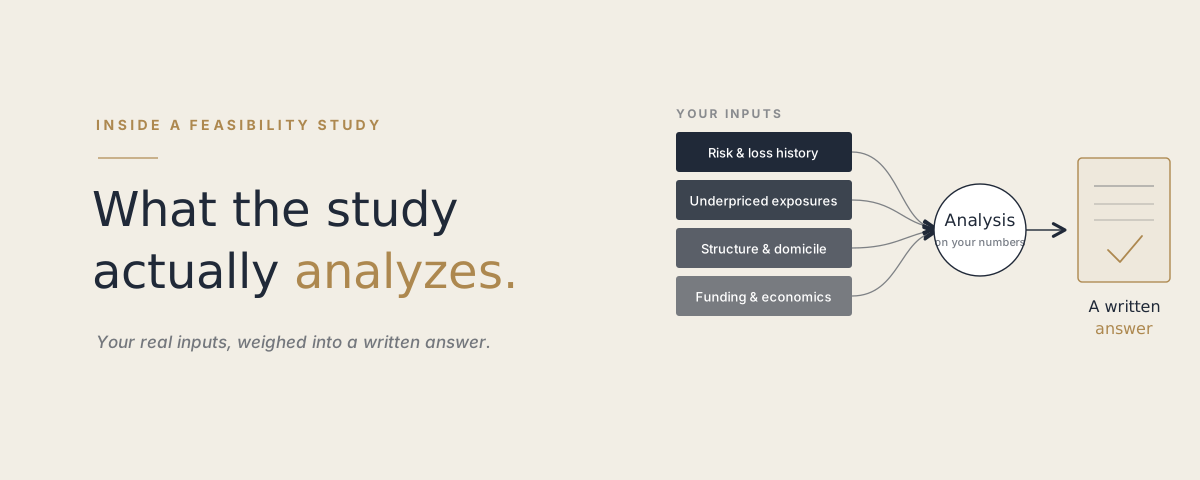
If you have decided a captive is at least worth investigating, the next thing people usually want to know is the most practical question of all: what actually happens when you commission a feasibility study? It sounds like a formality — a box to tick before the real work — but it is the opposite. The feasibility study is the real work. It is the analysis that decides whether a captive should exist for your business at all, and everything that might follow stands on it.
This piece is about the mechanics of that analysis: what a feasibility study examines, the order it works in, what you walk away holding, and the part most sales pitches skip — that a good study is genuinely willing to come back and tell you no. It is not a pitch for the study itself (the feasibility study page is where you actually request one), and it is not a re-explanation of what a captive is. It is a look under the hood at the analysis that comes first.
Why the study comes first — and why that order matters
The arrangements that get businesses into trouble are almost always the ones built backward: someone decides they want a captive — often for a tax reason — and then works backward to justify it. A feasibility study exists to prevent exactly that. It puts the analysis before the decision, so the question of whether a captive is genuine insurance for you gets answered honestly, on your own facts, before a single dollar is committed to forming one.
That ordering is not just prudent; it is part of what makes a captive defensible in the first place. A captive has to operate as real insurance to be respected as one, and the discipline of testing that up front — rather than assuming it — is the same discipline that holds up later. So the study is not a hurdle in front of the real work. It is the foundation the real work is built on, and skipping it is how you end up owning something you should not.
What the study actually analyzes
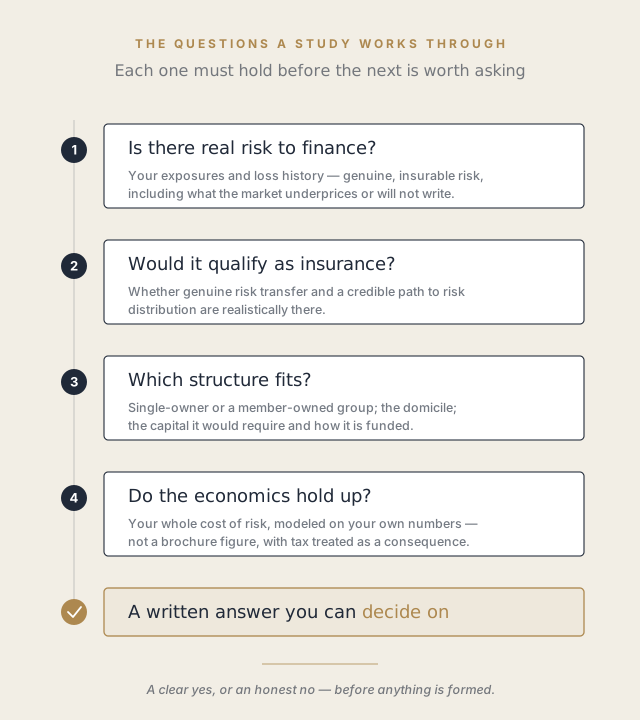
A feasibility study is a structured look at the handful of things that genuinely determine whether a captive works for a specific business. It is not a questionnaire with a pre-written conclusion; it is an analysis that can land either way. Concretely, it works through four questions — and each one has to hold before the next is really worth asking.
First: is there real risk to finance?
Everything starts with your actual risk. The study examines your risk profile and loss history — the exposures your business genuinely carries, what you currently insure, what you absorb yourself, and the losses you have actually had. The point is to find out whether there is real, insurable risk a captive could finance: enterprise risks the commercial market underprices, exclusions and gaps you are quietly swallowing, lines where you are paying for someone else’s worse losses. If there is no genuine risk for a captive to take on, the analysis can stop right here — and a good one will say so.
This is also where your loss history does double duty. A clean, documented record is both the evidence that you manage risk well and the raw material an actuary needs to price a captive defensibly. Patchy or volatile data does not just look bad; it makes the risk genuinely hard to fund.
Second: would it qualify as genuine insurance?
A captive only works — legally and economically — if it is real insurance. So the study tests whether the arrangement would actually function as insurance rather than merely look like it. That turns on two things courts treat as non-negotiable: genuine risk shifting (the economic risk of loss really moves to the captive) and risk distribution (the captive pools enough independent, uncorrelated exposures that losses become predictable). Distribution is the prong that single-owner arrangements most often struggle with, and it is precisely where the well-known failures came undone — the Tax Court rejected arrangements that lacked real distribution and were priced to a target rather than to the actual exposure (see Avrahami v. Commissioner, 149 T.C. 144 (2017), and Reserve Mechanical Corp. v. Commissioner, T.C. Memo. 2018-86, aff’d 34 F.4th 881 (10th Cir. 2022)). A feasibility study asks the honest version of that question up front: is there a credible path to genuine distribution and arm’s-length pricing here, or not?
Third: which structure would fit?
If there is real risk and a credible path to genuine insurance, the study then models how a captive would actually be built. This is where the two routes come in, because a captive is not one thing. A single, closely held business carrying enterprise and uninsured risks the market underprices tends toward a single-owner micro-captive — the structure walked through in how to start an 831(b) captive and our micro-captives and 831(b) page. A financially sound mid-market business with a strong record in the working lines — workers’ compensation, general liability, auto — more naturally fits a group captive, where unrelated, underwritten members pool that risk together; that route is covered in group captive insurance for mid-market businesses and our group captives page. Part of the study’s job is simply to figure out which — if either — is the right shape for your risk. The same analysis also weighs where the captive would be domiciled and the capital it would require, since a captive has to be genuinely capitalized to function as an insurer at all.
Fourth: do the economics hold up on your own numbers?
Only once the insurance case stands does the study turn to the money — and even then, deliberately, last. It models the projected economics on your figures: the loss funding the captive would need, the cost of capitalizing and operating an insurance company, and how that compares against what you spend today. The right comparison is not “captive premium versus commercial premium” — it is your whole cost of risk now, premiums plus the losses and exposures you already absorb, against your whole cost of risk with a captive in the picture, all-in.
This is also the part where you should be most skeptical of anyone who skips straight to it. There is no honest, universal savings number, and any percentage quoted before someone has seen your loss runs is marketing, not analysis. That is why we keep specific savings, payback, and return figures out of these pages on purpose — the only place they legitimately exist is a model built on your own history. A feasibility study is where that model gets built.
Where tax fits — and where it deliberately does not lead
Owners often expect a feasibility study to be a tax exercise. It is not, and the order is the whole point. The study tests the insurance first; tax treatment is analyzed only as a consequence of operating genuine insurance, never as the reason to proceed.
For smaller single-owner captives, that consequence can include the Section 831(b) election — a tax treatment available to a small insurance company that already qualifies as genuine insurance and stays at or below the premium limit ($2.9 million for the 2026 tax year (Rev. Proc. 2025-32, indexed annually)). The sequence there matters more than the figure: the election follows the insurance. A study that qualifies a captive as genuine insurance and then notes how it would be taxed is doing it in the right order. One that reasons backward from a desired deduction is doing the exact thing that fails. It is also worth knowing, without alarm, that micro-captives sit under active IRS scrutiny and a disclosure regime that has changed more than once and is still being litigated as of 2026 — which is simply more reason that the only version worth modeling is the genuine one. This is general information, not legal or tax advice — see our disclosures.
What you walk away with
The output of a feasibility study is not a sales deck. It is a written answer you can actually decide on — a straight read on whether a captive is right for your business, which structure would fit if so, the capital it would require, and what the economics realistically look like on your own numbers. The aim is to leave you holding enough detail to make the call yourself, before anything is formed, rather than a recommendation you are asked to take on faith.
That written answer is the deliverable in either direction. If the analysis is positive, you have a clear, grounded path forward and the basis for the next conversation. If it is not, you have a clear, documented reason why — and either way, you stop wondering and know where you stand.
The honest part: a good study may conclude no
Here is the part that separates a real feasibility study from a foregone conclusion dressed up as one: a good study is willing to come back and tell you no. If your risk does not support a captive, if the arrangement would not genuinely function as insurance, or if the economics do not hold up on their own insurance merits, the right outcome is to say so plainly — before anything is formed.
That is not the process failing. That is the process working. A captive that should not exist is far more expensive, and far more dangerous, than the study that talks you out of it — and the businesses that get into trouble are almost always the ones for whom the honest answer was no, who built one anyway. A study that cannot say no is not protecting you; it is just selling. We would rather give you a clean, well-reasoned no than a captive you regret.
So if you are weighing whether to commission one, that is exactly the posture to expect — and the most useful next step is not to decide, but to find out properly. A feasibility study is where the question gets an honest answer in either direction. If you are still getting your bearings on the category itself, what is a captive is the ground-floor explainer to start from instead.
Frequently asked questions
What does a captive feasibility study actually look at?
It examines the things that genuinely determine whether a captive works for you: your real risk profile and loss history, whether the arrangement could function as genuine insurance with a credible path to risk distribution, which structure would fit, the capital it would require and how it would be funded, and the projected economics modeled on your own numbers. Where tax treatment is relevant it is analyzed as a consequence of operating real insurance, never the reason to proceed. You can see the structure of the whole process on our feasibility study page.
How long does a captive feasibility study take?
There is no honest fixed timeline, because the work depends on your business — the lines and exposures involved, the quality and completeness of your loss data, and how many structures are worth modeling. A clean, well-documented single-line picture is faster to analyze than a complex multi-entity one with patchy history. Rather than quote a number that would not fit your situation, we scope the timeline with you once we understand what your study would actually involve. The point is a sound answer, not a fast one.
What do I get at the end of a feasibility study?
A written answer you can decide on. It tells you plainly whether a captive is right for your business, which structure would fit if so, the capital it would require, and what the economics realistically look like on your own numbers — enough detail to make the call before anything is formed. And the answer is sometimes no: if your risk, loss history, or economics do not support a captive, the study says so, and you have saved yourself the cost of building one that should not exist. An honest not-a-fit is a successful study.
Does a feasibility study look at the 831(b) tax election?
Where it is relevant, yes — but always second, and always as a consequence of the insurance, not the reason for it. Section 831(b) is a tax treatment available to a small insurance company that already qualifies as genuine insurance and stays at or below the premium limit ($2.9 million for the 2026 tax year, per Rev. Proc. 2025-32, indexed annually); the election follows the insurance, never the other way around. So a feasibility study tests the insurance case first. Only if a captive would genuinely function as insurance does the study then consider how it would be taxed. This is general information, not legal or tax advice — see our disclosures.
Is a feasibility study a commitment to form a captive?
No. A feasibility study is an analysis, not a formation, and not a client engagement to build anything. Its entire job is to tell you honestly whether a captive fits — which means it has to be genuinely willing to come back with a no. You can act on a positive study or not; nothing about commissioning the analysis obligates you to proceed. Doing the analysis first, before any commitment, is part of the same discipline that makes a captive defensible in the first place.
Feasibility Study
See whether a captive fits your business.
Every engagement starts with a feasibility study — an honest read on whether a captive is right for you before anything is formed.