
Captive Insurance for Roofing Contractors
Roofing contractors use group captives to finance their workers’ compensation and general liability when the commercial market for roofing narrows and tightens — so that a disciplined fall-protection program and careful workmanship lower their cost over time instead of being priced as the industry average. Falls drive the most serious claims, which is why safety is the whole model. A captive will not rescue a poor record, but it can reward a roofer that runs a safe, well-documented operation.
Roofing sits near the top of almost every list of hard-to-insure trades. Crews work at height in all weather, injuries are frequent and can be severe, and liability claims from leaks and water damage can surface long after a roof is finished. Many carriers limit how much roofing business they will take, which leaves roofers with fewer options and less room to negotiate. This piece explains why roofers look at captives, how a roofing captive works, what it takes to fit, and the habits that make it pay.
Why roofers look at captives
The commercial market treats roofing as a class. When the class performs badly, or when carriers decide to reduce their roofing exposure, every roofer feels it: fewer quotes, higher premiums, higher deductibles, and more exclusions. A roofer with an excellent safety record can still be priced as if it were average.
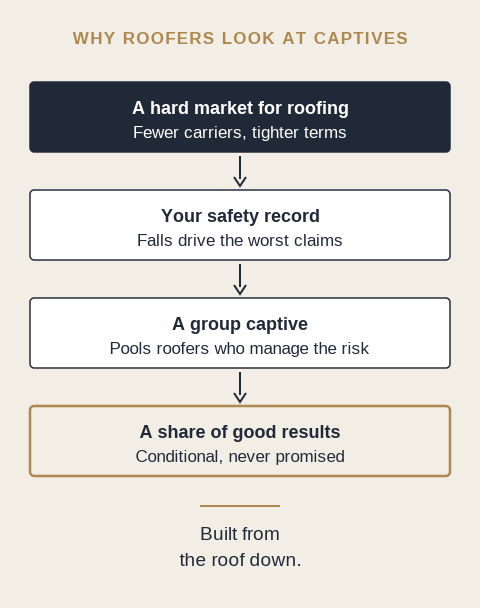
A group captive changes the arithmetic for a good roofer. Each member funds its own expected losses, shares larger losses with other selectively underwritten roofers, and keeps more of the result when its claims come in better than expected. The captive is priced from the members’ own records, not the market’s view of the trade. Our explainer on how group captive insurance works covers the layers in detail.
The lines a roofing captive covers
Workers’ compensation is usually the largest and most important line. Falls, strains from carrying materials, and heat-related illness drive claims, and falls in particular can produce severe, long-lasting injuries. Our post on workers’ comp captive insurance follows a claim through a captive.
General liability covers property damage and injuries to others, including claims that arise after a job is finished — water damage from a leak, for example. Those claims can take years to surface, which means the captive must reserve for them carefully.
Commercial auto covers the trucks and trailers that carry crews and materials to jobsites.
Catastrophic losses, on any line, are reinsured above the captive so one event cannot sink the pool. Our post on construction captive insurance puts these lines in the wider context of the building trades.
Falls are the economics
In a roofing captive, the fall-protection program is not paperwork; it is the single biggest driver of results. The habits that matter are well known to anyone in the trade:
- Fall protection used on every job, whether guardrails, safety nets, or personal fall arrest, chosen for the roof and the task.
- Training that is practical and repeated, so crews know how to set up and use the equipment, not just that it exists.
- Supervision on site, with foremen who enforce the rules rather than leaving them to individual judgment.
- Ladder and edge safety, including safe access and protection around skylights and openings.
- Heat and weather planning, so crews are not working in conditions that invite accidents.
OSHA’s guidance on fall protection in residential construction explains the expectations for roofing work and is a sound starting point for any contractor building or tightening its program.
Workmanship and completed operations
Not every roofing claim is an injury. A roof that leaks can damage a building’s interior, its contents, and sometimes its structure, and those claims may arrive long after the crew has moved on. Careful workmanship, manufacturer-approved installation methods, documented inspections, and photographs of completed work all help prevent those claims and defend them when they arrive.
In a captive, those practices pay off directly. Fewer callbacks and fewer water damage claims mean a healthier loss fund, and good documentation means better defense when a claim does come.
Who fits a roofing captive
A roofing contractor tends to fit when:
- Its safety program is real and enforced, with fall protection, training, and supervision that work on every job.
- Its loss history is credible, with enough claims data for an actuary to price the risk.
- It manages subcontractors carefully, collecting certificates and holding subs to the same safety standards.
- It can fund its own losses and post the capital or collateral a group requires.
- It is in for the long run, because captives reward discipline over years, through a bad year as well as good ones.
A captive is usually the wrong answer for a roofer looking for a quick price break, hoping to hide a poor record, or unwilling to invest in fall protection. Our post on whether captive insurance is worth it covers the honest trade-offs.
Contracts, certificates, and fronting
Roofers working for general contractors, property managers, and homeowners’ associations usually face insurance requirements in their contracts: certificates from a licensed, rated insurer, additional-insured status, and specific limits. A roofing captive generally works behind a fronting carrier that issues those policies and certificates, with the risk reinsured to the captive. Our post on what a fronting carrier is explains how that works. Confirm that each contract’s requirements are met before relying on the structure.
Subcontractors deserve the same attention. A roofer that uses subcontracted crews and lets their insurance lapse may find those crews’ injuries and damage flowing back to its own program. Collecting and tracking certificates, and holding subs to the same safety standard, protects the captive as much as the company.
What a feasibility study looks at for a roofer
Before anyone can say whether a captive fits, a feasibility study has to look at the roofing operation the way an insurer would. That typically includes:
- Loss history by line and by year. Workers’ comp, general liability, and auto each tell their own story, and the actuary needs enough history on each to price it.
- The mix of work. Residential versus commercial, new construction versus re-roofing, steep-slope versus low-slope, and the materials installed all change the risk.
- Payroll by job type, because workers’ comp exposure follows what crews actually do.
- Fall-protection and training programs as they run on real jobsites, not as written in a manual.
- Subcontractor practices, including how certificates are collected and tracked.
- Contract requirements from the general contractors and owners you work for.
- Financial capacity to fund a loss fund and post collateral without straining bonding capacity or working capital.
The study can conclude that the company should strengthen its program and revisit a captive once its results reflect the change. That is a useful answer.
Questions to ask a roofing group before joining
The group you join matters as much as the decision to join one. Before signing, ask:
- Who are the other members? A group of roofers with similar work and similar standards is healthier than a mixed pool.
- How are members underwritten and monitored? Look for standards that are enforced, including consequences for members whose results slip.
- What loss control support does the group provide? Strong groups offer training, site audits, and help building fall-protection programs.
- How are claims handled, and what will you see? Visibility into your own claims is what lets you manage them.
- How does leaving work? Our post on captive exit strategy explains why exit terms belong in the decision on the way in.
What a captive asks of a roofer
Joining a group captive asks more than buying a policy. Expect to fund a loss fund, post capital or collateral, pay your share of the captive’s costs, engage in the group’s loss control program, and commit for several years. Any return of unused loss funds is conditional, depends on your losses and the group’s, and comes only after an underwriting year’s claims have developed. Our post on captive dividends and distributions explains how money comes back.
Tax is not the reason to join. Where tax treatment applies, it follows from genuine insurance. This is general information, not legal or tax advice — see our disclosures.
Where to start
A feasibility study looks at your loss history by line, your fall-protection and training programs, your subcontractor controls, your contract requirements, and your capacity to commit, and it can conclude that your company should strengthen its program first. Our page on group captives explains the structure we work in.
Frequently asked questions
Why is roofing insurance so hard to place?
Roofing combines work at height, frequent injuries, and liability exposure from leaks and property damage that can surface long after a job is finished. Many commercial carriers limit how much roofing business they write, which narrows the market and tightens terms. A group captive is one way well-run roofers can finance their own risk instead of depending entirely on a shrinking pool of carriers.
Can a roofer with a few bad claims join a captive?
It depends on what caused them and what has changed. Groups look at the whole record, the safety program behind it, and whether the problems have been addressed. A contractor that has invested in fall protection and training since its bad years may be a better candidate than one with a clean record and no program. A captive will not hide a poor record; it will make the results more visible.
Do roofing captives cover completed-operations claims?
General liability for roofers often includes claims that arise after the work is finished, such as water damage from a leak. Whether and how a captive covers those claims depends on how the group writes its liability coverage. Because those claims can arrive years later, the captive must reserve for them carefully, which is one reason independent actuarial work matters.
Will general contractors accept a roofer insured through a captive?
They usually require certificates from a licensed, rated insurer and additional-insured status. A roofing captive typically operates behind a fronting carrier that issues those policies and certificates, with the risk reinsured to the captive. Confirm that a specific contract’s requirements are met before relying on the structure.
Feasibility Study
See whether a captive fits your business.
Every engagement starts with a feasibility study — an honest read on whether a captive is right for you before anything is formed.