
Group Captive Insurance: How Mid-Market Businesses Pool Risk and Share in the Reward
If you run a financially sound mid-market business with a loss record better than the pricing you keep getting quoted, you have probably had the same frustrating thought at renewal: you are paying the commercial market’s price for someone else’s bad risk. A group captive is one answer to that frustration. It lets a set of unrelated, well-run companies stop renting coverage from the market and instead co-own the insurance company that covers them — pooling their risk and sharing in the results their own discipline produces.
This is not a tax play, and it is not a way to “get money back.” It is insurance, owned differently. Below is what a group captive actually is, who it fits, how the membership and pooling mechanics work, the economics in plain terms, why member underwriting matters so much, and — just as honestly — when a group captive is the wrong move.
What a group captive is
A group captive is a licensed insurance company owned by multiple unrelated businesses that use it to insure their own risks. The word that does the most work in that sentence is unrelated: the members are separate companies, often in different industries, with no common ownership. They come together specifically to own and operate an insurer for their mutual benefit.
The lines a group captive writes are usually the predictable, high-frequency ones every operating business carries — most commonly workers’ compensation, general liability, and commercial auto. These are the working-layer coverages: frequent enough and stable enough that a quality pool can fund and price them to its own experience rather than to the broad market’s. That is the whole appeal. In the open market, your premium reflects the loss experience of every business in your class, good and bad. Inside a captive owned by selectively chosen members, your cost is driven much more directly by how your own business — and the businesses beside you — actually perform.
Groups come in two broad shapes. A homogeneous group gathers members from a single industry, so they share exposures, benchmarks, and safety practices — useful where an industry’s risks are distinctive. A heterogeneous group spans industries, which can smooth the pool’s overall volatility because no single sector’s bad year swamps the rest. Neither shape is inherently better; the right one depends on your lines, your loss profile, and the quality of the specific group.
The legitimacy of a group captive as insurance rests on the same fundamentals as any carrier. Courts treat an arrangement as insurance only when it genuinely shifts risk away from the insured and distributes that risk across a pool of independent exposures — and otherwise looks like real insurance (Helvering v. Le Gierse, 312 U.S. 531 (1941)). A true multi-member pool starts with an advantage on the distribution question: with many unrelated members each bringing their own independent exposures, the risk is spread across a genuinely diversified base of insureds by design, not assembled afterward to satisfy a test. That is a structural strength of the group model — a qualitative point, not a guarantee that any particular arrangement qualifies. The substance still has to be real.
Who a group captive fits
A group captive is not for everyone who is tired of their renewal. It is for a specific kind of business, and the members who thrive in one tend to share a profile:
- A documented better-than-average loss record. Not a feeling that you run a tight ship — actual loss runs that show it, over enough years to be meaningful.
- A genuine commitment to safety and active risk control. Membership comes with expectations, and the economics only work if you meet them.
- Enough premium in the working lines — workers’ comp, general liability, auto — to fund a meaningful loss layer of your own. A group captive is built around working-layer risk, so you need real volume in those lines.
- An ownership willing to take a multi-year view and engage as an owner, not a policyholder shopping the lowest number every twelve months.
The common thread is simple: a group captive suits businesses whose own results are better than the pricing they receive — companies that are, in effect, subsidizing the market’s worse risks. If that is you, owning the mechanism instead of renting it is a way to keep the upside of your own discipline.
How membership and pooling work
Joining a group captive means becoming an owner of an insurance company, and the mechanics follow from that. Members contribute capital to the company and typically post collateral — often a letter of credit — to secure their loss-fund obligations. The exact amounts depend on the group’s structure, your premium size, and your risk profile, and they are set by the captive and its domicile regulator, not invented to order; they are modeled against your own numbers before you commit.
Premium inside the captive is generally split across layers, and understanding those layers is the key to understanding the whole structure:
- Each member’s own loss fund. A portion of your premium funds your own expected, routine losses. This is the layer where your individual performance is felt most directly: run clean, and the unused portion of this fund is what may come back to you over time.
- A pool-level shared layer. Above each member’s retention sits a mutualized layer the whole membership funds together. When a member has a larger loss than its own fund can absorb, this shared layer catches it. This is the part of the structure where members genuinely share risk with one another.
- Reinsurance and excess protection. Above the pool, the captive buys coverage to cap catastrophic outcomes, so that a single severe year for one member — or the group — does not destabilize the whole arrangement.
This layering is what lets the law of large numbers do real work. Routine losses are absorbed individually; larger losses are spread across the membership; the rare extreme is transferred out to reinsurers. No single member’s bad year defines the group, and the pool’s predicted losses can approximate its actual losses precisely because it spreads many independent, unrelated exposures — the foundation of treating the arrangement as insurance in the first place.
The economics, in plain terms
Here is the part owners most want to understand, and the part most easily oversold. The reward in a group captive is real, and it is also strictly conditional.
When a member runs clean and the pool performs, the unused portion of that member’s loss fund — plus its share of the captive’s investment income — may be returned to members over time, as the claims from those years develop and finally close. This is the “good driver” effect: your results drive your cost, year after year, instead of being averaged into the market’s. Over a multi-year horizon, a disciplined member can see the value of running a safer operation flow back to it rather than to an outside carrier.
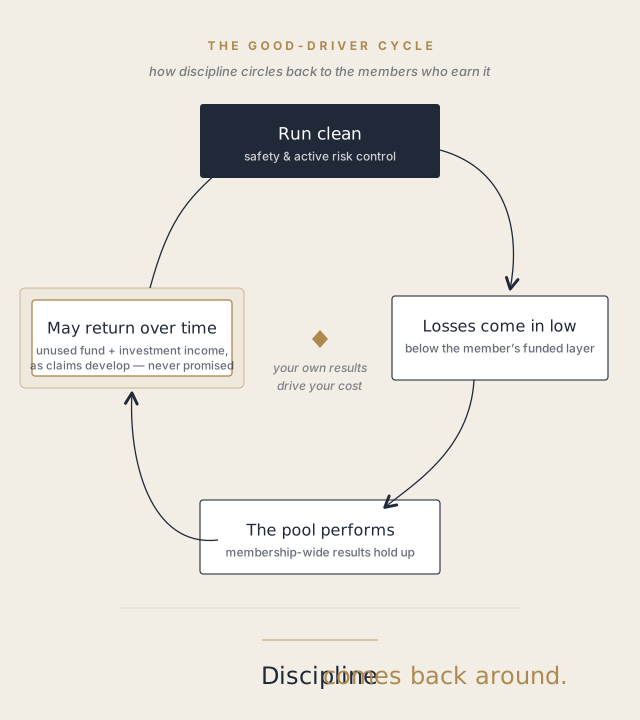
None of this is guaranteed, and any honest description has to say so plainly. Returns depend on actual losses, the pool’s overall performance, regulatory requirements, and how open claims ultimately settle. A poor loss year — yours or the group’s — reduces or erases any distribution. The structure rewards discipline; it does not promise a payout, and you should be skeptical of anyone who describes it as one. We deliberately keep specific dollar figures, return percentages, and “typical savings” out of the conversation entirely, because those numbers are facts-and-program specific and are only meaningful when modeled against your actual loss history in a feasibility study.
A note on tax, since it tends to come up: a group captive is funded to its working losses and has no special small-company premium ceiling, so the §831(b) election that defines single-owner micro-captives is a different conversation entirely — see our micro-captives & 831(b) page for that path. For a group, tax is a downstream consequence of operating as genuine insurance, never the reason to do it. As with anything tax-touching on this site, this is general information, not legal or tax advice — see our disclosures, and run your own numbers with your own advisors.
Underwriting discipline: why member selection is the engine
A group captive is only as strong as the businesses inside it, which is why member selection is the single most important thing a quality group does. Prospective members are underwritten before they join — on loss history, safety culture, financial stability, and demonstrated commitment to risk control — and that underwriting does not stop at the door. Good groups hold members to their risk-control commitments year after year and are willing to non-renew members who stop performing.
That selectivity is the whole reason a group can price to its own experience instead of the broad market’s. When you join a well-run group, you are not pooling your risk with whoever shows up; you are pooling it with businesses chosen for the same discipline you bring. It is also the first thing worth examining about any specific group on the table. A pool with loose admission standards and no willingness to remove underperformers will, over time, drift back toward market-average results — which defeats the entire purpose. The legitimacy of the arrangement as insurance, and its economics, both rest on that continuous underwriting being real.
This is also where the cautionary case law is instructive. Captive arrangements have failed when courts found the “pooling” was a circular flow of funds rather than a genuine spread of independent risk, and when premiums were set backward from a desired result rather than priced at arm’s length (see Avrahami v. Commissioner, 149 T.C. 144 (2017), and Reserve Mechanical Corp. v. Commissioner, T.C. Memo. 2018-86, aff’d 34 F.4th 881 (10th Cir. 2022)). A real group captive is the opposite of those arrangements: genuine distribution across many unrelated, independently underwritten members, with pricing built from actual exposure. The discipline is not paperwork — it is what makes the thing insurance.
When a group captive does not fit
Plenty of good businesses should not join a group captive, and saying so is part of an honest evaluation. A group is the wrong move when:
- Your loss history is poor or erratic. Pooling rewards discipline and punishes its absence. If your losses run hot, you will not be welcomed by a quality group, and joining a group that would take you is usually a warning about that group.
- You are unwilling to invest in safety and risk control. The model assumes you will, and the economics fall apart if you do not.
- You need the lowest possible first-year premium above all else. A group captive is a multi-year proposition with capital and collateral commitments. If next year’s cash number is the only thing that matters, the market may suit you better.
- You lack meaningful premium in the working lines. Without enough workers’ comp, general liability, or auto volume, there is not enough to fund and the structure does not pay for its own complexity.
- You want a tax outcome more than an insurance one. A group captive has to work as real insurance first. If the appeal is primarily tax, that is the wrong reason and, frankly, the wrong structure to be looking at.
A group captive is a genuinely good answer for the right business — and the honest way to find out whether yours is one is to look at your numbers and the specific group together, on the merits. That is what a feasibility study is for: we examine your loss experience and premium in the working lines, model how your numbers would behave inside a pooled, layered structure, and assess the quality and terms of the actual group on the table. If a group fits, you join as an informed owner. If none does, you will know exactly why.
Frequently asked questions
What exactly is a group captive?
A group captive is a licensed insurance company owned by a set of unrelated businesses that use it to insure their own predictable, high-frequency risks — most often workers’ compensation, general liability, and commercial auto. Instead of buying coverage from the open market each year, the members own the insurer, fund their own losses, and keep the underwriting and investment results the market would otherwise keep. Because the members are unrelated and selectively chosen, the pool spreads risk across a genuinely diversified base of insureds.
Who is a group captive a good fit for?
It fits a financially sound, established mid-market business with a documented better-than-average loss record, a real commitment to safety and risk control, enough premium in the working lines to fund a meaningful layer, and an ownership willing to take a multi-year view. In short: companies whose own results are better than the pricing the commercial market gives them. It is the wrong move for a business with a poor or erratic loss history, one unwilling to invest in safety, or one that needs the lowest possible first-year premium above all else.
Do I share in other members’ losses?
Partly, and by design. Most group captives are built in layers: each member funds its own loss layer, so most of your own good or bad experience stays with you, while a shared layer above those retentions is mutualized across the membership and reinsurance caps the extremes. You benefit from the group’s collective strength on large losses and carry a measured share of the group’s in return. Because membership is selectively underwritten, you are sharing risk with businesses chosen for their loss discipline — not with the open market.
Can I get money back in a good year?
Possibly, and it is a defining feature of a well-run group captive — but it is never guaranteed. When a member’s losses come in below what it funded, and the pool performs, the unused portion of its loss fund plus its share of investment income may be returned to members over time, subject to the captive’s rules, regulatory requirements, and how open claims develop and close. A poor loss year reduces or eliminates any return. The structure rewards good performance; it does not promise a payout.
How is a group captive different from a micro-captive?
Ownership and where risk distribution comes from. A micro-captive is owned by a single business and typically finances enterprise and uninsured risks; it may, if it qualifies as insurance and stays under the premium ceiling, elect §831(b) tax treatment. A group captive is co-owned by many unrelated members pooling working-layer lines, with no §831(b) premium ceiling, and its risk distribution is largely inherent in the membership rather than engineered after the fact. Our micro-captive page walks through that single-owner path.
Feasibility Study
See whether a captive fits your business.
Every engagement starts with a feasibility study — an honest read on whether a captive is right for you before anything is formed.