
Group captives
Pool your risk with businesses as good as yours
A group captive is an insurance company owned by many unrelated businesses that pool their risk and share in the results. For a quality mid-market operator tired of paying the commercial market’s price for its own good record, it is a way to keep the upside of disciplined risk.
Insurance first — built on the strength of the members in it.
What it is
Many owners, one insurance company, shared results
In a group captive, a set of unrelated businesses co-own a licensed insurer and use it to cover their own predictable, high-frequency risks.
Each member funds its expected losses, the group mutualizes the layer above, and members — not an outside carrier — keep the underwriting and investment results. Instead of renting coverage from the market every year, the members own the mechanism.
Groups come in two broad shapes. A homogeneous group gathers one industry, so members share exposures and benchmarks; a heterogeneous group spans industries to smooth overall volatility. Either way, the defining trait is selectivity: members are chosen, not merely enrolled, and the quality of that membership is what makes the economics work.
Who it fits
For the well-run business subsidizing everyone else’s losses
Group captives suit mid-market companies whose own results are better than the pricing they receive — businesses effectively subsidizing the market’s worse risks.
The members who thrive in a group tend to share a profile:
- A consistently better-than-average loss record they can document.
- A genuine commitment to safety and active risk control.
- Enough premium in the working lines — commonly workers’ comp, general liability, or auto — to fund a meaningful layer.
- An ownership willing to take a multi-year view and engage as an owner, not a policyholder.
A group captive is the wrong move for a business with a poor or erratic loss history, one unwilling to invest in risk control, or one that needs the lowest possible first-year premium above all else. Pooling rewards discipline; it punishes its absence, and we will say plainly when the fit is not there.
Why the structure holds together
In a group captive, risk distribution is built in — not engineered after the fact
The thing a single-owner captive has to work hardest to manufacture, a group captive has by its nature.
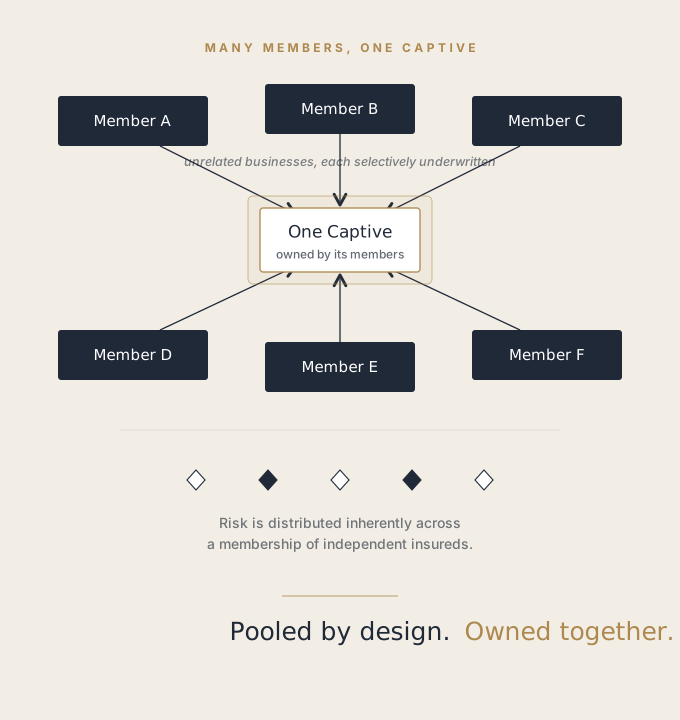
With many unrelated members each bringing their own independent exposures, the pool spreads risk across a genuinely diversified base of insureds — the classic foundation for treating an arrangement as insurance. Distribution here comes from the membership itself, not from a pool assembled to supply it.
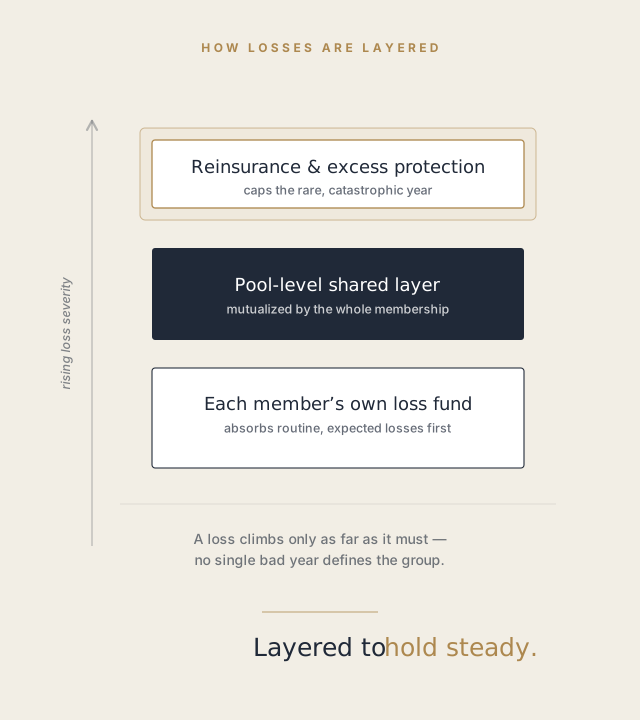
That changes the dynamics in practical ways. Loss sharing is layered: a member’s own fund absorbs its routine losses, the shared layer catches the larger ones, and reinsurance caps the extremes — so the law of large numbers does real work and no single member’s bad year defines the group. Member underwriting is continuous rather than one-time: the group keeps the pool clean by selecting who joins and holding members to their risk-control commitments. The result is a structure whose legitimacy as insurance rests on the same fundamentals as any carrier — genuine risk transfer across many independent insureds — reached by a different road than the micro-captive travels.
How the money works
Capitalization, loss funds, and the reward for running clean
Joining a group captive means becoming an owner, and the economics follow from that.
Members contribute capital to the company and post collateral — often a letter of credit — to back their loss-fund obligations. Premium is split between an individual loss fund, sized to each member’s own expected losses, and a contribution to the shared layer and operating costs.
The incentive is direct, and it is the heart of the model: when a member runs clean and the pool performs, the unused portion of its loss fund — plus its share of investment income — may be returned over time, as claims from those years develop and close. This is the “good driver” effect: your results drive your cost, year after year. None of it is promised. Returns depend on actual losses, the pool’s performance, regulatory requirements, and how open claims settle — a poor year reduces or erases any distribution. The model rewards discipline; it does not guarantee a payout.
What it writes
The working-layer lines a group captive is built around
Group captives are built on predictable, high-frequency risk — the lines where a quality pool can underwrite to its own experience and where safety investment shows up in the results. Coverage is structured in layers, with each member feeling its own performance first.
-
Workers’ compensation
The anchor line of most group captives. Predictable enough to fund and price within the pool, and the line where disciplined safety programs show up fastest in results.
-
General liability
Premises and operations exposure pooled across members, with each member’s own loss experience driving its contribution to the shared fund.
-
Commercial auto & fleet
A volatile line in the commercial market that a quality-selected pool can underwrite on its own terms, rewarding members who run safer fleets.
-
Member-level loss fund
The layer each member funds for its own expected losses. Good years stay with the member as potential return; this is where individual performance is felt directly.
-
Pool-level shared layer
The mutualized layer above each member’s retention, where the group collectively absorbs larger or less frequent losses across the membership.
-
Reinsurance & excess protection
Coverage the captive buys above the pool to cap catastrophic outcomes, so a single severe year does not destabilize the group.
Which path fits
Micro-captive or group captive?
The two structures solve different problems. A micro-captive lets a single owner finance enterprise and uninsured risks and may elect 831(b) tax treatment; a group captive lets a quality mid-market business pool working-layer risk with peers.
| Micro-captive (831(b)) | Group captive | |
|---|---|---|
| Who owns it | A single business or owner. | Many unrelated businesses, together. |
| Where risk distribution comes from | Engineered — typically a third-party pool or reinsurance arrangement adds unrelated risk. | Largely inherent — many unrelated members share risk by design. |
| Typical lines | Enterprise and uninsured risks (non-damage BI, key contract, cyber, reputational). | Working-layer lines (workers’ comp, general liability, commercial auto). |
| Premium scale | Smaller — net written premiums at or under $2.9 million for 2026 (IRS Rev. Proc. 2025-32, indexed annually) to elect 831(b). | Larger — funded to the pool’s working losses, with no 831(b) premium ceiling. |
| Best-fit profile | A profitable single owner with genuine uninsured exposures and a long view. | A mid-market business with good loss experience, tired of commercial-market pricing. |
Reading the left column and recognizing yourself? Start with the micro-captives & 831(b) page. Not sure either is right yet? What is a captive? covers the fundamentals first.
How we work
A feasibility study before you join or form anything
Whether you are evaluating an existing group or considering forming one, the first step is the same: an honest feasibility study.
We examine your loss experience and premium in the working lines, model how your numbers would behave inside a pooled, layered structure, and — just as importantly — assess the quality and terms of the specific group on the table.
A group captive is only as good as its members and its structure, so we would rather tell you a particular group is not worth joining than place you in a weak pool. If a group fits, you join as an informed owner; if none does, you know why.
Common questions
Group captive questions members actually ask
Do I share in other members’ losses?
Partly, and that is the point. A group captive is built in layers: each member funds its own loss layer, so most of your own good or bad experience stays with you, while a shared layer above those retentions is mutualized across the membership. You benefit from the pool’s collective strength on large losses, and in turn you carry a measured share of the group’s. Because membership is selectively underwritten, you are sharing risk with businesses chosen for their loss discipline — not with the open market.
How are members chosen, and why does it matter?
Member selection is the engine of a group captive. A pool is only as strong as the businesses in it, so quality groups underwrite prospective members on loss history, safety culture, financial stability, and commitment to risk control — and remove members who stop performing. That selectivity is what lets the group price to its own experience instead of the broad market, and it is the first thing we evaluate when assessing whether a particular group is worth joining.
What capital or collateral does joining require?
Members typically contribute capital to the captive and post collateral — often a letter of credit — to secure their loss-fund obligations. The amounts depend on the group’s structure, your premium size, and your risk profile, and they are set by the captive and its domicile regulator rather than by us. We model these requirements against your numbers during the feasibility study so there are no surprises at the point of joining.
Can I get money back in a good year?
Possibly, and this is a defining feature of a well-run group captive — but it is never guaranteed. When a member’s losses come in below what it funded, and the pool performs, the unused funds plus investment income may be returned to members over time, subject to the captive’s rules, regulatory requirements, and the development of open claims. Conversely, a poor loss year reduces or eliminates any return. The structure rewards good performance; it does not promise a payout.
What happens if I have a bad year, or want to leave?
A bad year primarily affects your own loss fund and any return you might otherwise have seen; the shared layer and reinsurance exist precisely to keep one member’s severe year from being catastrophic. Exiting a group is possible but deliberate: claims from your membership years continue to develop, so collateral and final settlement are handled as those claims close out. The terms vary by group, and we review them with you before you commit.
Should my business join a single-industry or a mixed-industry group?
Both models work. A homogeneous group brings together one industry, so members share risk profiles, benchmarks, and safety practices — useful where an industry’s exposures are distinctive. A heterogeneous group spans industries, which can smooth the pool’s overall volatility. The right answer depends on your lines, your loss profile, and the quality of the specific group; we help you weigh real groups against your situation rather than the model in the abstract.
Feasibility Study
Find out whether a group captive is worth joining
A feasibility study weighs your numbers and the specific group on its merits — insurance first. If a single-owner structure looks closer to your situation, the micro-captive page walks through that path.