
How Group Captive Insurance Works (and Whether It’s Worth It)
If you have heard the term “group captive” thrown around and nodded along without being entirely sure what it actually is, you are in good company. The phrase sounds like jargon, the explanations tend to leap straight into loss funds and reinsurance layers, and somewhere in the fog you are left wondering whether this is insurance, an investment, or some clever arrangement you should be suspicious of. This piece is the plain-English version: what a group captive is, how it works mechanically, how the money actually moves, and — honestly — whether it is worth it for a business like yours.
The shortest true answer is this: a group captive is real insurance that a set of unrelated businesses own together, instead of buying from an outside carrier. Everything else is detail about how that ownership works. Let us walk through it without the jargon.
What a group captive actually is (and is not)
Start with what you already know. When you buy commercial insurance, you hand a carrier a premium every year. In a good year, the carrier keeps the difference between what you paid and what your losses cost. In a bad year, the carrier absorbs the overage. Either way, the carrier owns the upside, sets the price based on the broad market, and you are a customer.
A group captive flips the ownership. A group of unrelated businesses get together and co-own a licensed insurance company — a real one, chartered and regulated like any insurer — and that company insures them. The word doing the heavy lifting is unrelated: these are separate companies, often in different industries, with no common ownership, who come together specifically to own and run an insurer for their mutual benefit. Because they own it, they — not an outside carrier — keep the underwriting and investment results their own discipline produces.
It helps to be clear about what a group captive is not. It is not a tax scheme, and it is not a way to “get money back.” It is not an investment fund you buy into for a return. And it is not a discount program where you simply pay less. It is insurance — genuine risk transfer, with all the obligations that implies — restructured so the people insured are also the owners. Any version that treats it as primarily a tax or savings play is pointed at exactly the kind of arrangement that gets businesses into trouble.
The everyday lines a group captive writes are the predictable, high-frequency ones nearly every operating business carries: most commonly workers’ compensation, general liability, and commercial auto. These are the “working-layer” coverages — frequent and stable enough that a quality group can fund and price them to its own experience rather than to the broad market’s. That is the whole appeal. In the open market, your premium reflects the loss experience of every business in your class, the careful and the careless alike. Inside a captive owned by selectively chosen members, your cost is driven far more directly by how your own business — and the businesses beside you — actually perform.
How you get inside one: joining versus forming
There are two ways a business ends up in a group captive, and knowing the difference clears up a lot of confusion.
Most owners join an existing group. A group is already up and running, with members, a structure, and a track record. You are underwritten to get in — the group looks hard at your loss history, your safety culture, and your financial stability before admitting you — and if you are a fit, you become a co-owner and start pooling your working-layer risk alongside members who were vetted the same way. This is the common path, and it is the one most of this article describes.
A smaller number of businesses form a new group. If no suitable group exists for their situation, a set of like-minded companies can charter the insurer themselves. Forming is the heavier lift — more capital, more setup, more governance to stand up — but it gives the founding members more control over the rules, the membership standards, and how the program runs.
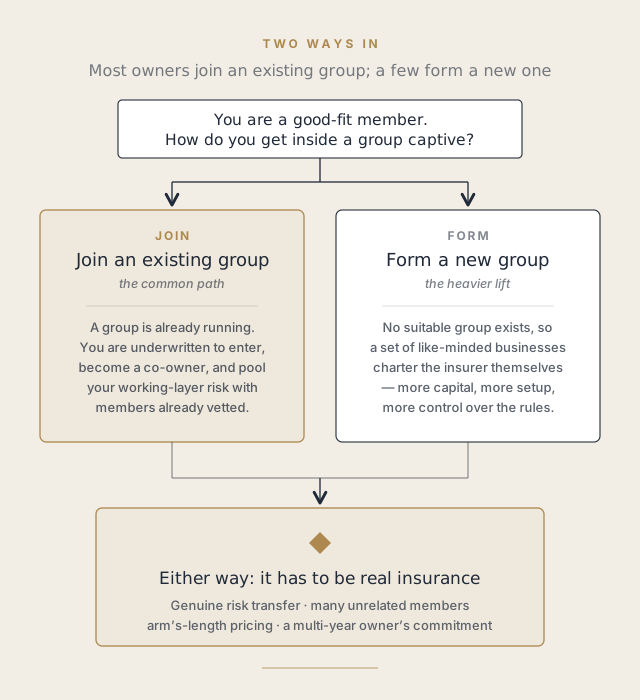
Either way, the destination is the same kind of thing: a member-owned insurance company that has to work as real insurance first. Joining is faster and lighter; forming gives you more say. Which makes sense depends entirely on your situation and whether a quality group already exists that fits you.
How the money actually moves
Here is the part that sounds complicated and is not, once you see the logic. When you join, you become an owner, so the mechanics follow from that. You contribute some capital to the company, and you typically post collateral — often a letter of credit — to back your share of the losses. The exact amounts depend on the group’s structure, your premium size, and your risk profile; they are set by the captive and its regulator and modeled against your own numbers before you commit, not invented to order.
Your premium inside the captive does not just disappear into one pot. It is generally split so that different kinds of losses are handled in different places. Think of it in three plain steps:
- Your own losses come out of your own fund first. A portion of your premium funds your expected, routine losses — the fender-benders and the everyday claims. This is the part of the structure where your own performance is felt most directly. Run clean, and the unused portion of this fund is the money that may eventually find its way back to you.
- Bigger losses are shared across the group. Above each member’s own fund sits a layer the whole membership funds together. When one member has a loss too large for its own fund to absorb, this shared layer catches it. This is where members genuinely share risk with one another — a measured slice of each other’s larger losses, in exchange for the group’s collective strength on your own.
- The rare catastrophe is handed off entirely. Above the group’s shared layer, the captive buys reinsurance to cap the extreme outcomes, so a single severe year — for one member or the whole group — does not threaten the arrangement.
That layering is not bureaucratic complexity for its own sake. It is what lets a group price to its own experience while staying stable: routine losses stay with the member who had them, larger ones spread across the membership, and the rare disaster gets transferred out to reinsurers. No single member’s bad year defines the group, and the pool’s predicted losses can track its actual losses precisely because it spreads many independent, unrelated exposures. That spreading is also the foundation for treating the arrangement as insurance in the first place.
If you want the same layered structure drawn out in detail, the mid-market cornerstone — group captive insurance for mid-market businesses — and our group captives page both walk through it visually.
The reward, and why it is conditional
This is the part owners most want to understand, and the part most easily oversold, so it is worth saying carefully.
When a member runs clean and the pool performs, the unused portion of that member’s loss fund — plus its share of the captive’s investment income — may be returned to members over time, as the claims from those years develop and finally close. That is the appeal in a sentence: your own results drive your own cost, year after year, instead of being averaged into the market’s. A disciplined member can, over a multi-year horizon, see the value of running a safer operation flow back to it rather than to an outside carrier.
But “may” is doing real work in that sentence, and any honest description has to lean on it. The return is strictly conditional. It depends on your actual losses, the pool’s overall performance, regulatory requirements, and how open claims ultimately settle. A poor loss year — yours or the group’s — reduces or erases any distribution. There is no fixed percentage, no scheduled check, no guaranteed payout. The structure rewards discipline; it does not promise anything, and you should be wary of anyone who describes it as though it does.
You will notice this article carries no split percentages, no “typical savings,” and no dollar figures. That is deliberate, not coy. Those numbers are entirely specific to your loss history, your premium, and the particular group on the table — they only mean something when they are modeled against your actual numbers in a feasibility study. Any figure quoted before someone has seen your loss runs is marketing, not analysis.
Why member selection is the engine
A group captive is only as strong as the businesses inside it, which is why member selection matters more than almost anything else. Because you share a layer of risk with the other members, the quality of those members is part of what you are buying. Prospective members are underwritten before they join — on loss history, safety culture, financial stability, and commitment to risk control — and that underwriting does not stop at the door. Good groups hold members to their commitments year after year and will non-renew members who stop performing.
That selectivity is the whole reason a group can price to its own experience instead of the broad market’s. When you join a well-run group, you are not pooling your risk with whoever shows up; you are pooling it with businesses chosen for the same discipline you bring. It is also the first thing to examine about any specific group on the table — a pool with loose admission and no willingness to remove underperformers drifts back toward market-average results over time, which defeats the entire purpose. The cornerstone post goes deeper on how membership pooling and the “good driver” return cycle play out over years; this is the plain-English version of why the gate at the front door matters so much.
The same logic is what keeps a group captive legitimate as insurance. Courts treat an arrangement as insurance only when it genuinely shifts risk away from the insured and distributes that risk across a pool of independent exposures — and otherwise looks like real insurance (Helvering v. Le Gierse, 312 U.S. 531 (1941)). A true multi-member group starts with a natural advantage here: with many unrelated members each bringing independent exposures, the risk is spread across a genuinely diversified base by design, not assembled afterward to satisfy a test. That is a structural strength — a qualitative point, not a guarantee that any particular arrangement qualifies. The substance still has to be real.
How this differs from the 831(b) micro-captive
It is easy to blur group captives together with the single-owner “831(b) micro-captives” you may have read about, so a quick contrast helps. A micro-captive is owned by a single business and typically finances its own enterprise and uninsured risks. If it qualifies as genuine insurance and its premiums stay under a small-company ceiling for the tax year, it may elect a particular tax treatment under Section 831(b). That premium ceiling, the 831(b) election, and the single-owner structure are a different conversation entirely — walked through on our micro-captives & 831(b) page.
A group captive has no such small-company premium ceiling, is co-owned by many unrelated members, and pools everyday working-layer lines rather than enterprise risk. Crucially, its risk distribution is largely inherent in the membership — many unrelated insureds supply the pooling themselves — where a single-owner structure has to work harder to establish it. The two solve different problems for different businesses.
On tax generally: for a group captive, tax is a downstream consequence of operating as genuine insurance, never the reason to do it. As with anything tax-touching on this site, this is general information, not legal or tax advice — see our disclosures, and run your own numbers with your own advisors. If you are weighing the broader “is any captive worth it” question across both structures, is captive insurance worth it takes the general view; the rest of this section is specifically about the group version of that question.
Whether a group captive is worth it — for a group, specifically
So: is it worth it? For a group captive specifically, the honest answer is that it is worth it for a recognizable kind of business and a poor move for others — and the difference is about fit, not size or cleverness.
A group captive tends to be worth it when most of these are true at once:
- You have a documented better-than-average loss record in the working lines — not a feeling that you run a tight ship, but actual loss runs that show it, over enough years to be meaningful. This is the single most important signal, because the entire premise is that your results are better than the pricing you receive.
- You carry real premium in the working lines — workers’ comp, general liability, commercial auto — enough to fund a meaningful layer of your own. A group captive is built around working-layer risk, so you need genuine volume there for the structure to pay for its own complexity.
- You are financially sound and willing to commit capital and collateral, and to engage as an owner across years rather than shop the lowest number every twelve months.
- You genuinely invest in safety and risk control — and will keep doing so, because membership comes with expectations and the economics only work if you meet them.
- You can take a multi-year, owner’s view. A group captive is run across loss cycles, not won or lost in a single renewal.
It is just as honest to name when a group captive is the wrong move. It does not fit a business with a poor or erratic loss history — pooling rewards discipline and punishes its absence, a quality group will not welcome you, and a group that would take you is itself a warning sign. It does not fit a business unwilling to invest in safety, one that needs the lowest possible first-year premium above all else, or one without enough working-layer premium to make the structure worthwhile. And it is the wrong tool for anyone who wants a tax outcome more than an insurance one — a group captive has to work as real insurance first, and if the appeal is primarily tax, that is the wrong reason and, frankly, the wrong structure to be looking at.
Notice how group-specific these signals are: they turn on your loss record and premium in the working lines, on your appetite to share a measured layer of risk with peers, and on the quality of the specific membership you would be joining — considerations that simply do not arise for a single-owner structure. “Worth it” for a group is a question about whether you and a particular pool are a genuine fit, and that is answerable only by looking at both together.
The honest way to find out
Everything above is how to think about a group captive. The way to actually answer whether one is worth it for you is to look at your numbers and a specific group together, on the merits — which is exactly what a feasibility study is for. We examine your loss experience and your premium in the working lines, model how your numbers would behave inside a pooled, layered structure, and assess the quality and terms of the actual group on the table. If a group fits, you join as an informed owner. If none does, you will know exactly why — and an honest “this isn’t for you” is a successful outcome, not a failed sale.
If you are still getting your bearings on the category itself, what is a captive is the ground-floor explainer. And if a single-owner structure sounds closer to your situation than a member-owned pool, the micro-captives & 831(b) route is the other path worth weighing.
Frequently asked questions
In one sentence, how does a group captive work?
A group of unrelated businesses co-own a licensed insurance company, use it to insure their own predictable risks — most often workers’ compensation, general liability, and commercial auto — and share in the results those risks produce instead of handing them to an outside carrier. It is real insurance, owned differently: the members fund their own losses, pool a layer of larger losses together, and buy reinsurance above that to cap the extremes.
Do I get money back at the end of the year?
Not on a schedule, and never as a promise. A group captive can return the unused portion of a member’s loss fund, plus a share of investment income, when that member runs clean and the pool as a whole performs — but only over time, as the claims from those years develop and finally close, and subject to the captive’s rules and regulatory requirements. A poor loss year, yours or the group’s, reduces or erases any distribution. The structure rewards discipline; it does not guarantee a payout. Treat anyone promising a fixed return with skepticism.
Can I be kicked out of a group captive?
Yes — and that is a feature, not a bug. Membership is selectively underwritten, and good groups hold members to their risk-control commitments year after year and will non-renew members who stop performing. The willingness to remove underperformers is exactly what keeps a pool clean and lets the group keep pricing to its own experience rather than drifting back to market-average results. A group that will take anyone, and never removes anyone, is a warning sign worth heeding.
How is a group captive different from an 831(b) micro-captive?
Ownership and scale. A micro-captive is owned by a single business and typically finances its enterprise and uninsured risks; if it qualifies as genuine insurance and stays under the small-company premium ceiling, it may elect §831(b) tax treatment. A group captive is co-owned by many unrelated members pooling everyday working-layer lines, with no such premium ceiling, and its risk distribution is largely built into the membership rather than engineered afterward. They solve different problems — our micro-captives page covers the single-owner route.
Is a group captive worth it for my business?
It is worth it for a financially sound, established business with a documented better-than-average loss record, real premium in the working lines, a genuine commitment to safety, and an owner’s appetite to take a multi-year view. In short: companies whose own results are better than the pricing the commercial market gives them. It is the wrong move for a business with a poor or erratic loss history, no appetite to invest in risk control, or a need for the lowest possible cash number next year. The honest way to know is to model your own numbers and the specific group together in a feasibility study.
Feasibility Study
See whether a captive fits your business.
Every engagement starts with a feasibility study — an honest read on whether a captive is right for you before anything is formed.