
Micro-captives & the 831(b) election
A small insurance company you own — built as real insurance first
A micro-captive lets an owner finance the risks the commercial market underprices, excludes, or won’t write — through a licensed insurer they control. It can elect to be taxed only on its investment income under Section 831(b) of the Internal Revenue Code, but only once it operates as genuine insurance.
The election follows the insurance, never the other way around.
What it is
A micro-captive is genuine insurance at a smaller scale
A captive is an insurance company you own; a micro-captive is simply a small one whose annual premiums fall under the Section 831(b) threshold.
Instead of paying an outside carrier for risks it understands better than the open market, the business forms its own licensed insurer, writes real policies, sets arm’s-length premiums, and pays its own claims. What makes it “micro” is size, not seriousness.
The same requirements that define insurance for any carrier — a genuine transfer of risk, real risk distribution, arm’s-length pricing, and the ability to actually pay claims — apply in full. A micro-captive that treats those requirements as paperwork is not a smaller insurance company; it is something the IRS and the courts have repeatedly declined to treat as insurance at all.
Who it fits
Built for the owner already carrying real, uninsured risk
A micro-captive tends to fit a profitable, closely held business already absorbing meaningful risk out of pocket because the commercial market excludes it, sublimits it, or prices it past reason.
The strongest candidates usually share a few traits:
- A clean, well-documented loss history and disciplined risk management.
- Identifiable risks that are genuinely uninsured or underinsured today.
- Revenue and margins steady enough to fund premiums year after year.
- An owner who takes a long-term view and wants to control their risk financing.
It is just as important to be honest about when a micro-captive does not fit. If the real motivation is a deduction rather than a risk to finance, if the business cannot fund premiums without strain, if there are no genuine uninsured exposures, or if no credible path to risk distribution exists, a captive is the wrong tool. Part of our job is to say so before you spend on one.
The hard part, handled honestly
Risk shifting is straightforward — distribution is where micro-captives are made or broken
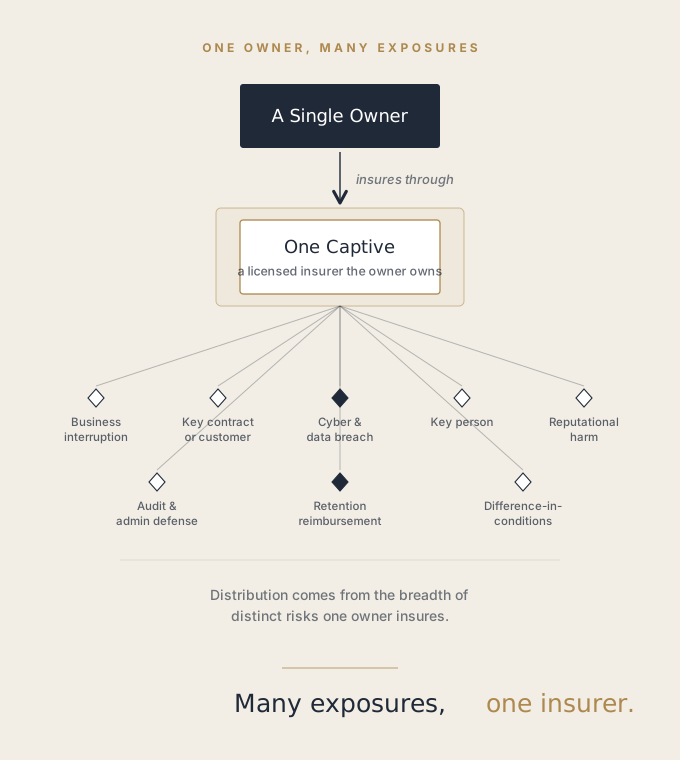
For a captive to be insurance, the insured must genuinely transfer the financial consequence of a loss (risk shifting), and the captive must spread that risk across enough independent exposures for the law of large numbers to work (risk distribution).
For a single-owner captive, shifting is the easy half — distribution is the half that gets tested. The problem is arithmetic: a captive insuring only its owner’s related businesses has very few independent exposures, and a handful of correlated risks do not distribute. This is exactly where the leading cases turned. In Avrahami v. Commissioner (U.S. Tax Court, 2017) and Reserve Mechanical Corp. v. Commissioner (U.S. Tax Court, 2018; affirmed by the Tenth Circuit, 2022), the arrangements failed because the risk was not genuinely distributed and the pooling meant to supply it did not hold up.
Distribution is legitimately achieved by adding unrelated risk — typically by having the captive participate in a third-party risk pool or reinsurance arrangement, assuming a measured slice of unrelated insureds’ losses while ceding a slice of its own. The IRS has long looked for a sufficient volume of independent risks; its brother-sister guidance in Revenue Ruling 2002-90 is the classic illustration of the principle. A pool only counts if it is real: arm’s-length pricing, genuine claim exposure, and counterparties that could actually pay. Tessera structures distribution as real reinsurance economics, and walks away from pools that exist only to manufacture a number.
The tax election, in its place
What the 831(b) election actually is
Section 831(b) of the Internal Revenue Code lets a qualifying small insurance company elect to be taxed only on its investment income rather than on its underwriting income.
The premiums it receives for genuine insurance are not taxed as the company’s income while they fund reserves — the same way reserving works for insurers generally. To be eligible, a company’s annual net written premiums must fall at or below the statutory limit — $2.9 million for the 2026 tax year (IRS Rev. Proc. 2025-32, indexed annually) — and it must meet the diversification requirements added by the Protecting Americans from Tax Hikes (PATH) Act of 2015.
Critically, none of this is available unless the company is first a real insurer: the election is a consequence of operating genuine insurance, not a strategy you run in reverse from a desired deduction.
This is general educational information, not tax or legal advice. Section 831(b) outcomes depend on your specific facts and are not guaranteed. Review any election with your own qualified tax and legal advisors — see our disclosures.
What it can write
The enterprise risks a micro-captive is built to cover
A micro-captive earns its keep on the risks an operating business already carries silently — the exposures with no clean commercial market, thin limits, or exclusions that leave you self-insured by default. Each line is a real insurable risk with a real trigger, priced to the exposure.
-
Non-damage business interruption
Income lost to an event with no physical-damage trigger — a supplier failure, a utility or network outage, a forced closure — that a standard property policy will not respond to.
-
Loss of a key contract or customer
The earnings shock when a concentrated revenue source — an anchor client, a renewing master agreement — is cancelled or lost on terms outside your control.
-
Loss of a key person
The cost of replacing and recovering from the sudden absence of an owner, rainmaker, or irreplaceable technician on whom the business depends.
-
Administrative & audit defense
The professional-fee exposure of responding to a regulatory inquiry, licensing action, or tax or wage-and-hour audit — costs that arrive whether or not you did anything wrong.
-
Reputational harm
The revenue impact of an adverse event, recall, or public dispute, and the cost of the crisis response needed to contain it.
-
Cyber & data breach
First-party response, notification, and downtime costs that exceed a thin commercial cyber limit or fall inside its exclusions and sublimits.
-
Deductible & retention reimbursement
A funded layer that absorbs the rising deductibles and self-insured retentions on your existing commercial policies, instead of paying them out of operating cash.
-
Employment practices (EPLI)
Defense and settlement exposure for employment claims — often a layer below, or broader than, what the commercial EPLI market will write for your industry.
-
Difference-in-conditions (DIC)
A wrap that fills the gaps, exclusions, and sublimits left by your primary commercial program, so a covered-looking loss does not fall through the seams.
-
Litigation & legal defense
A funded reserve for the defense costs of suits and disputes that fall outside, or pierce the limits of, your liability tower.
-
Pollution & environmental
Cleanup, third-party, and defense exposure that general liability policies routinely exclude — relevant to contractors, manufacturers, and property owners.
-
Warranty & service-contract obligations
The funded cost of standing behind product warranties or service guarantees you currently carry on the balance sheet with no insurance behind them.
Scrutiny, addressed directly
Micro-captives draw IRS attention — legitimacy is the answer, not avoidance
Micro-captives face heightened scrutiny, and any honest advisor will say so. The IRS has designated certain micro-captive arrangements as reportable “transactions of interest” (Notice 2016-66), and it has repeatedly challenged structures it views as deductions dressed up as insurance. The cases it has won — Avrahami and Reserve Mechanical among them — were lost on the same point: the arrangement was not genuine insurance, usually for lack of real risk distribution.
We do not treat that history as a reason to avoid captives, nor as a problem to paper over. We treat it as the standard. A micro-captive that genuinely shifts and distributes risk, prices at arm’s length, holds adequate capital, and operates as a real insurer stands on far firmer ground than one engineered toward a number. Tessera structures only insurance that can stand on its own — and we explain the full regulatory picture, including the reporting rules and the leading case law, on our compliance and legitimacy page.
How we work
It starts with a feasibility study, not a formation
We do not begin by forming a company. We begin by testing whether a captive is the right answer for your risk at all.
The feasibility study examines your loss history and exposures, identifies which risks are genuinely insurable, models whether a credible structure — including real risk distribution — can be built, and compares domiciles against your facts.
If a micro-captive makes sense, you get a structure designed as insurance from the ground up, with the 831(b) election treated as a downstream consequence. If it does not, you get a clear explanation of why and what would serve you better. Either way, you leave knowing where you stand.
Common questions
Micro-captive questions owners actually ask
If I am the only owner, how can my captive achieve real risk distribution?
This is the central question for a single-owner captive, and the honest answer is that distribution rarely comes from one business alone. A captive insuring only its related companies has very few independent risk exposures — the failing the courts identified in Avrahami v. Commissioner (U.S. Tax Court, 2017) and Reserve Mechanical Corp. v. Commissioner (U.S. Tax Court, 2018; affirmed by the Tenth Circuit, 2022).
Distribution is typically achieved by combining the captive with unrelated risk — most often through a third-party risk pool or reinsurance arrangement in which the captive assumes a slice of other, unrelated insureds’ losses and cedes a slice of its own. It only works if the pooled risk is genuine, priced at arm’s length, and able to pay claims. Tessera will not structure a pool that exists only on paper.
How much capital does a micro-captive need?
Minimum capital is set by the domicile’s insurance regulator, not by federal tax law, so the figure depends on where the captive is licensed and on the lines and limits it writes. Beyond the statutory minimum, the captive should hold enough surplus to credibly pay the claims it insures — a thinly funded company that could not actually cover a loss undercuts the case that it is real insurance. We size capital to the risk during the feasibility study rather than to a marketing number.
Can I lose the money I put into a captive?
Yes. A captive is a real insurance company that pays real claims, so its surplus is genuinely at risk — that is what makes it insurance rather than a savings account. If the captive has a bad loss year it pays out, and the funds are subject to the domicile’s solvency rules and the company’s own obligations. Premiums must be set at arm’s length for the risk assumed; a captive cannot be treated as a deposit you simply withdraw later. Any access to surplus is governed by the captive’s structure, its regulator, and the relevant tax rules, and should be planned with your own advisors.
Which domicile should a micro-captive use?
Both U.S. states with captive statutes and offshore jurisdictions license captives, and the right choice depends on your risk, cost tolerance, regulatory comfort, and where you do business. Each domicile sets its own capital minimums, premium tax, and reporting rules, so we compare options against your specific facts rather than defaulting to one jurisdiction. We treat domicile selection as a deliberate part of the feasibility work, not an afterthought.
What is involved in running a micro-captive each year?
An operating insurance company has ongoing obligations: actuarially supported pricing, policy issuance, claims handling, annual financial statements, regulatory filings and exams in its domicile, and tax compliance. Letting any of these lapse is exactly what undermines a captive under scrutiny. Tessera manages this ongoing operation so the captive behaves like the insurer it is — not a dormant entity that files once and goes quiet.
Is the 831(b) election the reason to form a micro-captive?
No — and treating it that way is the fastest route to trouble. The 831(b) election is a tax treatment available to a small insurance company that already qualifies as genuine insurance. The election follows the insurance; it is never the reason to create one. If the underlying risk financing does not make sense on its own merits, the election does not rescue it. We start from the risk, and we will tell you when a captive is not the right answer.
Feasibility Study
See whether a micro-captive fits your risk
A feasibility study is the honest first step — insurance first, tax treatment second. If a group structure looks closer to your situation, the group captive page walks through that path, and you can start with what a captive is if you want the fundamentals first.