
Group Captives for Staffing Company Workers’ Comp
Staffing firms use group captives to finance their workers’ compensation in an insurance company they co-own with other well-run firms, so that disciplined client selection and worksite safety lower their cost over time instead of being averaged away in the commercial market. The twist that makes staffing different is that the firm carries the coverage while the client controls the worksite — so in a staffing captive, how you choose and manage clients is as important as how you manage workers.
Workers’ compensation is usually the largest insurance cost a staffing company has, and the one most directly tied to decisions the firm makes: which clients to serve, which jobs to fill, and how carefully to check where its people will work. Commercial carriers price staffing as a class, and good firms pay for the industry’s worst results. A group captive is one way out of that. This piece explains how the shared risk works, how a staffing captive is structured, who fits, and what to watch for.
Why staffing is different
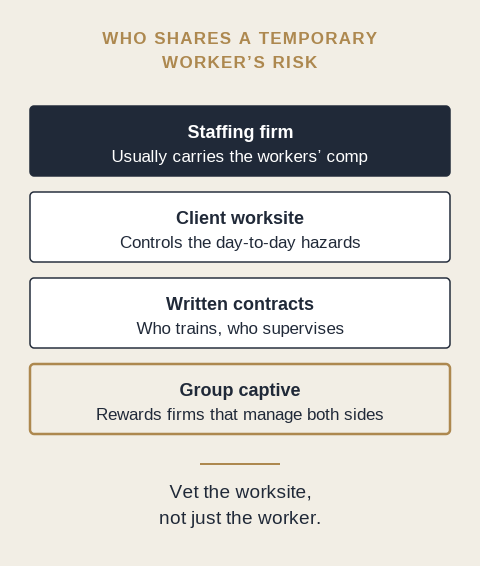
In most businesses, the employer that buys workers’ compensation also runs the workplace. In staffing, those roles split. The staffing firm is typically the employer of record and carries the coverage; the client supervises the work and controls the hazards on site. The Occupational Safety and Health Administration’s guidance on protecting temporary workers describes staffing agencies and host employers as sharing responsibility for worker safety.
That split is the central fact of staffing insurance. A staffing firm can have perfect internal practices and still suffer frequent, serious claims if it places people at unsafe client sites. In a captive, where the firm’s own loss fund pays its routine claims, that exposure lands directly on the firm’s results.
How a staffing group captive works
A staffing group captive follows the same layered structure as any group captive. Each member funds a loss fund for its own expected claims. Larger claims are shared across members in a pooled layer, and reinsurance sits above for the rare catastrophic injury. A licensed fronting carrier typically issues the statutory workers’ comp policies where a captive cannot, with the risk reinsured to the captive. Our post on how group captive insurance works explains the layers, and our post on workers’ comp captive insurance follows a claim from injury to payment.
What differs is the underwriting. A staffing captive looks not only at the firm’s loss history but at its book of placements: the industries it serves, the jobs it fills, and how much it knows about each client’s site.
Managing the client side
Staffing firms that do well in captives treat client selection as a core part of loss control. In practice, that tends to mean:
- Screening clients before placing workers. Asking about the work, the equipment, the hazards, and the client’s own safety record — and declining work that does not meet the standard.
- Visiting the worksite. Seeing where people will actually work, not relying on a job description.
- Writing clear contracts. Who provides training, who provides protective equipment, who supervises, and what the client must do after an injury.
- Matching workers to jobs. Placing people in roles they are trained and fit for.
- Staying in contact after placement. Checking that conditions match what was promised and pulling workers if they do not.
OSHA’s guidance on communication and coordination among host employers, contractors, and staffing agencies is a useful reference for building that discipline.
Claims handling and return to work
Prompt reporting and good claims handling matter in any workers’ comp program, and they matter more in staffing, where an injury happens at a site the firm does not control. Firms that do well make it easy for clients and workers to report injuries quickly, get injured workers to appropriate care, and offer suitable modified work when the worker is ready. A temporary worker who has been injured may have no obvious place to return to; firms that create those options tend to see shorter, smaller claims. Some firms place recovering workers in light-duty roles with other clients or in their own offices, which keeps them connected to work and income.
Who fits
A staffing firm tends to fit a group captive when:
- Its client selection and worksite review are real, documented, and enforced.
- Its placements are concentrated in work it understands and can manage.
- It has loss history credible enough for an actuary to price.
- It can fund its own losses and post the capital or collateral a group requires.
- It intends to stay for several years, through a bad year as well as good ones.
A captive is usually the wrong answer for a firm that grows by taking any order that comes in, places workers in hazardous roles without visiting sites, or hopes a new structure will hide a poor record. Our post on group captive insurance for mid-market businesses explains the membership model more broadly.
State rules and multi-state placements
Workers’ compensation is regulated by each state, and staffing firms often place workers in several. The structure has to work in every one of those states. In many, a fronting carrier issues the statutory policy; a few states run monopolistic state funds that employers must use, which limits what a captive can do there. The U.S. Department of Labor maintains a directory of state workers’ compensation officials for each state’s program. Our post on what a fronting carrier is explains the fronting arrangement.
What a feasibility study looks at for a staffing firm
A feasibility study for a staffing firm has to look at the book of business, not just the loss runs. That usually means:
- Payroll by job type and industry served. Clerical, light industrial, warehouse, and construction placements carry very different risk, and the mix drives the pricing.
- Loss history by client and job type. Where injuries have come from tells the actuary and the group whether the firm’s results reflect its controls or its luck.
- Client selection and site review practices, as they actually operate rather than as written in a handbook.
- The states where workers are placed, because each state’s workers’ comp system shapes how a captive can participate.
- Contracts with clients, especially who provides training, equipment, and supervision.
- Financial capacity to fund a loss fund and post collateral while carrying payroll.
The study can conclude that a firm should tighten its client discipline first and revisit a captive once its record reflects the change.
Questions to ask a staffing group before joining
Every group is different, and the one you join shapes your results. Before you sign, ask:
- Who else is in the group? A pool of firms placing similar work, held to similar standards, is healthier than a mix of firms with very different risk.
- How are members underwritten and monitored? You want to see standards that are enforced, including consequences for members whose results deteriorate.
- How is the shared layer structured? Know where your own loss fund ends and the pooled layer begins.
- Who handles claims, and how will you see them? Visibility into your own claims is what lets you manage them.
- What are the exit terms? Our post on captive exit strategy explains why leaving a group is a gradual process.
The trade-offs
A staffing captive asks more of a firm than a conventional policy. Your results are your results: a bad year costs more than it would in pooled commercial pricing, and a good year rewards you. Returns of unused loss funds, when they happen, are conditional and come only after an underwriting year’s claims have developed. Funding a loss fund and posting collateral ties up cash, which matters in a business where payroll comes before client payments. Our post on captive dividends and distributions explains how money comes back.
Tax is not the reason to join a captive. Where tax treatment applies, it follows from genuine insurance. This is general information, not legal or tax advice — see our disclosures.
Where to start
Whether a group captive fits your staffing firm depends on your placements, your client discipline, the states you work in, and your capacity to commit. A feasibility study works through those questions first and can conclude that the commercial market is the better answer for now. Our page on group captives explains the structure we work in.
Frequently asked questions
Who is responsible for a temporary worker’s injury?
Usually the staffing firm carries the workers’ compensation coverage as the employer, while the client controls the worksite where the injury happens. Federal safety regulators describe the staffing agency and host employer as sharing responsibility for the worker’s safety. Who pays what in a particular case depends on state law and the contracts between the firm and its client, which is why those contracts matter so much in a captive.
Can a staffing firm with high-hazard placements join a group captive?
Possibly, but the group will look closely at the mix of placements, the clients’ safety practices, and the firm’s ability to manage both. Groups price the risk they can see. A firm with a heavy concentration of hazardous work and little control over client worksites is harder to place than one that screens clients carefully and walks the sites before placing workers.
Do injured temporary workers get different benefits under a captive?
No. Workers’ compensation benefits are set by state law, and an injured worker is entitled to them however the employer finances the coverage. A captive changes who funds the losses and who keeps the results, not what the worker receives.
How does a staffing captive handle workers placed in several states?
Workers’ compensation is regulated state by state, so the structure has to work in each state where the firm places workers. In many states, a licensed fronting carrier issues the statutory policy and the risk is reinsured to the captive. A few states run monopolistic state funds that employers must use. The feasibility study maps how the captive can participate state by state.
Feasibility Study
See whether a captive fits your business.
Every engagement starts with a feasibility study — an honest read on whether a captive is right for you before anything is formed.