
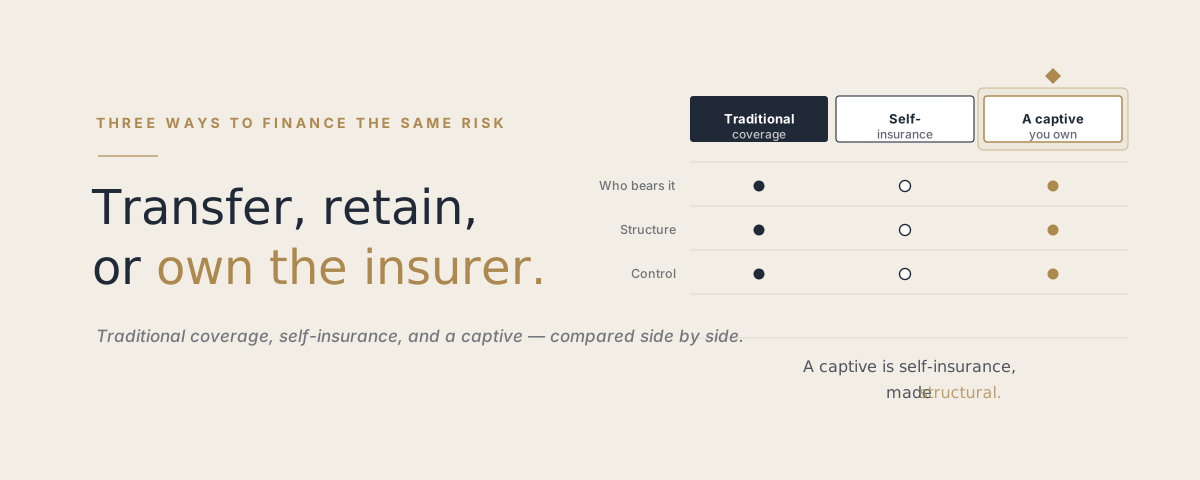
Captive Insurance vs. Self-Insurance vs. Traditional Coverage
Owners reach for three different words almost interchangeably — insurance, self-insurance, and a captive — and the blur between them is where a lot of confusion about captives begins. They are not three flavors of the same thing, and they are not three points on a one-way road from worst to best. They are three distinct ways to finance the same underlying risk, each with its own logic, and the fastest way to understand a captive is to set all three beside each other and compare them head to head.
That is what this piece does. If you want the wider landscape first — the full spectrum of how businesses finance risk and where every option fits — start with what is risk financing?, which lays out the whole map. This article is narrower and more practical: a direct, column-by-column comparison of traditional commercial coverage, self-insurance, and a captive you own, on the dimensions an owner actually weighs.
The three options, in one sentence each
Before the table, the plainest possible version of each.
Traditional commercial coverage is risk transfer. You pay a premium to an outside insurer, and in exchange it agrees to bear specified losses if they occur. The risk leaves your balance sheet and lands on theirs. This is what most people mean when they say “insurance.”
Self-insurance is risk retention. You keep a risk on your own books and pay for losses yourself when they come. In its simplest, informal form there is no separate company and no dedicated reserve — you simply absorb losses as they happen. Sometimes this is deliberate; often it is a default no one chose.
A captive you own is formalized retention. Instead of either renting coverage from the market or absorbing losses informally, you finance your own risk through a licensed insurance company you own — one that issues real policies, holds reserves, and is regulated in its domicile. It is insurance, but you are the owner rather than the customer.
Notice that the second and third already share a side of the line. That is the most important point in this whole comparison, and it deserves its own heading.
The point most comparisons miss: a captive is a form of self-insurance
It is tempting to treat “self-insurance” and “a captive” as rivals — two separate boxes to choose between. They are not. In risk-management terms, a captive is the formalized, licensed end of self-insurance, not an alternative to it.
Risk managers group captive insurers together with risk pools, risk retention groups, and individual self-insurance under one heading: alternative risk financing — risk-financing mechanisms that do not rely on a commercial insurer. A captive belongs to that family. Both self-insurance and a captive keep the economic risk with the business rather than transferring it to an outside carrier. The difference between them is not whether you retain the risk but how much structure you wrap around the retention.
So the honest way to read the comparison below is as a line with traditional coverage on one side and retained risk on the other — and self-insurance and a captive as two points on the same retained side, one informal and one formalized. A captive is what self-insurance becomes when you give it a license, real policies, reserves, and regulation. It is structured self-financing, not “going bare.” We develop that spectrum framing more fully in the risk-financing piece; here it is the hinge the whole comparison turns on.
The head-to-head comparison
With that established, here is the side-by-side. Every cell is qualitative on purpose — the real numbers (premiums, retained losses, cost of capital) depend entirely on your business and are modeled in a feasibility study, never quoted from a blog post.
| Dimension | Traditional commercial coverage | Informal self-insurance | A captive you own |
|---|---|---|---|
| Who bears the risk | An outside insurer. The risk leaves your balance sheet. | You do, directly and informally — the loss lands on your own books. | You do, but through a licensed insurer you own that is built to genuinely shift and distribute risk. |
| Cost behavior | A premium you pay regardless of outcome. In a good year it is a sunk cost the insurer keeps as profit. | No premium, but losses hit unbudgeted when they come — and a bad year arrives with no reserve set against it. | Funded premiums build reserves you own; underwriting and investment results stay inside a company you control rather than padding a carrier’s margin. |
| Formality & reserves | Fully formal, but the structure and reserves belong to the carrier, not to you. | Little or none — typically no separate entity and no dedicated reserve. | A licensed company with real policies, actuarial pricing, and reserves you fund and hold. |
| Regulation | The carrier is regulated; you are simply its customer. | Essentially unregulated — you are absorbing risk privately. | Regulated as an insurer in its domicile, with filings, exams, and capital requirements. |
| Control | Low. You take the carrier’s terms, pricing, and exclusions. | Total but unstructured — you control everything because nothing is organized. | High and structured. You own the mechanism, its terms, and its results. |
| Cost visibility | You see the premium line, but not the carrier’s margin or your true cost of risk. | Poor — retained losses surface unpredictably and are easy to under-count. | High. Owning the insurer makes what your risk actually costs visible rather than guessed at. |
| When it fits | Severe-but-unlikely risk, fairly priced coverage, or a risk you simply want off your books. | Small, predictable, or genuinely trivial exposures — and, by default, anything the market will not write. | A profitable business carrying real risk the market overprices, excludes, or sublimits, able to fund an insurer long term. |
Read down any column and a character emerges. Traditional coverage trades control and cost visibility for the simplicity of handing the risk away. Informal self-insurance keeps total control but offers no structure and no safety net. A captive sits where the other two leave a gap: it keeps the risk with the business, like self-insurance, but wraps it in the structure, reserves, and standing of a real insurer — closer to traditional coverage in formality, but owned by you.
How to read the comparison without getting it backward
A table like that one can be misread as a ranking, with the captive column “winning.” It is not, and reading it that way is the surest path to a captive that does not fit. A few guardrails.
No option is universally best. For a severe, low-frequency risk you could not absorb — the kind of loss that could threaten the business — transferring it to a carrier with the balance sheet to carry it is exactly right, and a captive is the wrong tool. The comparison is about fit per risk, not a verdict that one column always wins.
The three are not mutually exclusive. Most businesses end up with a blend: traditional coverage for the risks the market prices fairly, a captive for the ones it handles badly, and deliberate retention for the small and predictable. A captive rarely replaces all of your commercial insurance; it takes on the slice where owning the insurer makes more sense than renting one.
A captive is still real insurance. This is the line that trips people up, so it is worth stating flatly: a captive is not a way to skip insurance and keep the money. Courts treat an arrangement as insurance only when it genuinely shifts risk away from the insured and distributes that risk across a pool of independent exposures — and otherwise looks like real insurance (Helvering v. Le Gierse, 312 U.S. 531 (1941)). A properly built captive is designed to meet those substantive requirements; it issues policies, prices them at arm’s length, holds reserves, and pays claims, like any insurer. The difference from traditional coverage is not that it is less insurance — it is that you own the insurer. We walk through those two ideas, risk shifting and risk distribution, from the ground up in what is a captive insurance company?, which also answers the common “how is a captive different from self-insurance?” question in detail.
Where a captive earns its place — and the two routes to it
Set the comparison against your own situation and the case for a captive sharpens. It earns its column when you are carrying real risk on the retained side of the line — risk you are keeping anyway, often because the commercial market excludes it, sublimits it, or prices it past reason — and you would rather finance that risk with structure than absorb it informally. In other words, a captive is most compelling exactly where informal self-insurance is quietly happening and traditional coverage is not a fair deal.
Tessera works at that structured point through two distinct routes.
The first is a single-owner micro-captive: a profitable, closely held business formalizes the retention of its own enterprise and uninsured risks into a licensed insurer it owns. Because such a captive is small, it may — if it qualifies as genuine insurance and stays under the premium ceiling — elect a particular tax treatment under Section 831(b) ($2.9 million for the 2026 tax year (Rev. Proc. 2025-32, indexed annually)). The order matters: the election follows the insurance, never the reverse. This is general information, not legal or tax advice — see our disclosures, and review anything tax-touching with your own advisors. If that route sounds like your situation, how to start an 831(b) captive walks the path in order, and the micro-captives & 831(b) pillar covers it in depth.
The second is a group captive, which reaches the same structured point differently: a set of unrelated mid-market businesses co-own a single insurer and pool the predictable, working-layer risks every operating company carries — commonly workers’ compensation, general liability, and commercial auto. It is still retention made structural; the structure is simply shared across the membership. The mechanics, and who it fits, are laid out in group captive insurance for mid-market businesses and the group captives pillar.
Both routes share the logic the comparison reveals: you are already financing your risk somehow, and for the risk you are retaining, a captive is the structured version of what informal self-insurance does unstructured. Whether that trade serves your business depends entirely on your numbers — your exposures, your loss history, how the market prices you, and whether you can fund and stand behind an insurer over the long term. The only way to know where you land across these three columns — and whether a captive fits your business at all — is to look, which is what a feasibility study is for. It models your situation before anything is formed, and it is just as willing to tell you a captive is the wrong tool as the right one.
Frequently asked questions
What is the difference between a captive and self-insurance?
They sit on the same side of the line — both keep risk with the business rather than handing it to an outside carrier — but they differ in structure. Self-insurance, in its simplest form, means keeping a risk on your own books and paying losses as they happen, with no separate company and often no dedicated reserve. A captive formalizes that: it is a licensed insurance company you own that issues real policies, holds reserves, is regulated in its domicile, and is treated as insurance when it qualifies. In risk-management terms a captive is a form of self-insurance — the structured, licensed end of it — not a different category.
Is a captive still real insurance if I own the company?
Yes — that is the whole point. Owning the insurer does not make it less of an insurer. Courts treat an arrangement as insurance only when it genuinely shifts risk away from the insured and distributes that risk across a pool of independent exposures, and otherwise looks like real insurance (Helvering v. Le Gierse, 312 U.S. 531 (1941)). A properly built captive is designed to meet those substantive requirements: it issues policies, prices them at arm’s length, holds reserves, and pays claims. The difference from traditional coverage is not that it is less insurance — it is that you own the insurer instead of renting one.
When does traditional commercial coverage make more sense than a captive?
Often — and an honest comparison says so. Traditional transfer is the right move for a severe-but-unlikely risk you could not comfortably absorb, when the market prices the coverage fairly relative to your actual exposure, or when you simply want a risk off your books and are content to let the insurer keep the difference in a good year. Where the commercial market already covers you well and cheaply, a captive usually is not worth the effort. The comparison is about fit, not about one option always winning.
Does a captive replace my commercial insurance?
Usually not entirely. A captive tends to take on the risks the commercial market handles badly — the exposures it excludes, sublimits, or prices past reason — while you keep traditional coverage for the risks it prices fairly. In practice most businesses end up with a blend: transfer for some lines, a captive for others, and deliberate retention in between. The three approaches are not mutually exclusive; they are tools, and the right answer is usually a mix tailored to your actual exposures.
How do I know which approach is right for my business?
It depends on your actual exposures, your loss history, how the commercial market prices you, and whether you can fund and stand behind retained risk over the long term. The comparison here is a map, not a verdict. The honest way to find out where a captive fits your business — if it fits at all — is a feasibility study, which models your numbers before anything is formed and is just as willing to tell you a captive is the wrong tool as the right one.
Feasibility Study
See whether a captive fits your business.
Every engagement starts with a feasibility study — an honest read on whether a captive is right for you before anything is formed.