

Construction Captive Insurance
Contractors with strong safety records use captives — most often group captives — to finance their high-frequency lines of workers’ compensation, general liability, and commercial auto, and to keep the results of their own loss control instead of paying the market’s average price. Catastrophic losses are reinsured above the captive, and contract insurance requirements are met through a licensed fronting carrier. It works for contractors who run safe jobsites and can commit for the long term; it does not fix a poor loss record.
Construction is one of the industries where captives make the most intuitive sense. Your premiums are driven by the industry’s losses, but your claims are driven by your own jobsites. If your safety culture is better than your industry’s, a captive is one way to be paid for that difference. This piece explains which contractor risks fit a captive, how the structure handles contract requirements, who fits, and where it goes wrong.
Why captives fit construction
Construction carries frequent, predictable losses. Crews get hurt, vehicles get into accidents, and third parties get injured on or near a site. Those losses are painful, but they happen often enough to be measured and funded — which is exactly the kind of risk a captive is built to finance.
In the commercial market, a contractor’s premium reflects a broad pool that includes firms with weak safety programs. A contractor that invests heavily in training, supervision, and fleet management carries part of the cost of competitors who do not. In a captive, the contractor funds its own expected losses, and when its losses come in better than expected, more of that result stays with the owners instead of an outside carrier. Our explainer on what a captive insurance company is covers the basic mechanics.
Which contractor risks belong in a captive
Not every risk fits inside the captive. The structure sorts a contractor’s exposures by how predictable they are.
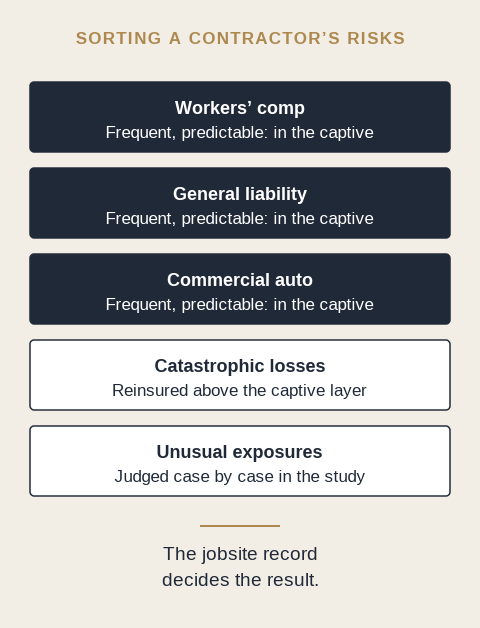
Workers’ compensation, general liability, and commercial auto are the working lines most group captives are built around. They produce frequent claims that can be priced from loss history and funded through the captive. Our post on workers’ comp captive insurance goes deeper on the line that matters most to many contractors.
Catastrophic losses — the rare large claim that could swamp a year’s results — are reinsured above the captive so that one event cannot sink the insurer.
Unusual exposures, such as certain warranty, contract, or project-specific risks, are judged case by case in the feasibility study. Some may suit a single-owner micro-captive built for enterprise risks the commercial market excludes or prices out of reach; others belong in the commercial market.
Group captive or micro-captive for a contractor
For most contractors, the working lines point toward a group captive. A group captive lets selectively underwritten businesses that are too small to own an insurer alone share one, with each member funding its own losses and sharing larger ones. Our post on group captive insurance for mid-market businesses explains the membership model, and our post on captive insurance for roofing contractors looks at one of the highest-hazard trades.
A single-owner micro-captive solves a different problem: enterprise risks that the commercial market will not cover well. The two are not competitors, and a contractor might consider either, both, or neither. That decision belongs in a study, not a sales pitch.
How a captive handles contract insurance requirements
Contractors live with insurance requirements written into their contracts. Project owners, general contractors, and lenders often require coverage from a rated, licensed insurer and certificates naming them as additional insureds. A captive on its own may not satisfy those terms.
The common solution is a fronting arrangement. A licensed carrier issues the policy and the certificates your counterparties require, and the risk is then reinsured to the captive. The project owner sees the paper it asked for; the captive carries the risk and the results. Our post on what a fronting carrier is explains how that works. Confirm that a specific contract’s requirements are met before relying on the structure.
Who fits — and who does not
A contractor tends to fit a captive when:
- Its safety program is real, documented, and led from the top.
- It has loss history good enough to price and stable enough to predict.
- It can fund its own losses and post the capital or collateral the captive requires.
- It is prepared to stay committed for several years, through a bad year as well as good ones.
A captive is usually the wrong answer when a contractor is looking for the cheapest first-year price, has a loss record it hopes a new structure will hide, or has no appetite for the safety investment the model rewards. Our post on whether captive insurance is worth it covers the honest trade-offs.
Subcontractors and your captive’s results
Many contractors rely heavily on subcontractors, and how those subcontractors are insured flows straight into a captive’s results. When a subcontractor is properly insured and the contract shifts responsibility for its work to it, injuries and damage it causes are more likely to be paid by the subcontractor’s own insurance. When a subcontractor carries little or no coverage, or its certificates lapse mid-job, those losses can find their way back to the contractor’s own program, depending on the contract and the state.
In a captive, that is no longer the carrier’s problem; it is yours. Contractors that do well in captives tend to manage their subcontractors tightly: they collect and track certificates, require additional-insured status where appropriate, review contract language, and stop using subcontractors who cannot meet the standard. The discipline is the same whether or not you own a captive, but a captive makes its payoff visible.
Safety is the engine of the whole model
In a captive, safety is not a compliance exercise; it is the economics. Fewer and smaller claims mean lower losses in your loss fund, and over time that is what separates a captive that rewards its owners from one that costs them. Group captives typically expect members to take loss control seriously, because one member’s poor results affect the pool.
Claims handling matters almost as much as prevention. A contractor that reports injuries promptly, gets injured workers to care quickly, and brings them back to suitable work when they are ready tends to see smaller claims than one that lets a claim drift. In a captive, you see that difference in your own loss fund rather than in a carrier’s results.
Contractors who already run strong programs know the territory. For firms building one, OSHA’s construction industry resources are a sound starting point for the hazards that drive most claims.
Tax is not the reason
For a single-owner micro-captive that qualifies as insurance, the §831(b) election can affect how the captive is taxed. For a contractor, that is a consequence of genuine insurance, never the reason to form one; the reason is financing real risk on better terms. Our post on captive insurance and taxes covers what is real and what is hype. This is general information, not legal or tax advice — see our disclosures.
Talk to your surety before you commit
Contractors who bond their work have a third party who cares about a captive decision: the surety. A captive asks its members to fund a loss fund and post capital or collateral, and that money is no longer sitting in the contractor’s working capital. Sureties look closely at a contractor’s balance sheet and liquidity when they set bonding capacity, so a commitment that reshapes those numbers is worth discussing with them before you sign, not after.
That conversation usually goes better than owners expect. A surety that sees a contractor taking ownership of its risk, backed by a serious safety program and disciplined claims handling, may view it favorably. What sureties dislike is surprise. Bring your CPA and your surety into the feasibility discussion early, so the captive’s funding fits alongside the bonding capacity your business depends on.
Where to start
The question for a contractor is not whether captives work in construction — they do, for the right firms — but whether your firm is one of them. A feasibility study answers that: it looks at your loss history, your safety program, your contract requirements, and your capacity to commit, and it can conclude that a captive is not right for you yet. Our post on what happens in a captive feasibility study walks through the process.
Frequently asked questions
Can a small or mid-sized contractor use a captive?
Often, yes — usually through a group captive. A group captive lets well-run contractors that are too small to own an insurer alone share one with other selectively underwritten businesses. Size matters less than safety record, financial stability, and a willingness to fund your own losses and stay committed for several years. A feasibility study is how you find out whether your firm fits.
Will a captive satisfy the insurance requirements in my contracts?
It can, when it is structured for it. Project owners, general contractors, and lenders often require coverage written by a rated, licensed insurer and certificates naming them as additional insureds. A licensed fronting carrier can issue the policy and certificates while the risk is reinsured to the captive. Whether a particular contract’s requirements are met is something to confirm before you rely on the structure.
What lines of coverage do contractor captives usually cover?
Group captives are typically built around the working lines — workers’ compensation, general liability, and commercial auto — because those losses are frequent and predictable enough to fund and price. Catastrophic losses are reinsured above the captive. Other exposures, such as warranty or contract risks a single-owner captive might cover, are evaluated case by case in the feasibility study.
What happens to a contractor captive in a bad loss year?
The captive pays the claims — that is its job. Your loss fund absorbs your routine losses first, larger losses reach the shared or reinsured layers, and in a group captive your results affect what, if anything, comes back to you later. A bad year costs you more than it would have in the commercial market’s pooled pricing; a run of good years rewards you. That trade only makes sense for contractors confident in their safety program.
Is a micro-captive or a group captive better for a contractor?
They solve different problems. A group captive usually fits a contractor’s working lines, where frequent losses need pooling across many members. A single-owner micro-captive is more often considered for enterprise risks the commercial market excludes or prices out of reach. Some firms consider both. Which, if either, fits is exactly what a feasibility study decides.
Feasibility Study
See whether a captive fits your business.
Every engagement starts with a feasibility study — an honest read on whether a captive is right for you before anything is formed.