
Compliance & legitimacy
Built to withstand scrutiny
Micro-captives face real IRS scrutiny. That is not a reason to avoid them — it is the reason that how they are structured matters more than anything else. A captive earns its standing by being genuine insurance, and that is the only kind Tessera builds.
Legitimacy is structural. It is built in, or it is not there.
The honest picture
Why micro-captives draw scrutiny
The IRS does not object to captive insurance. It objects to arrangements that wear the label without doing the work — and over the past decade it has pursued them hard.
The pattern in the arrangements the IRS has challenged is consistent. The “insurance” did not distribute risk across enough genuinely independent exposures. Premiums were not set on an actuarially sound basis — often inflated to approach the Section 831(b) premium limit, currently $2.9 million for the 2026 tax year (IRS Rev. Proc. 2025-32, indexed annually), rather than to price real risk. Money moved in circles between related parties. And the structure existed mainly to produce a tax result, not to finance a loss anyone seriously expected to insure against.
We say this plainly because understanding exactly what the IRS targets is the first requirement of building something that holds up. A captive that genuinely transfers and distributes risk, prices at arm’s length, and operates like the insurance company it is sits on entirely different ground from one engineered backward from a deduction. The whole of this page is about that difference.
The legal foundation
What makes a captive “insurance” in the eyes of the law
Federal tax law does not treat something as insurance just because it is called insurance. Courts apply a long-established framework, and a captive has to satisfy all of it.
The four elements courts look for are:
- Risk shifting. The insured genuinely transfers the financial consequence of a loss to the captive — the risk actually leaves the operating business.
- Risk distribution. The captive spreads risk across enough independent exposures that the law of large numbers can work. For a single owner this is the hardest element, and it is where most challenged arrangements have failed.
- Insurance risk. The risk being covered is a real, fortuitous risk of loss — not an investment or business risk dressed up as one.
- Commonly accepted notions of insurance. The arrangement looks and operates like real insurance: arm’s-length pricing, real policies, claims actually handled, adequate capital, and an entity run like an insurer.
A labeled-as-insurance arrangement that skips any of these is not insurance for tax purposes — and the Section 831(b) election, which only ever follows genuine insurance, has nothing to attach to. The election is a consequence of getting the insurance right; it is never the point of the exercise.
The regulatory & case-law landscape
The rules and the rulings, accurately
Here is the record as it actually stands — the cases the IRS has won, the reporting rules now in force, and what each one does and does not mean.
The leading cases
In Avrahami v. Commissioner, 149 T.C. 144 (2017) — the first case to test a Section 831(b) micro-captive — the U.S. Tax Court held the arrangement was not insurance. It turned on inadequate risk distribution, premiums that were not actuarially sound, and a circular flow of funds through a risk pool the court found was not bona fide. In Reserve Mechanical Corp. v. Commissioner, T.C. Memo. 2018-86 (affirmed by the U.S. Court of Appeals for the Tenth Circuit in 2022), the captive again failed because it did not provide insurance “in the commonly accepted sense,” largely for lack of genuine risk distribution. These are not arguments that captives are illegitimate; they are rulings that those arrangements were not real insurance.
The reporting rules
Separately, the IRS has required disclosure of certain micro-captive arrangements. It first did so through Notice 2016-66, which labeled them “transactions of interest.” That notice was set aside by a federal district court in 2022 for failing to follow the Administrative Procedure Act’s notice-and-comment process — a procedural defect in how the rule was issued, not a ruling that micro-captives are improper.
The IRS then went through proper rulemaking. Final regulations (T.D. 10029, published January 14, 2025) now identify certain Section 831(b) micro-captive transactions as listed transactions (Treas. Reg. §1.6011-10) and others as transactions of interest (Treas. Reg. §1.6011-11). In broad terms, the most scrutinized category captures arrangements with very low loss ratios or related-party financing; the other captures a wider band warranting attention. Both carry disclosure obligations under Section 6011 (reported on Form 8886) for taxpayers and their material advisors. Disclosure is a reporting requirement — not, by itself, a finding that any particular captive is improper.
A note on CIC Services
CIC Services, LLC v. IRS, 593 U.S. 209 (2021), is often cited in this area, so it is worth being precise: the Supreme Court ruled unanimously on a procedural question — that the Anti-Injunction Act did not bar a pre-enforcement challenge to the reporting requirement. It was not a ruling on whether micro-captives are legitimate. The substance of legitimacy still rests where it always has: on whether the arrangement is genuine insurance.
This section describes the regulatory landscape in general terms and is not legal or tax advice. The rules are detailed and fact-specific; review your situation with your own qualified advisors — see our disclosures.
How we structure for legitimacy
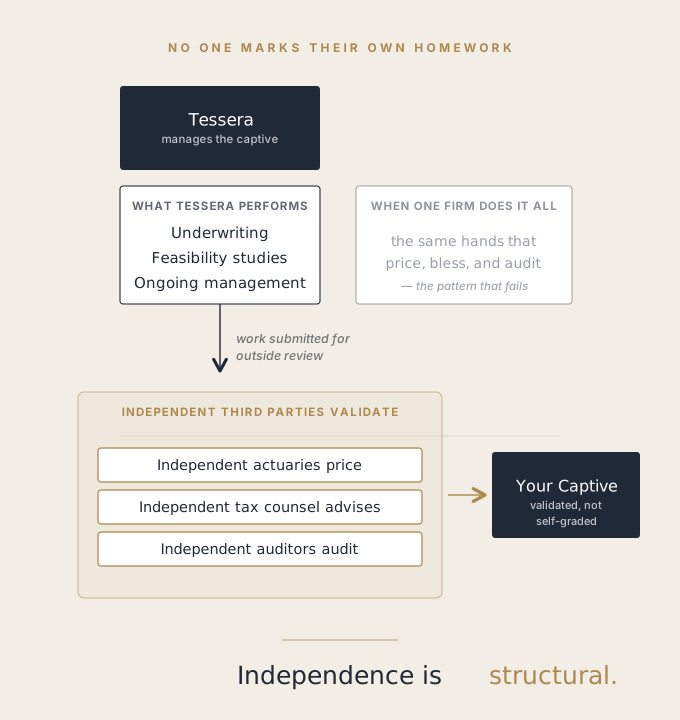
Separation of functions: no one marks their own homework
The single most important safeguard against the failures above is structural — making sure the parties who validate a captive are independent of the party who manages it.
The arrangements that have failed share a tell: the same people who built the structure also priced it, blessed it, and audited it. Tessera is built the opposite way. We separate the functions so that independent professionals validate the work — and that independence is itself part of what makes the arrangement defensible.
What Tessera performs
- Underwriting
- Feasibility studies
- Ongoing captive management
What independent third parties perform
- Independent actuaries set and validate pricing
- Independent tax counsel advises on tax treatment
- Independent auditors perform the insurance-company audit
- Independent CPAs handle accounting
This is not a formality. The failures in Avrahami — actuarially unsound premiums and circular cash flows — are precisely what independent actuarial pricing and arm’s-length structuring are designed to prevent. When pricing is set by an independent actuary, the audit is done by an independent auditor, and the tax position is reviewed by independent counsel, no single party is grading its own work. Combine that with genuinely structured risk distribution, and you have a platform whose legitimacy rests on independent validation rather than on its manager’s say-so.
Where we draw the line
What Tessera will not do
The clearest way to describe how we work is to be exact about what we refuse to build.
- We will not build an arrangement whose real purpose is a tax result rather than financing genuine risk.
- We will not structure a captive without real risk shifting and genuine risk distribution.
- We will not skip or shortcut independent actuarial pricing, tax review, or audit.
- We will not set premiums to reach a number; premiums follow the risk, priced at arm’s length.
If a captive does not make sense as insurance on its own merits, the honest answer is that it should not be built — and we will say so. That is not a limitation on what we offer; it is the whole basis of it.
An honest word on risk
Sound structure withstands scrutiny — it does not eliminate it
We want to be direct about something the careful arrangements get right and the careless ones gloss over: no captive is immune from examination. Any captive can be reviewed by the IRS, and proper structure does not make an arrangement “audit-proof” — there is no such thing. What sound structure does is reduce the likelihood of problems and put the arrangement in a position to hold up if it is examined.
A well-built captive is one that can answer the questions: genuine risk transfer, documented risk distribution, independent actuarial pricing, clean arm’s-length operation, and complete records. Clients should expect that scrutiny is part of the landscape and be prepared for it. We structure so that, if the questions come, the answers are already on the table.
Feasibility Study
The legitimate path starts with an honest question
Is a captive genuinely right for your risk? A feasibility study is where that gets answered — insurance first, structured to stand on its own. Read more about micro-captives and group captives, or start the conversation below.