
Captive Insurance Dividends and Distributions: How Money Actually Comes Back to Owners
Sooner or later, every owner weighing a captive asks the plain version of the question: what do I actually get out of this, and how does the money come back to me? It is a fair question, and it deserves a straight answer rather than a brochure. The honest answer has two halves. The first is that a captive really can let you keep value that an outside insurer would otherwise keep. The second — the half that gets glossed over in sales pitches — is that the money comes back conditionally, on the captive’s terms and the regulator’s, and never as a guaranteed payout.
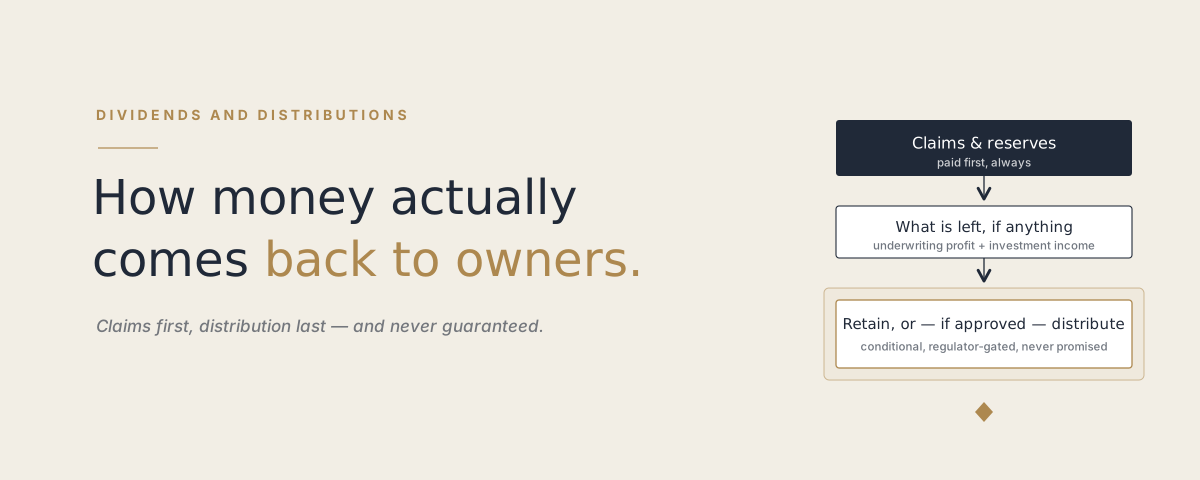
This piece walks through how value is created inside a captive, how it can flow back to owners on both routes — the single-owner micro-captive and the group captive — and, just as importantly, everything that has to come first. If there is one idea to hold onto, it is this: a captive is a real insurance company, and a real insurer pays its claims and protects its solvency before it pays its owners. Distribution is the last step, not the first.
Where the value comes from in the first place
Before any money can come back, the captive has to generate value, and it does so in two ways.
The first is underwriting profit: premiums collected, minus the claims paid, minus the cost of running the company. When a captive’s insured risks perform better than the premiums charged to cover them — a genuinely good loss year — there is an underwriting margin left over. In the commercial market, that margin belongs to the carrier. In a captive you own, it stays inside the company you own. This is the whole economic premise: you are keeping the upside of your own discipline instead of renting coverage and handing that upside to an outside insurer.
The second is investment income. A captive holds reserves — money set aside to pay claims that have been incurred but not yet settled — and those reserves are invested while they wait. The return on that invested float is the captive’s investment income. It is modest and market-dependent, not a windfall, but over a multi-year horizon it is a real second source of value that, again, accrues to the owners rather than to someone else’s balance sheet.
Both sources are conditional by nature. Underwriting profit only exists in years where losses come in below what was funded; a bad loss year produces no underwriting margin at all, and a severe one can require adding to reserves. Investment income rises and falls with markets. Neither is promised, and that is exactly why nothing downstream of them can be promised either.
What gets paid first — the order that never changes
Here is the part that distinguishes a captive from a savings account, and the part most worth understanding before you think about distributions at all. A captive is an insurance company, and an insurance company has obligations that come ahead of its owners. The order of priority is not negotiable:
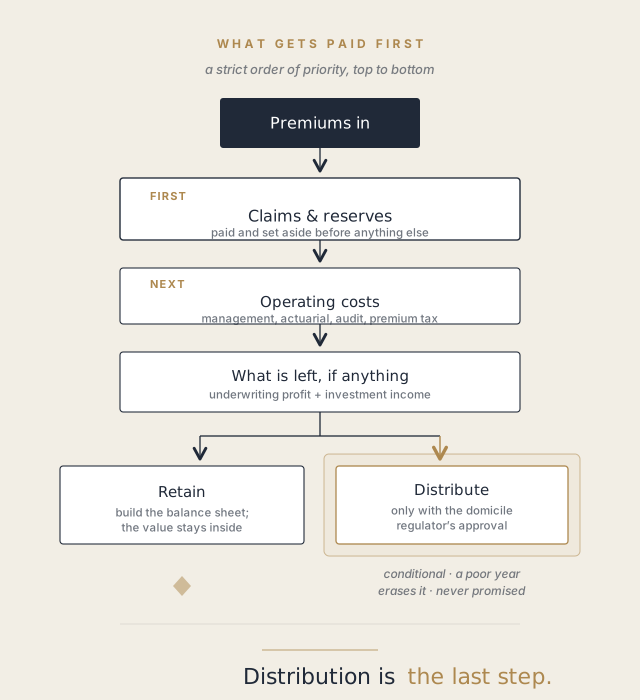
Claims and reserves come first, always. The captive’s first job is to pay the losses it covers and to hold adequate reserves for claims that have been incurred but not yet settled. Insurance claims often take years to develop and close, so reserves are not optional money sitting idle — they are promises the captive has already made and must be able to keep. Nothing is “left over” until those promises are fully funded.
Operating costs come next. Running a licensed insurer carries real expense: captive management, actuarial work, audit and accounting, and premium taxes, among others. These are paid before any value is considered surplus. (Our is captive insurance worth it piece and the broader cost picture sit alongside this — here the point is simply that costs are paid ahead of owners.)
Only then is there anything that might come back. What remains after claims, reserves, and costs — the genuine underwriting profit plus investment income — is the only pool from which a return can ever be drawn. In a poor year, that pool is small or nonexistent, and there is simply nothing to distribute. This is not a technicality; it is the reason a captive cannot be treated as money you can pull out whenever you like.
How money comes back in a single-owner captive
In a single-owner captive — the structure most often associated with the §831(b) micro-captive route — the owner decides what to do with whatever value remains after claims, reserves, and costs. There are two honest choices, and a well-advised owner weighs them deliberately.
The first is to retain it. Leaving the value inside the captive builds its balance sheet — its capital and surplus — which strengthens the company, supports the risks it writes, and lets it stand on its own as a more substantial insurer over time. Many owners retain for years precisely because the long-term value of a captive is the asset it becomes, not the cash it hands back.
The second is to distribute it as a dividend — and this is where the regulator enters, by design. A dividend from a single-owner captive generally requires the approval of the domicile’s insurance department. The regulator’s role is to confirm the captive remains solvent and able to pay the claims it has promised to cover before any money is released to its owner. It reviews the captive’s financial position and ratios and can withhold approval if a distribution would weaken the company’s ability to meet its obligations. That gate is not bureaucratic friction to be engineered around — it is the same protection that applies to any insurer, and it is part of what makes a captive genuine insurance rather than a holding account. The practical consequence is blunt: no owner can simply decide to take money out. Claims and reserves come first, the regulator checks solvency, and only then — if there is value to release and approval is granted — does a distribution happen.
So even on the single-owner route, where there is one decision-maker, the path to a dividend runs through real obligations and a real regulator. It is conditional at every step, and it is never guaranteed.
How money comes back in a group captive
In a group captive, the mechanics of return are tied to the membership structure rather than a single owner’s decision — and that membership mechanic is covered in depth elsewhere, so we will link rather than re-teach it. The how a group captive works explainer and the mid-market cornerstone both walk through loss funds, the shared layer, and the “good driver” return cycle in detail. Here, the focus is narrowly on how the money comes back.
The short version: in most group captives, each member funds its own loss layer, and after an underwriting year closes — after the claims from that year have had time to develop and settle — a member may earn back the unused portion of its loss fund, plus its share of the captive’s investment income. Ownership is typically equal, but distributions are not equal: what comes back to any one member is tied to that member’s own loss experience and premium. A member who ran clean and funded more than its losses required can see the unused portion return over time; a member whose losses ran hot may see little or none, even in the same group and the same year. The structure rewards each member’s own discipline.
Crucially, the conditions are the same family as the single-owner route. The return depends on actual losses — the member’s and the pool’s — on how reserves develop as old claims finally close, on investment results, and on the captive’s rules and regulatory requirements. A poor loss year for the member or the pool reduces or erases any distribution. Group captives, like any insurer, fund claims and reserves before they return anything to members. Different route, same iron rule: claims first, conditional return last.
The long-term framing: an asset, not a yearly check
It helps to step back from the year-to-year mechanics and see the captive for what it is over time. The most accurate way to think about the value a captive returns is not as an annual payout but as a balance-sheet asset that builds.
In a strong run of years, value accumulates inside the captive — whether it is retained to strengthen the company or, when conditions and the regulator allow, distributed. Either way, the value of your own good results is being kept inside an entity you own, rather than surrendered to an outside carrier that would have kept it for itself. Over a long horizon, a disciplined business can build something of real and durable worth: a capitalized insurer it owns, on its own balance sheet. That is the genuine “what do I get out of this” answer — and it is a fundamentally different proposition from a check in the mail.
It is also why the right mindset is patience, not yield-chasing. A captive run as real insurance, with claims and reserves funded first and distributions taken conditionally and with approval, is a long-term asset. One run as a vehicle to extract cash on a schedule is neither sound insurance nor, frankly, defensible. The discipline that makes a captive work is the same discipline that makes its returns, when they come, real.
Why every honest description says “never guaranteed”
You will notice this article carries no return percentages, no “typical distribution,” and no dollar figures. That is deliberate. Any such number is entirely specific to your loss history, your reserves, your investment results, and your captive’s rules and domicile — it means nothing until it is modeled against your actual numbers. A figure quoted before anyone has seen those is marketing, not analysis, and the figures that float around the captive market untethered to a named source are exactly the kind we keep off this site.
More fundamentally, every return mechanism described above is conditional, and any honest account has to say so repeatedly rather than once in fine print. A return depends on actual losses, on pool or portfolio performance, on reserve development as old claims settle, and — for a single-owner captive — on regulatory approval. Any one of those can reduce a distribution; a poor loss year can erase it entirely. The captive structure rewards discipline; it does not promise a payout. That sentence is the whole truth of the matter, and it applies equally to both routes.
A word on tax, because it is the natural next question. For a single-owner micro-captive that has elected §831(b), the captive itself is taxed only on its taxable investment income if it qualifies as insurance and stays under the premium limit for the tax year. Beyond that narrow point, the tax treatment of any distribution to owners depends on your specific facts and structure, and it is a question for your own tax advisor — not something to settle from a web page. As with anything tax-touching here, this is general information, not legal or tax advice — see our disclosures, and confirm the treatment of any distribution with your own advisors.
The honest way to find out what your captive could return
Everything above is how to think about distributions. The way to actually know what a captive could mean for your business — whether the single-owner micro-captive or the group captive route fits you, and what value either could realistically build — is to model your own numbers. That is what a feasibility study is for: we look at your loss experience, your premium, and your appetite for the obligations a captive carries, and we model how value would actually accumulate and return under your facts — conditionally, claims-first, and without promising a number we have not earned the right to quote. If a captive fits, you will understand exactly how the money could come back, and on what terms. If it does not, you will know that too.
Frequently asked questions
Do I get a dividend check every year from a captive?
No — there is no scheduled check, and nothing is guaranteed. A captive returns value only when there is value left after claims and reserves are funded, operating costs are paid, and — for a single-owner captive — the domicile insurance department approves a distribution. A poor loss year, adverse reserve development, or weak investment results reduces or erases any distribution entirely. The honest framing is that a well-run captive can become a long-term balance-sheet asset, not that it pays you a yearly check. Anyone describing it as a guaranteed annual return has mis-sold it.
What has to happen before any money comes back to me?
Claims and reserves come first — always. A captive is a real insurer, so its first obligation is paying the losses it covers and holding reserves for claims that have not yet settled. Only what remains after those obligations, after operating costs, and after the value is genuinely earned can be considered for a return. For a single-owner captive, a dividend also requires the domicile insurance department’s approval, because the regulator checks the captive’s solvency and ability to pay future claims before releasing money to owners. For a group captive, a member’s share is settled after an underwriting year closes and its claims have developed. In both routes, distribution is the last step, never the first.
Does the insurance regulator really have to approve a dividend?
For a single-owner captive, yes — a dividend generally requires the domicile insurance department’s approval. The regulator’s job is to make sure the captive stays solvent and able to pay the claims it has promised to cover, so it reviews the captive’s financial position before any money is released to its owners. That gate is not red tape; it is the same protection that applies to any insurer, and it is part of what makes a captive real insurance rather than a savings account. It also means no owner can simply decide to take money out at will.
How is the money taxed when it comes back?
That depends entirely on your facts and how the captive is structured, and it is a question for your own tax advisor — not something to take from a web page. For a single-owner micro-captive that has elected §831(b), the captive itself is taxed only on its taxable investment income if it qualifies as insurance and stays under the premium limit for the tax year; the treatment of distributions to owners beyond that is fact-specific. We deliberately do not assert dividend tax rates or treatment here. This is general information, not legal or tax advice — see our disclosures, and confirm the tax treatment of any distribution with your own advisors.
If returns are not guaranteed, what is the point?
The point is that, over time, a disciplined business can keep the value its own results produce instead of handing it to an outside carrier. In the commercial market, a good year’s margin belongs to the insurer. In a captive you own, what is left after claims, reserves, and costs stays inside the company you own — building its balance sheet whether or not it is ever distributed. A return, when it happens, is a reward for genuine loss discipline and sound results; it is never a guaranteed payout. The captive is a long-term asset you own, not a yearly check you are owed.
Feasibility Study
See whether a captive fits your business.
Every engagement starts with a feasibility study — an honest read on whether a captive is right for you before anything is formed.