
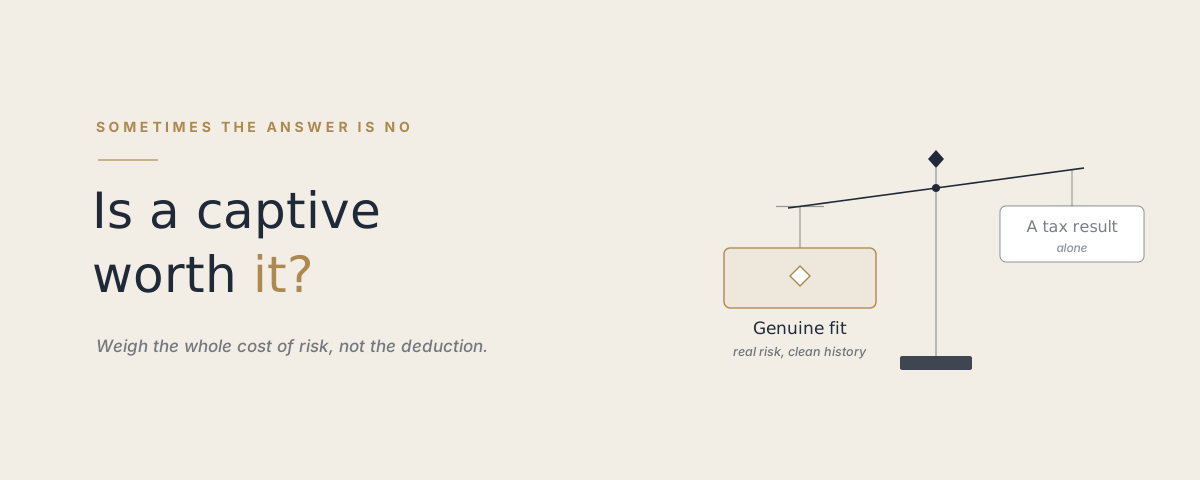
Is Captive Insurance Worth It? When It Makes Sense (and When It Doesn’t)
If you have read enough about captives to understand what one is, the question that actually keeps you up is narrower and more personal: is it worth it for me? It is the right question to ask, and it deserves a more honest answer than the usual sales pitch. So here is the honest version up front — sometimes the answer is yes, sometimes it is a clear no, and the only way to tell which is to weigh your own risk and your own numbers, not someone else’s brochure.
This piece is about that weighing. Not what a captive is, and not the step-by-step of forming one — those live elsewhere — but the decision itself: the signals that a captive may genuinely be worth it for your business, the signals that it is not, and the lens that separates the two. Tessera’s posture here is the same one that runs through everything we publish: a good evaluation is willing to tell you no, and an honest “this isn’t for you” is a successful outcome, not a failed sale.
”Worth it” is a question about fit, not a number
The first thing to get straight is what “worth it” even means for a captive, because the instinct is to reach for a savings figure — will it save me money, and how much? That is the wrong place to start, for two reasons.
The first is that no honest number exists in the abstract. Whether a captive improves your economics depends entirely on your actual losses, your current premiums, the capital the captive would require, and what it costs to run — all of which are specific to you. Any percentage quoted before someone has seen your loss runs is marketing, not analysis. We keep specific savings, payback, and return figures out of these pages on purpose, because the only place they belong is a model built on your own history.
The second reason is more important. A captive is, before anything else, an insurance company. It earns its keep by financing genuine risk better than the alternatives — not by producing a deduction. If you frame “worth it” as a tax or savings result, you are already pointed at the version of this that gets people into trouble. Framed correctly, “worth it” is a question about fit: does a captive solve a real risk-financing problem you actually have, well enough to justify the work and capital of owning an insurer? Get that right and the financial advantages, where they exist, follow from it. Get it backward and no amount of tax benefit rescues a structure that should not exist.
The lens that makes the question answerable: your whole cost of risk
The reason “is it worth it?” feels slippery is that most owners compare a captive against the wrong baseline. They look at the premium line on their commercial policies and ask whether a captive beats it. But premiums are only part of what risk actually costs you.
Risk managers use a more complete measure called the total cost of risk: not just what you pay in premiums, but also the losses you absorb yourself (deductibles, self-insured retentions, and the uninsured hits that never touch a policy), plus the cost of controlling and administering risk. (The concept is usually credited to Douglas Barlow at Massey-Ferguson in 1966, and it has been the standard lens ever since.) Almost every business finances its risk somehow — the only question is how deliberately. The premium you can see is rarely the whole story; the retained and uninsured losses sitting quietly on your balance sheet are part of the cost too.
A captive is the deliberate, structured way to finance risk you are already carrying. So the worth-it comparison is not “captive premium versus commercial premium.” It is your whole cost of risk today — premiums plus retained losses plus the exposures you currently swallow — against your whole cost of risk with a captive in the picture, including everything it costs to fund and run one. Viewed through that lens, a captive looks worth it precisely when it lets you finance real, currently mispriced or unfinanced risk more sensibly than you do now. It looks pointless when the commercial market already covers you well and cheaply and you are carrying little uninsured exposure. The lens does not hand you an answer — but it points the question at the right total.
The signals it may make sense
With that lens in place, a recognizable pattern emerges in the businesses for which a captive tends to be genuinely worth it. None of these is a box to check or a guarantee on its own; think of them as weights on a scale, where it is the balance that matters.
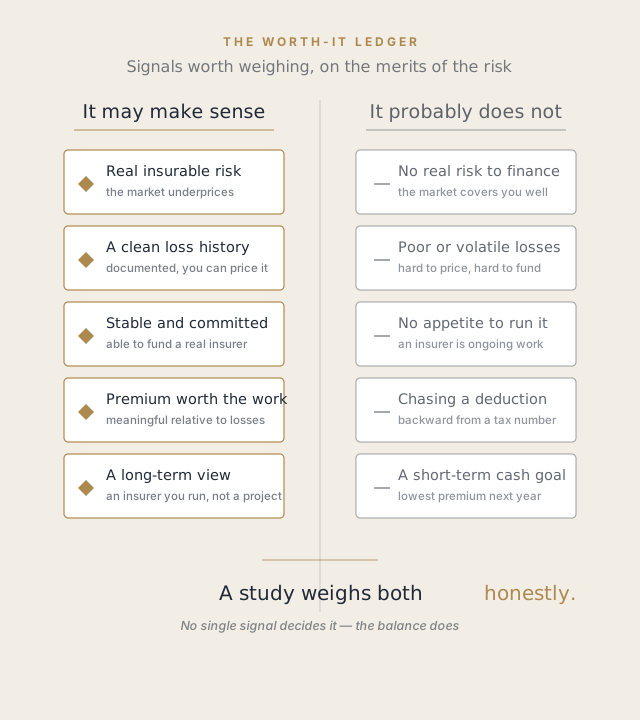
A captive moves toward worth-it when several of these are true at once: you carry genuine insurable risk the commercial market underprices, excludes, or won’t write, so there is a real financing problem to solve rather than a deduction to manufacture. You have a clean, documented loss history, which is both the evidence that you manage risk well and the raw material an actuary needs to price the captive defensibly. You have the financial stability and commitment to stand behind an insurance company through a bad year — because the capital is genuinely at risk, which is what makes it insurance and not a deposit. Your premium is meaningful relative to your losses, the classic sign that you may be subsidizing the market’s worse risks and the carrier’s margin. And you can take a long-term, owner’s view, because a captive is something you run across loss cycles, not a move you make for next year’s renewal.
When most of that describes you, a captive is at least worth examining seriously. The more of it that is true, the heavier the scale tips toward yes.
The signals it does not — and the one that should stop you cold
The honest counterpart matters just as much, and a real evaluation spends as much energy here as on the positive case. A captive tends to not be worth it when the opposite weights dominate: you have no real uninsured or underinsured risk — the market already covers you well, so there is nothing meaningful for a captive to finance. Your loss history is poor or volatile, which makes the risk hard to price, hard to fund, and a poor foundation for an arrangement that depends on predictability. You have no appetite to actually run an insurer — and a captive is an operating insurance company with year-round obligations, not a structure you set up once and forget. Or your goal is fundamentally short-term — the lowest possible cash number next year — which a multi-year, capital-committed structure is simply the wrong tool to deliver.
Any one of those should give you pause. But there is one signal that should stop you cold, because it is not a matter of degree — it is the failure mode itself: chasing a tax result. If the reason a captive looks worth it is primarily the deduction, you are reasoning backward from a tax number, and that is precisely the pattern the courts have rejected. Arrangements built that way have failed when the “insurance” did not genuinely shift and distribute risk and the pricing was set to a desired result rather than to the actual exposure — the substance the IRS and the Tax Court treat as non-negotiable (see Avrahami v. Commissioner, 149 T.C. 144 (2017), and Reserve Mechanical Corp. v. Commissioner, T.C. Memo. 2018-86, aff’d 34 F.4th 881 (10th Cir. 2022)). The tax treatment of a captive — including the Section 831(b) election for small captives, available only at or below $2.9 million for the 2026 tax year (Rev. Proc. 2025-32, indexed annually) — is a consequence of operating genuine insurance, never the reason to build one. This is general information, not legal or tax advice — see our disclosures. If you remove the tax angle entirely and the captive no longer looks worth it, you have your answer.
It is also worth knowing, without alarm, that micro-captives sit under active IRS scrutiny and a disclosure regime that has itself changed more than once and is being litigated as of 2026. That is not a reason to avoid a captive; it is a reason that the only version worth doing is the genuine one — real risk, real distribution, arm’s-length pricing, disciplined documentation. The businesses that get into trouble are the ones for whom the honest answer to “is it worth it?” was no, who built one anyway.
If the balance tips toward yes, there are two paths
For the businesses where the weighing comes out positive, “worth it” usually takes one of two concrete shapes, and which one fits depends on your risk and your structure.
If you are a single, closely held business carrying enterprise and uninsured risks the commercial market underprices or won’t write, the path is typically a single-owner micro-captive — small enough to consider the 831(b) election once it qualifies as genuine insurance. The mechanics, the order of the work, and who genuinely fits are walked through in how to start an 831(b) captive, and the structure itself in our micro-captives and 831(b) page.
If instead you are a financially sound mid-market business with a better-than-average loss record in the working lines — workers’ compensation, general liability, auto — the more natural path is joining a group captive, where unrelated, selectively underwritten members pool that working-layer risk and share in the results their discipline produces. That model, including its own honest account of when it does not fit, is covered in group captive insurance for mid-market businesses, and the structure in our group captives page.
The two solve different problems, and part of answering “is it worth it?” is figuring out which — if either — is even the right shape for your risk. If you are still getting your bearings on the category itself, what is a captive is the ground-floor explainer.
The honest way to settle it: a feasibility study
Everything above is a way to think about the question. The way to actually answer it — for your business, with your numbers — is a feasibility study, and that is deliberate. A study takes the weighing out of the abstract: it examines your real exposures and loss history, tests whether a captive could function as genuine insurance for you, models your whole cost of risk with and without one, and tells you plainly where the balance lands.
Crucially, a good feasibility study is willing to come back with a no. If your risk does not support a captive, if the economics do not hold up on their own insurance merits, or if the only thing making it look attractive is a tax result, the right outcome is to say so before anything is formed — and to save you the considerable cost of owning a captive that should not exist. That is not the process failing; that is the process working. A captive that shouldn’t exist is far more expensive than the study that talks you out of it.
So if you have been asking whether a captive is worth it for you, the most useful next step is not to decide — it is to find out, properly. A feasibility study is where the question gets an honest answer in either direction: a clear path if it fits, and a clear reason if it does not. Either way, you stop wondering and know where you stand — which is the whole point of asking the question well.
Frequently asked questions
Is captive insurance worth it for a small business?
It depends far less on size than on fit. A captive can be worth it for a profitable, well-run business that carries genuine insurable risk the commercial market underprices or won’t write, has a clean and documented loss history, and can commit to funding and running an insurance company for the long term. It is not worth it for a business with no real uninsured risk, a poor or volatile loss record, or no appetite to operate an insurer — regardless of revenue. The honest way to size it for your numbers is a feasibility study.
How do I know if a captive will save me money?
There is no honest universal answer, and anyone quoting you a savings percentage before looking at your numbers is selling, not advising. Whether a captive improves your economics depends on your actual losses, your current premiums, the capital it would require, and the cost of running it — figures that are modeled against your own history, never generic. It is also the wrong first question. A captive earns its keep by financing real risk well; if the insurance case is sound, the economics tend to follow. We deliberately keep specific savings, payback, and return figures out of the conversation until they are modeled for you. This is general information, not legal or tax advice — see our disclosures.
Can a captive be worth it just for the tax benefit?
No — and building one for the tax benefit is exactly the pattern that fails. Section 831(b), where it applies, is a tax treatment available to a small company that already qualifies as genuine insurance; the election follows the insurance, never the other way around. A captive assembled backward from a desired deduction, without real risk transfer and distribution, is the arrangement the courts rejected in cases like Avrahami v. Commissioner (U.S. Tax Court, 2017). If the only reason a captive looks worth it is the tax result, that is a signal it probably is not.
What’s the real cost of running a captive?
A captive is an operating insurance company, so the cost is more than premiums. The true picture is its total cost of risk: the capital and loss funding it requires, the professional work to run it — actuarial pricing, claims handling, audit, legal, regulatory filings, and management — plus any risk you still retain or transfer outside it. Weighed against what you currently spend on premiums and the losses you already absorb, that total is what tells you whether a captive is worth it. The components are real and ongoing; they are modeled on your facts in a feasibility study rather than quoted from a brochure.
How long before a captive is worth it?
A captive is a long-term commitment, not a one-year move, and it should be weighed that way. It is an insurance company you fund, capitalize, and run year after year, and its value builds across loss cycles rather than in a single renewal. A business looking for the lowest possible cash number next year is usually a poor candidate; a business willing to take a multi-year owner’s view of its risk is a much better one. How a captive’s economics develop over time is one of the things a feasibility study models against your own loss history before anything is formed.
Feasibility Study
See whether a captive fits your business.
Every engagement starts with a feasibility study — an honest read on whether a captive is right for you before anything is formed.