
Captive Exit Strategy Explained
You exit a captive by first stopping new business, then dealing with every claim it still owes — running those claims off as they settle, transferring them to another insurer, or carrying them with the captive in a sale or merger — and finally getting the domicile regulator’s approval to release the remaining capital. The tax treatment is settled with your own counsel along the way. The exit is easiest when it was planned before the captive was formed.
Few owners think about leaving a captive while they are excited about starting one. They should. A captive is a licensed insurance company with promises to keep, and those promises do not end when the owner’s interest does. This piece explains why a captive cannot simply be switched off, the routes out, what is different for group captive members, and how a sale of the operating business changes the picture.
Why you cannot just switch a captive off
A captive makes promises every time it writes a policy: pay covered losses that occur during the policy period. Some of those losses are reported and settled quickly. Others surface months later, or take years to resolve. When the owner decides to stop, every one of those promises is still outstanding.
That is the difference between a captive and a savings account, and it is the reason the exit takes time. The captive’s capital is there to protect the people it insures. The NAIC’s overview of captive insurance companies describes how captives are licensed and overseen in their domicile; that oversight does not stop at the exit. The regulator will want to see that remaining claims are provided for before it lets capital leave.
The routes out
Every exit starts the same way and ends the same way. In between, there are a few different paths.
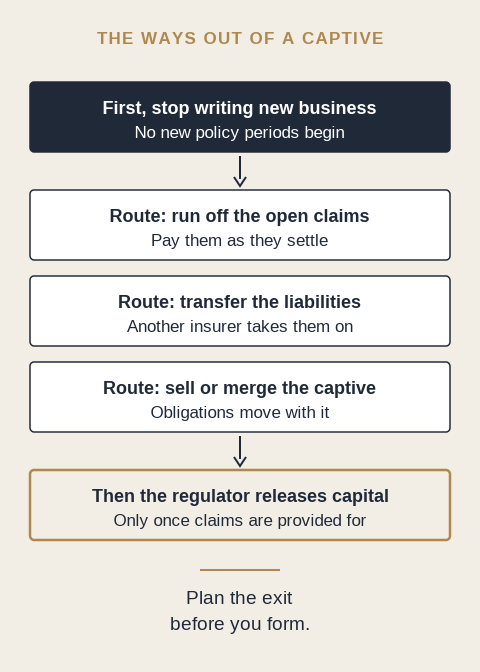
Stop writing new business. The captive stops issuing new policies. No new policy periods begin, so no new promises are added.
Run off the open claims. The simplest path: the captive stays licensed and keeps paying claims as they settle. Once the remaining obligations are resolved or small enough to be provided for, it can wind down. The cost of this path is time and continuing administration.
Or transfer the liabilities. Another insurer can take over the captive’s remaining obligations in exchange for a payment. Industry terms for these arrangements include loss portfolio transfers and novation. This can shorten the exit considerably, at the price of paying someone else to carry the uncertainty.
Or sell or merge the captive. The captive itself, obligations included, can be sold to or combined with another owner or captive. This is less common for small captives, but it is an option worth knowing about, especially when a business is being sold.
Regulator releases the capital. Whatever the route, the domicile regulator must approve the release of capital to the owners. That approval is the regulator confirming that the captive’s promises are covered.
Leaving a group captive
Exiting a group captive works differently, because you are a member of a shared insurer rather than its sole owner.
The rules are in the membership agreement. Typically a departing member stops participating in new underwriting years but remains part of the years it was in, because the claims from those years are still developing. The member’s share of any remaining loss funds and capital is settled under the agreement as those years close — which is why leaving a group captive is a gradual unwind rather than an immediate check. Our explainer on how group captive insurance works covers the underwriting-year mechanics, and our post on captive dividends and distributions explains how value is returned along the way.
Before joining any group, read its exit terms as carefully as its entry terms.
Signs it may be time to exit
Most captives are meant to run for many years, and leaving one is not a failure. But there are good reasons to consider it:
- The risks it insures have changed. A business that has sold a division, changed what it does, or moved operations may find the captive’s coverages no longer match its real exposures. A captive insuring risks the business no longer faces is not doing its job.
- The costs no longer make sense. A captive carries fixed costs every year: management, actuarial work, audit, and regulatory fees among them. If premium volume has shrunk, those costs can outweigh the benefits.
- The owner is retiring or selling. A transition of ownership is the moment to decide whether the captive goes with the business, stays with the seller, or winds down.
- The arrangement no longer holds up. If a fresh review raises real doubts about whether an older captive was built as genuine insurance, an orderly exit planned with counsel may be better than continuing.
None of these makes the decision for you, but each is a reason to put the question on the table rather than let a captive run on autopilot.
Who stays involved during run-off
Run-off is quieter than active operation, but it is not unmanaged. The captive is still a licensed insurer with open claims, so most of its service providers stay in place until the end.
The captive manager keeps the company in good standing, handles regulatory filings, and coordinates the wind-down. The actuary continues to review reserves, because the estimate of what is still owed drives when capital can be released. The auditor keeps auditing the financial statements the regulator relies on. And claims handling continues for every open claim until it is closed. Ending those relationships too early is one of the ways an exit goes wrong.
When you sell your operating business
A sale of the business is the most common reason owners suddenly need an exit plan. The captive insured risks of the business being sold, so the buyer, the seller, and both sets of advisors need to decide what happens to it.
There are a few common outcomes. The buyer may take the captive on as part of the deal. The captive may stay with the seller and run off the obligations it already has. Or its liabilities may be transferred to another insurer so the deal can close cleanly. Which is right depends on what the captive insures, how much is still open, and what the buyer wants.
The mistake is treating the captive as an afterthought at closing. Bring it into deal planning early, with your counsel, so it does not become a loose end.
The tax questions to settle with counsel
How the money is taxed when a captive closes or is sold depends on your facts, the structure, and how the exit is carried out. We deliberately do not describe that treatment here, because the answer is specific to each owner and getting it wrong is costly. For a micro-captive that has elected §831(b), our post on hiring a micro-captive attorney explains why your own tax counsel should be involved long before the exit, and our post on captive insurance and taxes covers the broader picture.
One principle holds regardless: an exit should be the end of a genuine insurance arrangement, not the payoff of a tax plan. A captive set up mainly to move money out on favorable terms is the kind of arrangement that draws scrutiny, and the exit is often where that intent becomes visible. This is general information, not legal or tax advice — see our disclosures.
Plan the exit before you form
The decisions that make an exit easy or hard are made at formation:
- What the captive insures. Risks whose claims settle quickly unwind quickly. Long-developing claims mean a longer tail.
- Where it is domiciled. Each domicile has its own process for winding down a captive and releasing capital.
- What the documents say. Formation documents and, for a group captive, the membership agreement should address a sale, a wind-down, and a member’s departure.
- Who will run it at the end. Run-off still needs a manager, an actuary, an auditor, and claims handling.
A feasibility study is where these questions belong, alongside whether a captive fits your business at all. Our post on how much it costs to start a captive covers the ongoing cost categories that also apply during run-off.
The honest summary
A captive is a long-term commitment. You can leave, and there are several sound ways to do it, but none of them is instant, and all of them run through the captive’s obligations and its regulator. Owners who understand that at the start build captives that are easier to end, and they tend to run them better along the way. If you are weighing one now, start with what a captive insurance company is and plan the exit into the design.
Frequently asked questions
Can I just close my captive and take the money out?
No. A captive is a licensed insurer that has made promises to pay claims, and some of those claims may still be open or not yet reported. Before any capital can leave, those obligations have to be paid, transferred, or otherwise provided for, and the domicile regulator has to approve the release. Closing a captive is a process measured in the life of its claims, not a withdrawal.
What happens to my captive if I sell my business?
It depends on the deal and on what the captive insures. A buyer may take the captive on, the captive may stay with the seller and run off its existing obligations, or its liabilities may be transferred to another insurer. Because the captive’s obligations relate to the business being sold, the captive belongs in deal planning early, alongside your counsel and the buyer’s.
How does leaving a group captive work?
Membership agreements set the terms. Typically a departing member stops participating in new underwriting years but remains part of the years it was in, because the claims from those years are still developing. Its share of any remaining loss funds and capital is settled under the agreement as those years close. Read the exit terms before you join, not when you want to leave.
How is the money taxed when a captive closes?
That depends heavily on your facts, the structure, and how the exit is carried out, and it is a question for your own tax counsel well before the captive closes. We deliberately do not describe the tax treatment of a liquidation or sale here, because getting it wrong is costly and the answer is specific to each owner. This is general information, not legal or tax advice — see our disclosures.
Why plan the exit before forming a captive?
Because the decisions that make an exit easy or hard are made at the start: what the captive insures, how long its claims tend to take to settle, where it is domiciled, how its documents treat a sale or wind-down, and, for a group captive, the membership agreement’s exit terms. A captive designed with its end in mind leaves you options; one designed without it can leave you managing claims long after you meant to be done.
Feasibility Study
See whether a captive fits your business.
Every engagement starts with a feasibility study — an honest read on whether a captive is right for you before anything is formed.