
Do Micro-Captives Make Sense for Dental Practices?
A micro-captive can make sense for a dental practice only when the practice has real, insurable risks that its commercial policies exclude or price out of reach — and enough of them to justify the cost of running an insurance company. For many practices, especially smaller ones, the honest answer is no. When the pitch starts with your tax bill instead of your risks, that is the signal to slow down.
Dentists hear about micro-captives more than most business owners do. Successful practices are profitable, and promoters know it. That makes this one of the most important places to separate a sound insurance decision from a tax pitch wearing an insurance label. This piece explains what a micro-captive is, the risks a dental practice might genuinely insure through one, the tests a proposal must pass, and the warning signs to watch for.
What a micro-captive is
A micro-captive is a small insurance company owned by, or related to, the business it insures. If it qualifies as insurance, it can make the §831(b) election, which affects how the captive itself is taxed. Our page on micro-captives and the 831(b) election explains the structure, and our explainer on what a captive insurance company is covers the basics.
The important words are “if it qualifies as insurance.” The election follows genuine insurance; it never creates it. A dental practice’s micro-captive has to make sense as an insurer of real risks before anything else about it matters.
Why dental practices hear this pitch so often
Profitable professional practices are attractive prospects for anyone selling a structure that promises tax results. The IRS has noticed. In its 2024 Dirty Dozen release, it described abusive micro-captive transactions as a continuing enforcement priority.
None of that makes micro-captives illegitimate. It does mean that a practice owner who is approached about one should expect scrutiny and should insist on an arrangement built the right way. Our post on whether micro-captives are legal and what the IRS targets explains where the line is.
The real risks a dental practice faces
A sound micro-captive starts with an honest inventory of the practice’s exposures, especially the ones commercial insurance handles poorly. Depending on the practice, these might include:
- Interruption without property damage. An office that has to close because of a utility failure, a building access problem, or the loss of a key provider may have no claim under a standard business income policy, which usually requires physical damage. Our post on non-damage business interruption covers this gap.
- Licensing and regulatory defense. Responding to a board complaint or a regulatory inquiry costs money even when the practice did nothing wrong.
- Deductibles and retentions. A practice with a high-deductible commercial program may finance those deductibles through its captive. Our post on deductible reimbursement explains how.
- Cyber and data events. Patient records make dental offices targets, and commercial cyber policies often leave gaps.
Whether any of these belongs in a captive depends on how likely and how costly it really is for your practice. A single-location general practice, a multi-office group, and a specialty practice with expensive equipment face very different versions of the same risks. That is why the inventory has to be built from your practice, not copied from a template.
Notice also what is missing from the list: the practice’s core professional liability. Most dentists keep malpractice coverage in the commercial market or a dedicated professional liability program. A micro-captive is generally about the risks around the practice, not a replacement for its core coverage. A proposal that moves core coverage into a new single-owner captive deserves especially careful review by your own advisors.
The tests a dental micro-captive must pass
Before saying yes, a practice should be able to answer four questions with confidence.
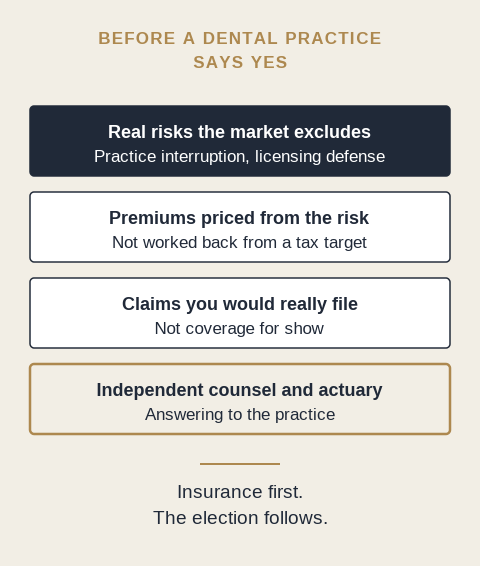
Are the risks real? Each coverage should match something the practice could actually suffer, not a list borrowed from another client’s captive.
Are the premiums priced from the risk? An independent actuary should set premiums from evidence. Premiums that happen to land just under the §831(b) limit — currently $2.9 million for the 2026 tax year (Rev. Proc. 2025-32, indexed annually) — for a single practice should make anyone ask how they were set. Courts have looked closely at pricing; in Avrahami v. Commissioner, 149 T.C. 144 (2017), the arrangement was found not to be insurance.
Would the practice really file claims? A captive that never pays claims looks less like insurance every year. Our post on how claims work in a micro-captive explains why paid claims matter.
Are the advisors independent? The practice’s own tax counsel and an independent actuary should be part of the design, not a promoter’s package.
Warning signs in a pitch to a dental practice
Walk away, or at least get your own counsel involved, if you hear:
- That the captive is mainly about reducing taxes.
- That premiums were chosen to reach a number rather than priced from your risks.
- Coverages for events your practice could not realistically suffer.
- That the money can come back to you quickly or be lent back to the practice.
- That the arrangement is “audit-proof.” There is no such thing.
Our post on hiring a micro-captive attorney explains what independent counsel looks for, and our post on questions to ask before starting an 831(b) captive covers the owner’s own checklist.
What a sound dental micro-captive looks like year to year
If a practice does go ahead, the captive has to behave like an insurance company every year, not just on the day it is formed. In practice, that means:
- Premiums are re-priced as the practice changes. A new location, a new associate, or a change in services changes the risk, and the actuary’s pricing should follow.
- Claims are reported and paid. When a covered event happens, the practice files a claim, the captive reviews it against the policy, and it is paid or denied with the reasons documented.
- Money stays in the captive. Premiums that move into the captive and quickly find their way back to the owner are the circular pattern courts have pointed to when finding an arrangement was not insurance. Our post on how a captive manages its cash explains how a captive should hold its funds.
- The governance is real. Board meetings happen, decisions are recorded, the books are audited, and filings are made on time. Our post on a captive’s annual requirements lays out the recurring work.
A captive that does all of this is doing the job of an insurer. One that skips it is building the record an examiner would use against it.
Questions to put to your own CPA and attorney
Before you sign, take the proposal to advisors who work only for you and ask:
- Would you recommend this captive if it had no tax effect at all? If the answer is no, the insurance case is not strong enough.
- Which of these coverages would the practice realistically claim on? Coverages that never pay are a warning sign.
- How were the premiums priced, and by whom? Ask to see the actuarial work.
- What happens if the practice is sold or the owner retires? A captive is a long-term commitment, and a dental practice transition is a common moment when the question comes up. Our post on captive exit strategy explains the routes out.
- What are our disclosure obligations for the coming tax year? Those rules have been actively litigated and have changed, so the answer must come from current counsel.
When a micro-captive is the wrong answer
For many practices, a micro-captive will not make sense. A captive carries fixed costs every year, and a practice needs enough genuine, insurable risk to justify them. A practice that mainly wants a tax result, has few uninsured risks, or cannot commit for the long term is usually better served by improving its commercial program. Our post on how much it costs to start a captive lays out the cost categories.
Any tax treatment depends on your facts and should be confirmed by your own advisors. This is general information, not legal or tax advice — see our disclosures.
Where to start
If your practice is weighing a micro-captive, start with a feasibility study that looks at your real risks first and can conclude that a captive is not right for you. You can also read the statute behind the election, 26 U.S.C. §831, to see that it applies only to insurance companies. A sound answer, either way, protects your practice.
Frequently asked questions
Why are micro-captives pitched so often to dentists?
Profitable professional practices are attractive prospects for anyone selling a structure that promises tax results, and that is exactly the problem. The IRS has repeatedly named abusive micro-captive arrangements among its top enforcement concerns. A sound micro-captive starts from the practice’s real risks; a pitch that starts from the practice’s tax bill has the order backward.
What could a dental practice’s micro-captive actually insure?
Risks the practice genuinely faces that commercial policies exclude, limit, or price out of reach — for example, an interruption that closes the office without property damage, the cost of defending a licensing board complaint, or deductibles on the practice’s commercial program. Each coverage has to match a real exposure and be priced by an independent actuary from the evidence.
Does a micro-captive replace my malpractice insurance?
Generally no. Professional liability for dentists is a core line that most practices keep in the commercial market or in a dedicated professional liability program. A single-owner micro-captive is more often considered for the enterprise risks around the practice. Any proposal to move core coverage needs careful review by your own advisors.
Can a smaller practice justify a micro-captive?
Often not. A captive carries real fixed costs every year — management, actuarial work, audit, and regulatory fees among them — and a practice needs enough genuine, insurable risk to justify them. A feasibility study should tell a smaller practice honestly when the numbers do not work, and a sound adviser will say so before you spend money forming anything.
Feasibility Study
See whether a captive fits your business.
Every engagement starts with a feasibility study — an honest read on whether a captive is right for you before anything is formed.