
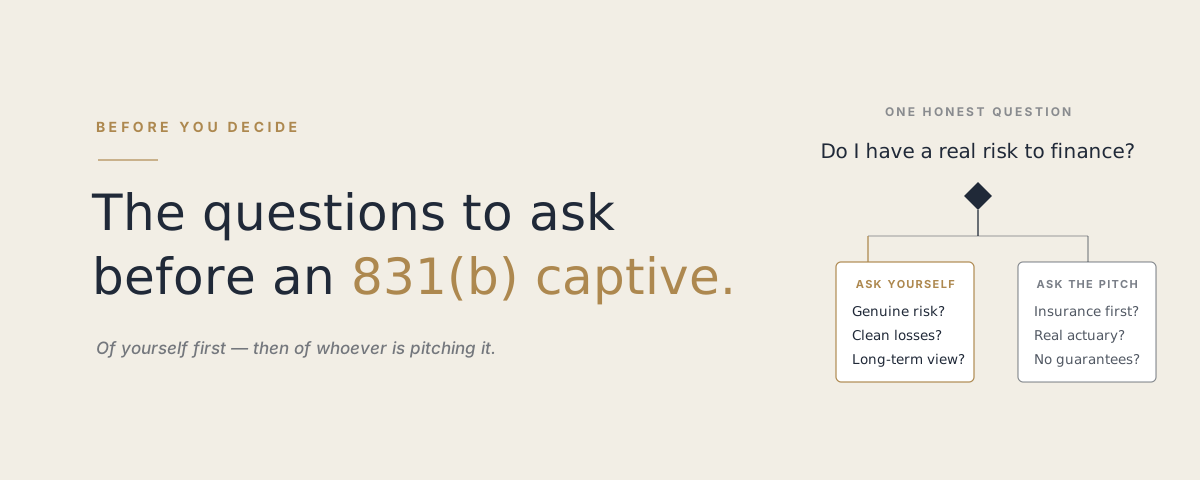
Questions to Ask Before Starting an 831(b) Captive
Most material written about 831(b) captives explains how to form one. This is not that. Before you reach the procedural steps — and before you sit across from anyone selling you a structure — there is an earlier, more honest conversation to have with yourself. Are you actually ready? Do you have something a captive is built to do? And when someone does pitch one to you, how do you tell a sound proposal from a sales script?
These are pre-decision questions. If, after working through them, a captive still looks like the right tool, the procedural walk-through lives in our companion piece on how to start an 831(b) captive. This piece sits one step earlier: the readiness check, and the warning signs.
One principle frames everything below, so it’s worth stating up front. A captive is an insurance company you own. The tax election that makes 831(b) structures attractive is available only to a company that already qualifies as genuine insurance — it follows the insurance; it doesn’t lead it. Every question here flows from that order. This is general educational information, not legal or tax advice — see our disclosures, and review anything specific with your own qualified advisors.
The questions to ask yourself first
Before you evaluate any provider or structure, evaluate your own situation. These are the questions a good feasibility study will press on anyway — asking them yourself first tells you whether the conversation is even worth starting.
Do I carry a genuine insurable risk the market underprices?
This is the foundational question, and it has nothing to do with taxes. A captive exists to finance real exposures — risks with an actual trigger that the commercial market excludes, sublimits, or prices past reason. Non-damage business interruption, the loss of a key contract or customer, regulatory and administrative defense, cyber response beyond a thin commercial limit, warranty obligations sitting unfunded on the balance sheet.
The test is concrete: can you name the specific, currently uninsured or underinsured risks the captive would write? If you can, you may have something a captive is built to do. If you can’t — if the honest answer is “I want the tax treatment and we’ll find risks to fill it” — you don’t yet have a captive. You have a deduction looking for a justification, which is precisely the pattern that fails under scrutiny.
Do I have a clean, documented loss history?
A captive rests on the premise that you understand and manage your own risk well enough to price it. That case is far easier to make when your loss history is clean, well-documented, and backed by disciplined risk management. The history is also what an actuary works from to set defensible premiums, and what a regulator — or the IRS, if the structure is ever examined — will look at first.
You don’t need a spotless record to be a candidate, but you do need a documented one. If you can’t produce a credible loss history across your real exposures, that’s a signal to slow down, not to paper over the gap with assumptions.
Do I have the financial stability and commitment to run a real insurer?
Premiums have to be real and paid year after year, and the captive has to hold enough surplus to credibly pay the claims it insures. That surplus is genuinely at risk — that’s what makes it insurance rather than a deposit — so the commitment has to be one you can sustain through a bad loss year, not just a good one.
Be honest about capacity here. A business that can’t fund premiums without strain, or that quietly intends to treat the captive as a savings account it can tap, is not a fit. An insurance company is something you stand behind financially, indefinitely.
Am I taking a long-term view, not a one-year tax move?
A captive is not a project you complete; it’s an insurer you run. It carries ongoing obligations — actuarially supported pricing each year, policy issuance, claims handling, annual financial statements, regulatory filings and exams in its domicile, and tax compliance. Letting any of those lapse is exactly what undermines a captive under examination.
If your horizon is a single tax year, a captive is the wrong instrument. The structures that hold up are run with discipline over many years; the ones that collapse were treated as a one-time maneuver. Ask yourself whether you’re genuinely prepared to operate an insurance company for the long haul.
What to have in place before you start
If the questions above point in a promising direction, a short readiness list follows naturally — the inputs a serious exploration needs:
- A documented loss history across the exposures you intend to insure, in enough detail that an actuary could work from it.
- A clear account of the specific uninsured or underinsured risks you’re trying to finance — named, not hypothetical.
- The financial stability to fund real premiums and adequate surplus year after year, through good years and bad.
- A willingness to operate a real insurer over the long term, with all the governance and compliance that entails.
With those in hand, the next step is not forming a company. It’s a feasibility study — diagnostic work that tests whether a credible insurance structure, including genuine risk distribution, can actually be built around your facts. Its most valuable output is sometimes the word no, and hearing that before you spend on formation is a feature, not a setback.
The red flags in how it’s pitched to you
The second half of due diligence is turning the same scrutiny outward. Not every 831(b) captive is sold well. Some are pitched as tax products with an insurance veneer — and those are the arrangements that have failed in court and drawn IRS attention. You don’t need to be an expert to spot the warning signs; you need to know what a sound pitch sounds like, and notice when one doesn’t.
The pitch leads with the tax, not the risk. If the first thing you hear is the size of the deduction, and the actual exposures you’d insure are an afterthought, the order is backward. A sound proposal leads with the risk a captive would finance and treats the tax election as a downstream consequence of operating real insurance.
Target premiums set to the §831(b) ceiling. A captive’s premiums should be priced to the risk assumed — defensibly, by an actuary, from your loss history. When premiums are instead reverse-engineered to reach the election limit — $2.9 million for the 2026 tax year (Rev. Proc. 2025-32, indexed annually) — the number is driving the insurance rather than the other way around. That exact pattern, premiums that tracked the ceiling rather than the loss exposure, was central to why the arrangement failed in Avrahami v. Commissioner (149 T.C. 144 (2017)).
One structure for everyone. A captive should be designed to your specific facts — your exposures, your loss history, the right domicile for your situation. A provider who offers an identical template to every client, regardless of industry or risk profile, is selling a product, not building insurance. The fit is supposed to be bespoke; a one-size structure is a sign it isn’t being tested against your reality.
Guaranteed or “audit-proof” outcomes. No one can honestly guarantee a tax result, promise the IRS will accept a structure, or call a captive “audit-proof.” Tax treatment depends on facts and proper structure, and a responsible provider says exactly that — using conditional language (“may,” “depending on the facts,” “if properly structured”). When a pitch trades in certainties it can’t deliver, treat the certainty itself as the warning sign.
No independent actuary or audit. Genuine insurance is priced by an independent actuary and verified by an outside audit. A structure that skips these — or relies only on in-house numbers from the same party selling it — lacks the arm’s-length discipline that makes a captive defensible. A sound provider welcomes outside review; a weak one avoids it.
These aren’t abstract concerns. The IRS has repeatedly named abusive micro-captive arrangements on its annual “Dirty Dozen” list of tax scams — the kind that lack the attributes of genuine insurance: implausible risks that don’t match real business needs, coverage that simply duplicates existing commercial policies, and excessive, non-arm’s-length premiums. And the leading cases the IRS has won — Avrahami and Reserve Mechanical Corp. v. Commissioner (T.C. Memo. 2018-86, aff’d 34 F.4th 881 (10th Cir. 2022)) — turned on the same failures: risk that wasn’t genuinely distributed, pricing that wasn’t arm’s length, and pooling arrangements that were a circular flow of funds rather than bona fide insurance.
It’s also worth knowing the regulatory ground here is moving. Micro-captives sit under active IRS scrutiny and a disclosure regime that is itself being litigated; the rules have changed more than once and are on appeal as of 2026. That’s not a reason to avoid a captive — it’s the reason genuine structure, arm’s-length pricing, and disciplined documentation matter. Confirm your own current obligations with current tax counsel rather than rely on anything frozen into evergreen copy, and see our disclosures.
Two routes, one honest front door
Worth a brief note: the 831(b) micro-captive is one route, suited to a single profitable business with its own insurable risk. It isn’t the only one. A group captive — member-owned insurance shared across multiple unrelated businesses — can be a better fit when pooling risk with peers makes more sense than standing up your own single-owner insurer. Which route fits, if either does, is itself one of the questions a feasibility study answers.
For the mechanics of the 831(b) structure specifically, our overview of micro-captives and the 831(b) election covers the ground, and how to start an 831(b) captive walks the formation path in order. If you’re still working out whether a captive of any kind makes sense, what a captive actually is starts at the beginning.
Start with feasibility, not formation
Every question in this piece — the readiness check you run on yourself, and the scrutiny you turn on any pitch — converges on the same first step. You don’t begin by forming a company, and you don’t begin by accepting a structure someone is eager to sell. You begin by testing, rigorously and independently, whether a captive is the right answer for your risk at all.
That’s what a feasibility study is for. It examines your loss history and real exposures, tests whether a credible insurance structure with genuine risk distribution can be built, weighs the 831(b) route against alternatives, and reaches an honest conclusion in either direction. If a captive fits, you leave with a structure designed as insurance from the ground up. If it doesn’t, you leave knowing why — and what would serve you better. Either way, you know where you stand, which is the entire point of asking the questions before you start.
Frequently asked questions
What is the single most important question to ask before starting an 831(b) captive?
Whether you have a real, insurable risk worth financing — independent of any tax result. A captive is an insurance company, and the §831(b) election follows the insurance, never the other way around. If you can’t name the specific uninsured exposures the captive would write, the tax treatment can’t rescue the structure. Test the question honestly in a feasibility study before forming anything.
What are the red flags in how an 831(b) captive is pitched to me?
Watch for a pitch that leads with the tax deduction rather than the risk, sets target premiums at the §831(b) ceiling instead of pricing to actual losses, offers one identical structure to every client, promises a guaranteed or audit-proof outcome, or skips an independent actuary and audit. Those are the patterns the courts rejected in cases like Avrahami v. Commissioner (U.S. Tax Court, 2017), and the kind of arrangement the IRS has repeatedly flagged as abusive.
Do I need a clean loss history before forming a captive?
It helps enormously. A captive rests on the premise that you understand and manage your own risk well enough to price it, and a clean, well-documented loss history is what an actuary works from to set defensible premiums — and what a regulator or the IRS examines if the structure is ever questioned. A volatile or poorly documented history doesn’t automatically disqualify you, but it makes the case harder and is something a feasibility study weighs honestly.
Is an 831(b) captive a short-term tax move?
It shouldn’t be treated as one. A captive is a licensed insurance company with ongoing obligations — annual actuarial pricing, claims handling, financial statements, regulatory filings, and tax compliance — that you run indefinitely. Approaching it as a one-year deduction is exactly the mindset that produces fragile structures. If you’re not prepared for a long-term commitment to running a real insurer, a captive is probably the wrong tool.
What should I have in place before I even start exploring a captive?
A documented loss history, a clear sense of the specific uninsured or underinsured exposures you’re trying to finance, the financial stability to fund real premiums and surplus year after year, and a willingness to run an actual insurer over the long term. With those in hand, the next step isn’t forming a company — it’s a feasibility study that tests whether a credible insurance structure can be built around your facts.
Feasibility Study
See whether a captive fits your business.
Every engagement starts with a feasibility study — an honest read on whether a captive is right for you before anything is formed.