

Using a Captive for Deductible Reimbursement
Deductible reimbursement means a captive pays back the deductibles your business owes under its commercial insurance policies. The commercial carrier still handles and pays the claim; your business still pays the deductible; and then your captive reimburses that deductible from premium you paid it. The loss is the same, but instead of being absorbed by the operating budget it is funded in a planned way through an insurer you own — and in quiet years, the unused funds stay in the captive.
Deductibles have been rising across much of the commercial market. Carriers raise them to control their own costs, and businesses accept higher deductibles to keep premiums down. The result is that many businesses now retain significant risk without ever deciding to. Deductible reimbursement is one of the simplest and most common reasons to put a captive to work, because it formalizes risk the business already carries. This piece explains how it works, why it can make sense, the trade-offs, and what makes it legitimate insurance.
How deductible reimbursement works
The mechanics are straightforward, and they leave the commercial program in place.
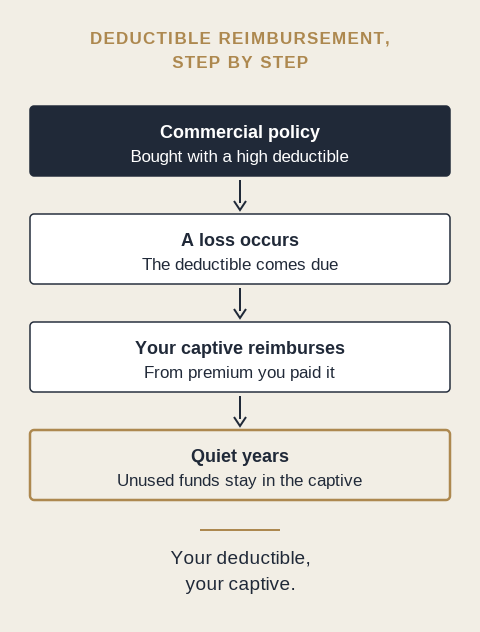
The business buys commercial policies — property, general liability, workers’ compensation, auto, or others — with deductibles or retentions. It also pays premium to its captive for a policy that reimburses those deductibles. When a loss occurs, the commercial carrier pays the claim and the business pays the deductible. The business then submits a claim to its captive, which reimburses the deductible under its policy.
Because the captive is a separate, regulated insurer, the premium is set by an independent actuary from the business’s claims history, the captive holds capital, and its results are audited. Our explainer on what a captive insurance company is covers that structure.
Why businesses use it
It formalizes risk the business already carries. Every business with a deductible retains risk. Deductible reimbursement turns that retained risk from an unplanned expense into a funded layer with its own pricing and reserves.
It supports higher deductibles. Higher deductibles usually lower commercial premiums. A business with a captive can accept a larger deductible, knowing the retained layer is funded, and keep the premium savings. Whether that trade works has to be modeled carefully for each business.
It rewards good loss experience. In years with few claims, less is paid out of the captive and more of the premium stays there. Over time, a business with strong loss control keeps more of its own results.
It is easy to layer onto an existing program. Because the commercial policies stay in place, lenders, landlords, and contract counterparties continue to see the coverage they require.
It improves visibility. When deductibles are paid from the operating budget, they are often scattered across departments and locations and rarely analyzed. Routing them through a captive produces a clear record of what the business actually retains, line by line and year by year. That record is useful in its own right: it shows where losses come from, which locations or operations drive them, and where loss control spending would pay off.
It creates options at renewal. A business that knows its retained losses can negotiate its commercial program from a position of knowledge, deciding deliberately whether to raise or lower deductibles rather than accepting whatever the market offers.
The trade-offs
Deductible reimbursement is not free money, and it is not right for every business.
A captive has costs. Management, actuarial work, audits, and regulatory fees are incurred every year. If the deductibles involved are small, those costs can outweigh the benefit. Our post on how much it costs to start a captive lays out the cost categories.
Bad years still happen. A year with many claims, or a large one, means the captive reimburses more. It has to be capitalized for that, and the business has to be prepared for it. An actuary should model how several bad years in a row would affect the captive before deductibles are raised to rely on it.
Money stays in the captive. Premium paid to the captive belongs to the captive and is held to pay claims. It is not a fund the business can draw on at will. Our post on how a captive manages its cash explains how those funds are held.
What makes it legitimate insurance
Deductible reimbursement is a common, legitimate captive coverage when it is built properly. The tests are the same as for any captive coverage:
- The deductibles are real. The business actually pays them, based on its claims history.
- The premium is priced from evidence. An independent actuary sets it from the business’s loss experience, not from a target premium.
- Claims are actually filed and paid. When deductibles are paid, the business claims reimbursement and the captive pays.
- The coverage is not duplicated. The captive is not reimbursing something already covered elsewhere.
Deductible reimbursement priced to reach a number, or covering deductibles the business never pays, looks like a tax arrangement rather than insurance. Our post on what the IRS targets in micro-captives explains why that matters.
Which businesses it suits
Deductible reimbursement tends to suit businesses that carry meaningful deductibles on several lines, have claims history an actuary can price, and can fund the captive’s capital. Contractors, property owners, fleets, and multi-location businesses often fit that description. Our posts on construction captive insurance and captive insurance for real estate investors show how it fits in those industries.
A business with small deductibles and few claims is usually better served by its commercial program alone. The NAIC’s guide to small business insurance is a useful refresher on how deductibles work across the common commercial lines.
Which lines work best
Deductible reimbursement works best on lines where the business pays deductibles regularly enough that its history can be priced. Workers’ compensation and auto, where many businesses carry deductibles that are triggered by routine claims, are common candidates. Property deductibles can be a good fit for owners with many locations, where water damage and similar claims occur often enough to measure. General liability deductibles fit businesses whose operations produce a steady flow of smaller claims.
Lines where deductibles are rarely triggered are harder to price and less valuable to reimburse. If a business has not paid a property deductible in many years, reimbursing that deductible through a captive adds cost without much benefit — and coverage that rarely pays is the kind that raises questions. The feasibility study should look line by line and recommend only the lines where the retained risk is real.
How reimbursement claims are documented
Every reimbursement should be supported by the same paper trail a commercial insurer would want. That usually means the commercial carrier’s claim file or loss run showing the claim and the deductible, proof that the business paid the deductible, and the captive’s own claim record showing the reimbursement was reviewed and paid under its policy terms.
That documentation does two jobs. It lets the captive pay claims accurately, and it builds the record showing the captive is a real insurer that pays real losses. Our post on how claims work in a micro-captive explains why that record matters.
Single-owner or group
A single business can write deductible reimbursement through its own micro-captive, alongside other coverages for risks the commercial market handles poorly. In a group captive, the members’ loss funds often play a similar role for the working layer, with pooled and reinsured layers above. The right structure depends on what else you want the captive to do.
Lenders, contracts, and higher deductibles
Before raising deductibles, check what your loan documents, leases, and contracts require. Some lenders cap the deductibles they will accept on property they finance, and some contracts require specific coverage terms. Deductible reimbursement works best when the commercial policies remain fully compliant and the captive simply funds what the business would otherwise pay out of pocket. The NAIC’s overview of captive insurance companies explains how captives are regulated alongside the commercial market.
Tax is not the reason to use deductible reimbursement. Where tax treatment applies, it follows from genuine insurance. This is general information, not legal or tax advice — see our disclosures.
Where to start
A feasibility study looks at your deductibles and retentions by line, your claims history, your lender and contract requirements, and what else a captive might cover. It can conclude that deductible reimbursement does not justify a captive’s costs for your business.
Frequently asked questions
What is deductible reimbursement in a captive?
It is coverage written by a captive that reimburses the business for deductibles it pays under its commercial insurance policies. The commercial carrier handles and pays the claim, collects or offsets the deductible from the business, and the captive then reimburses the business from premium the business paid to the captive. The deductible is still paid; what changes is that it is funded in a planned way through the business’s own insurer.
Why not just keep a reserve on the balance sheet instead?
An internal reserve is not insurance: it does not shift or distribute risk, and money set aside in the operating company is easily redirected. A captive formalizes the retained risk with independent pricing, separate capital, regulatory oversight, and audited results. Whether that is worth the captive’s costs depends on the size of the deductibles and what else the captive insures.
Can I raise my deductibles to lower my commercial premium?
Often that is part of the strategy: higher deductibles usually mean lower commercial premiums, and the captive funds the larger retained layer. The trade-off has to be modeled carefully, including how a bad year would affect the captive and whether your lenders and contracts allow the higher deductibles.
Is deductible reimbursement a legitimate captive coverage?
It can be, when it reflects real retained losses and is priced from actual claims history. Deductible reimbursement priced to reach a premium target, or covering deductibles the business rarely pays, looks like a tax arrangement rather than insurance. The same tests apply as for any captive coverage: real risk, independent pricing, and claims actually paid.
Feasibility Study
See whether a captive fits your business.
Every engagement starts with a feasibility study — an honest read on whether a captive is right for you before anything is formed.