
Can a Captive Cover Business Interruption Without Damage?
Yes — a captive can cover business interruption losses that happen without physical damage, such as income lost when a critical supplier fails, access to your location is blocked, or a key customer disappears. Commercial business income policies usually require physical damage, so this is a genuine gap. But the coverage must match events your business could realistically suffer and be priced by an independent actuary from evidence. Coverage written for unlikely events at outsized premiums is one of the patterns that draws IRS scrutiny.
Most business owners discover the limits of their business income coverage the hard way. A road closure keeps customers away for weeks. The single supplier of a critical component goes out of business. A major customer cancels a contract. Income stops, but nothing was damaged, and the standard policy does not respond. That gap is one of the most common reasons owners consider a captive. It is also one of the coverages most often misused. This piece explains the gap, how a captive can address it, and the tests that separate real coverage from a tax arrangement.
The gap in standard coverage
Standard commercial business income coverage protects a business when a covered event damages its property and forces it to stop or slow operations. The NAIC’s overview of business interruption coverage describes it as responding when a covered event, such as a fire, causes physical property damage — and notes that losses unrelated to property damage are generally excluded.
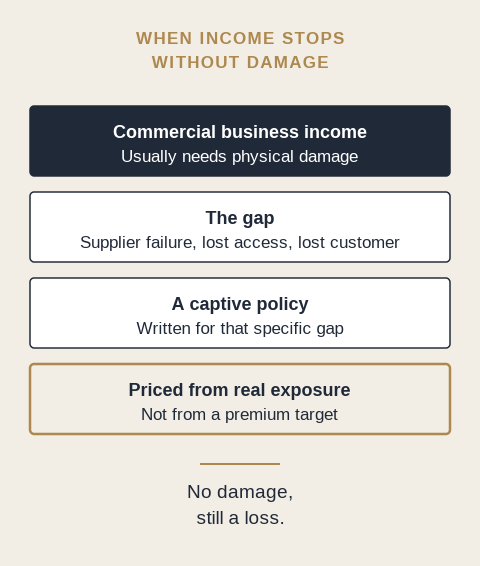
That leaves a category of losses where income stops for reasons that have nothing to do with damage to the business’s own property. Some commercial policies add limited extensions — for example, coverage when a supplier’s property is damaged — but those extensions usually still depend on physical damage somewhere.
What non-damage coverage can address
A captive policy can be written for specific events that interrupt income without physical damage. Depending on the business, those might include:
- Supplier or customer failure. A critical supplier stops delivering or a dominant customer stops buying, for reasons unrelated to physical damage.
- Loss of access. Authorities or circumstances block access to the business’s location even though the premises are undamaged.
- Regulatory or licensing action. A license suspension or regulatory order halts operations temporarily.
- Loss of a key person. The death or disability of someone the business depends on interrupts revenue.
Each of these has to be defined precisely. “Loss of a major customer,” for example, needs a clear definition of which customer, what counts as a loss, and what is excluded — a customer that leaves because of the business’s own poor performance is a business risk, not an insurable event.
Which events belong in a policy depends entirely on the business. A manufacturer that depends on a single supplier has a very different exposure from a professional practice that depends on one licensed principal.
The tests the coverage must pass
Non-damage business interruption is legitimate coverage when it meets the same standards as any insurance:
- The events are realistic. The business could plausibly suffer them, based on its operations and history.
- The coverage is clearly defined. The policy says exactly what triggers it, how the loss is measured, and what is excluded.
- The premium is priced from evidence. An independent actuary sets it from data about how likely and how costly the events are, not from a target premium.
- Claims are filed and paid. When a covered event happens, the business files a claim and the captive pays it under the policy terms.
Courts reviewing captive arrangements have looked closely at how premiums were set. In Avrahami v. Commissioner, 149 T.C. 144 (2017), the Tax Court found that the arrangement was not insurance. Our post on what the IRS targets in micro-captives explains the patterns enforcement has focused on.
Why this coverage is often misused
Non-damage business interruption is flexible, and that flexibility is what makes it easy to abuse. A policy can be written for an event that is theoretically possible but practically remote, and the premium can be set high enough to move a meaningful sum into the captive each year. Combined with a captive that never pays claims, that is a tax arrangement with an insurance label.
The honest version looks different. It covers events the business genuinely worries about, at premiums an independent actuary can defend from data, and it pays claims when those events happen. If a proposal for this coverage cannot explain why the premium is what it is, that is a reason to stop.
How the 831(b) election fits
Non-damage business interruption is a coverage commonly written by single-owner micro-captives. If a captive qualifies as insurance, it can make the §831(b) election, which affects how the captive is taxed, provided its premiums stay within the limit for the tax year — $2.9 million for the 2026 tax year (Rev. Proc. 2025-32, indexed annually). The statute, 26 U.S.C. §831, applies only to insurance companies.
The order matters. The coverage has to make sense as insurance first. Our page on micro-captives and the 831(b) election explains the structure, and our post on captive insurance and taxes covers what is real and what is hype. This is general information, not legal or tax advice — see our disclosures.
Waiting periods, limits, and how much to cover
A well-designed non-damage business interruption policy answers practical questions in its wording. How long must income be interrupted before coverage begins? How long will the policy pay? How is lost income measured, and which expenses are deducted? What is the maximum the policy will pay for any one event and in total?
Those choices shape both the protection and the price. A short waiting period and a long payment period cost more; a longer waiting period lets the business absorb brief disruptions itself. The limit should reflect the income genuinely at risk, measured from the business’s own financial records, not a figure chosen to produce a premium. An actuary should be able to explain how each of these terms affects the premium.
Questions to ask about a non-damage proposal
If you are shown a proposal for this coverage, ask:
- Which specific events does it cover, and why are they realistic for us?
- How was the premium priced, and can we see the actuarial work?
- How would a claim be measured and documented?
- Does it duplicate anything our commercial policies already cover?
- Would we buy this coverage if there were no tax effect at all? If the honest answer is no, the insurance case is not strong enough.
Our post on hiring a micro-captive attorney explains why your own counsel should review those answers.
Measuring and proving a claim
When a covered event happens, a non-damage business interruption claim is measured much like any business income claim. The business documents that the event occurred, then shows the income it lost, using financial records from before and after the event and adjusting for expenses it no longer incurred. The captive reviews the claim against the policy terms and pays what is owed.
That process matters beyond the single claim. A captive that pays well-documented claims is building the record that shows it is a real insurer. Our post on how claims work in a micro-captive explains why.
Which businesses it suits
Non-damage business interruption tends to suit businesses with concentrated dependencies — on a supplier, a customer, a location, a license, or a person — that standard coverage leaves exposed. Manufacturers with single-source components, practices that depend on a licensed principal, and businesses tied to a single location are common examples. Our posts on captive insurance for manufacturers and micro-captives for dental practices discuss how it fits those businesses.
The common thread is concentration: the more a business depends on one thing it does not control, the more an interruption costs.
Reducing the dependency is often worth more than insuring it. A second supplier, a broader customer base, or a succession plan for a key person can lower the risk itself. A sound design considers both.
Where to start
A feasibility study identifies your real concentrated dependencies, estimates how likely and costly an interruption would be, and recommends whether captive coverage is warranted. It can conclude that the risk is better reduced than insured. If you are weighing a proposal now, our post on questions to ask before starting an 831(b) captive is a useful checklist.
Frequently asked questions
Why doesn’t my business income policy cover losses without damage?
Standard commercial business income coverage is usually triggered by direct physical loss or damage to property from a covered cause. When income stops for another reason — a supplier fails, access to your location is blocked, a key customer is lost — there is often no physical damage to trigger the coverage. That gap is what non-damage business interruption coverage in a captive is designed to address.
What events can non-damage business interruption cover?
It depends on how the policy is written and on the business’s real exposures. Examples include the failure of a critical supplier, loss of access to a location, the loss of a major customer or contract, or a regulatory action that halts operations. Each covered event must be something the business could realistically suffer, defined clearly, and priced from evidence.
Why does this coverage draw IRS attention?
Because it is easy to abuse. Coverage for events the business could never realistically suffer, priced at premiums out of proportion to the risk, can be used to move money into a captive under an insurance label. The Tax Court has looked closely at how captive premiums were priced in cases such as Avrahami v. Commissioner, 149 T.C. 144 (2017). Legitimate non-damage coverage avoids that by being realistic and independently priced.
How is a claim proven under this kind of coverage?
The same way any business income claim is: by documenting that the covered event happened and measuring the income actually lost, using financial records from before and after the event. A captive that pays these claims should handle them with the same rigor as a commercial insurer, and keep the records.
Feasibility Study
See whether a captive fits your business.
Every engagement starts with a feasibility study — an honest read on whether a captive is right for you before anything is formed.