

What a Captive Owner Must Do Every Year
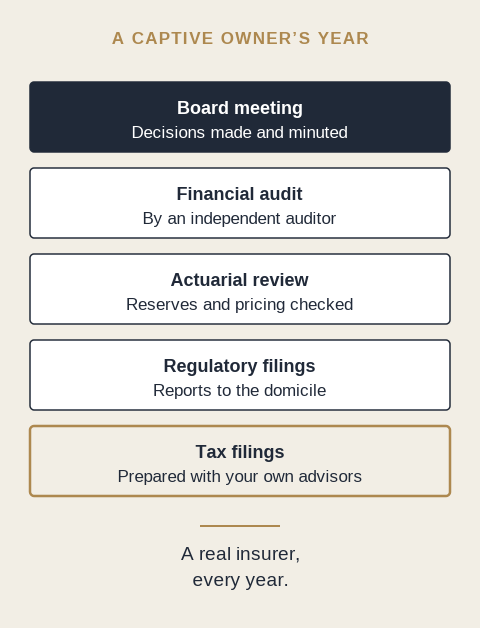
Every year, a captive owner’s insurance company needs a cycle of governance and reporting: board meetings that make and record real decisions, an audit of the financial statements by an independent auditor, an actuarial review of premiums and reserves, the filings the domicile regulator requires, and tax filings prepared with the owner’s own advisers. The captive manager usually coordinates the cycle, but the owner and the board remain responsible for it. Doing this work well is not paperwork for its own sake. It is the evidence that the captive operates as a real insurer.
Owners who form a captive sometimes think of the license as the finish line. It is the starting line. A captive is a licensed insurance company with obligations that recur every year, and its credibility — with its regulator, its auditor, and anyone who might review it — is built one year at a time. This piece walks through the annual cycle, what each part involves, what the owner needs to provide, and the mistakes that cause trouble.
The yearly cycle
Board meetings
A captive has a board of directors, and the board is responsible for its decisions: approving the coverages and premiums, reviewing claims and financial results, setting investment policy, approving the audit and the actuarial reports, and appointing service providers. Many domiciles expect at least some meetings to be held in the domicile or with a local presence, and they expect minutes that show what was discussed and decided.
The quality of board work matters. Minutes that record genuine discussion — why a coverage was added, why a claim was paid, why an investment was approved — show an insurer managing itself. Minutes that record only unanimous approval of documents nobody read show the opposite. Directors should read the materials, ask questions, and expect answers.
The board also handles conflicts of interest. In a single-owner captive, the same people often sit on both sides of a transaction: they run the business that pays the premium and the insurer that receives it. Recording those conflicts openly, and making decisions on the evidence — the actuary’s report, the claim file, the investment policy — is how the board shows that the captive is run as an insurer rather than as an extension of the business. Some domiciles require or encourage an independent or local director, which can strengthen that showing.
The financial audit
Captives generally must file financial statements audited by an independent auditor. The auditor examines the captive’s premiums, claims, reserves, investments, and expenses, and tests whether the financial statements fairly present its position. The owner and manager provide the records; the auditor reaches its own conclusions.
Independence is the point. The auditor should not be the captive manager, the promoter, or anyone whose fees depend on the result. Our post on what a captive manager does explains why the manager coordinates the audit but must not conduct it.
The actuarial review
Each year, the actuary revisits the captive’s premiums and reserves. Pricing for the next policy period should reflect the business as it is now — new locations, new products, divisions sold, claims experience — not as it was at formation. Reserves should be reviewed as claims develop. Many domiciles also require a formal actuarial opinion on reserves.
An actuarial report that never changes from year to year is a warning sign, because the business it covers almost certainly has. Our post on what a captive actuary does explains the actuary’s role in more detail.
Regulatory filings
The domicile regulator expects regular filings: annual financial statements, the audit, actuarial materials, and notice of significant changes to the business plan, ownership, or service providers. Requirements vary by domicile and by the kind of captive. The NAIC’s overview of captive insurance companies describes how captives are licensed and overseen.
Regulators also examine captives periodically. A captive whose records are current and whose filings are on time handles an examination easily. Missed filings can lead to penalties, regulatory action, and in serious cases a threat to the license.
Changes during the year need attention too. Adding a coverage, changing a fronting arrangement, replacing a service provider, or changing ownership usually requires notice to the regulator, and sometimes its approval, before the change takes effect. The business plan on file with the regulator should describe the captive as it actually operates. When the two drift apart, the gap tends to surface at the worst possible time.
Tax filings with your own advisers
The captive files its own tax returns, and the operating business reports the premiums it pays. Those filings should be prepared by the owner’s own CPA and reviewed by the owner’s own tax counsel, not by the promoter or manager.
The timing of the tax cycle depends on the rest of the year. The captive’s return relies on audited figures, which rely on the actuary’s reserves, which rely on complete claims information. A delay anywhere in that chain pushes the tax filings late. Owners who keep the earlier steps on schedule rarely face a rushed tax season.
For micro-captives, disclosure rules have changed over the years through rulemaking and litigation, and may continue to change. Whether a disclosure is required for your situation in a given year, and in what form, is a question for your own counsel. When disclosure applies, it generally uses IRS Form 8886, the reportable transaction disclosure statement. Our post on hiring a micro-captive attorney explains why that counsel should answer only to you.
What the owner needs to provide
The manager coordinates the cycle, but much of the information comes from the owner’s operating business:
- Exposure updates. Revenue, payroll, locations, vehicles, products, and other measures the actuary uses to price coverage.
- Changes in the business. Acquisitions, sales, new lines of business, new contracts, or closed operations.
- Claims. Prompt notice of losses that may be covered, with documentation.
- Commercial insurance. Renewals and changes to the commercial program, so the captive’s coverage still fits around it.
- Financial information the auditor and actuary request.
- Time. Board meetings and decisions need the owner’s genuine attention.
Owners who provide this information promptly keep the cycle running smoothly and their captive’s record strong. A simple habit helps: when the business makes a significant decision — a new location, a new product, a large contract — tell the captive manager the same week. Exposure changes reported months later are harder to price and harder to explain.
Mistakes that cause trouble
The most common problems in captive administration are not dramatic. They are neglect:
- Renewing on autopilot, with the same coverages and premiums year after year while the business changes.
- Never filing claims, which raises the question of whether the captive is insuring anything real.
- Treating captive funds as the owner’s money, through loans or investments that look more like personal finance than insurance reserves. Our post on captive insurance cash management covers why that matters.
- Paper boards, with minutes that show no real deliberation.
- Late filings that put the captive’s standing at risk.
Each of these weakens the evidence that the captive is an insurer, and together they describe the arrangements that draw scrutiny. Our post on what the IRS targets in micro-captives explains the patterns.
Single-owner and group captives
In a single-owner micro-captive, the owner carries this cycle directly, with the manager coordinating. In a group captive, the group’s board and manager run the governance cycle, and each member’s obligations are mostly to provide exposure information, report claims, participate in risk management, and meet the group’s standards. Members should still read the group’s financial reports and understand its results.
The cycle also shapes what happens at the end. A captive with clean records and current filings can be wound down or transferred far more easily than one with gaps. Our post on captive exit strategy explains why the end should be planned from the start.
This is general information, not legal or tax advice — see our disclosures.
Where to start
If you are considering a captive, ask any prospective manager to walk you through its annual calendar and what it will need from you. If you already own one, compare your last year against the cycle above. A feasibility study can also review an existing captive to see whether its coverage and operations still fit the business. If you find gaps — a missed meeting, a stale actuarial report, claims that were never filed — the right response is to correct them openly and document the correction, with your own counsel involved where tax questions arise. Problems fixed in the ordinary course of business look very different from problems discovered by someone else.
Frequently asked questions
Does a captive need an annual audit?
Domicile regulators generally require captives to file audited financial statements, prepared by an independent auditor, on a regular schedule. The details vary by domicile and by the kind of captive. Your captive manager should know the requirements and coordinate the audit, but the auditor must be independent of the manager.
Do I have to attend the captive’s board meetings?
The captive’s board is responsible for its decisions, and directors should participate genuinely. Many domiciles expect at least some meetings to be held in the domicile or with a local presence. A board that rubber-stamps decisions made elsewhere, or never meets, weakens the case that the captive is a real insurance company.
Do I have to disclose my micro-captive to the IRS?
Disclosure rules for micro-captive transactions have changed through rulemaking and litigation, and they may continue to change. Whether a disclosure is required for your situation, and in what form, is a question for your own tax counsel each year. Disclosure generally uses Form 8886 when it applies.
What happens if a captive misses a required filing?
Consequences depend on the domicile and the filing, but missed filings can lead to penalties, regulatory action, and in serious cases a threat to the captive’s license. They also weaken the record that the captive operates like an insurer. A good manager tracks every deadline so the owner never has to.
Feasibility Study
See whether a captive fits your business.
Every engagement starts with a feasibility study — an honest read on whether a captive is right for you before anything is formed.