
How a Captive Manages Its Cash
A captive manages its cash for one job before any other: paying claims. That means cash for claims coming due is kept liquid, reserves for open claims are invested conservatively to match when those claims will settle, and the whole portfolio sits inside limits set by the captive’s domicile regulator. Investment return matters, but it comes last.
Owners often expect the opposite. They hear that a captive holds real money, they know their advisor manages money, and the natural question is how to put that money to work. This piece explains why the answer starts with claims, what the layers of a captive’s cash look like, who decides how it is invested, and the patterns that turn a sound captive into one that draws scrutiny.
Why claims decide how the money is held
A captive is an insurance company, not an investment account that happens to be called one. When it writes a policy, it makes a promise to pay covered losses, and some of those losses will not be known, reported, or settled for months or years. The cash on the captive’s balance sheet is, first and foremost, the means of keeping that promise.
That single fact drives everything else. If the captive’s money is locked up in something that cannot be sold quickly, or that might be worth less on the day a large claim lands, the captive cannot do the one thing it exists to do. A regulator reviewing the captive will ask that question before any other, and so should you.
If you are new to how a captive is put together, our explainer on what a captive insurance company is and the CFO’s guide to how captive insurance works cover the structure. Here the focus is narrower: what happens to the premium dollars once they arrive.
The layers of a captive’s cash
It helps to think of a captive’s money in layers, ordered by when it will be needed.
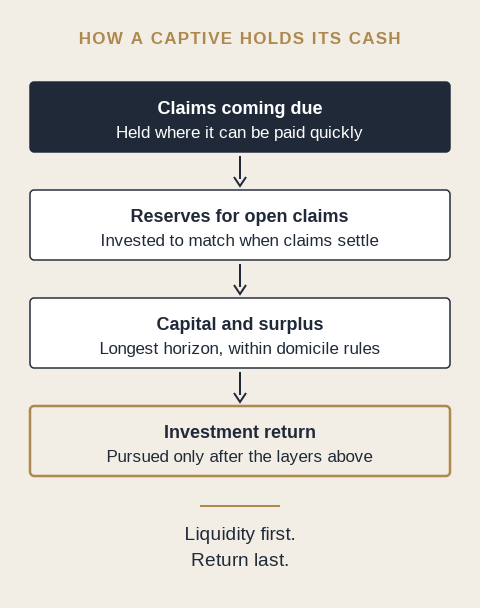
Cash for claims coming due. Some claims are open and expected to be paid soon. The money for them belongs somewhere it can be reached quickly and will not lose value on the way. This is the least glamorous part of the portfolio and the most important.
Reserves for open claims. Reserves are the captive’s estimate of what it will still owe on claims that have happened but are not yet closed. The actuary’s view of when those claims are likely to be paid tells the captive how long that money can be invested. Money set aside for a claim expected to settle in the near term is invested differently from money set aside for a claim that may take years. Matching the investments to that timing is the core discipline of captive cash management.
Capital and surplus. Beyond reserves, a captive holds capital — the cushion the regulator requires so the insurer can absorb a worse year than expected. Because it is not earmarked for a specific claim, it can carry a longer horizon, but it still sits inside the regulator’s rules, because it is the margin that protects policyholders when results go wrong.
Investment return. Only once those layers are protected does the question of return come in. Return is real and it matters over time, but a captive that reaches for return at the expense of the layers above it has its priorities upside down.
Who sets the rules on investments
Three sources shape what a captive may do with its cash.
The first is the domicile regulator. A captive is licensed by the insurance regulator of the jurisdiction where it is formed, and that regulator oversees its solvency. The NAIC’s overview of captive insurance companies describes how captives are licensed in their domicile and remain subject to state insurance oversight. Investment rules and their details differ from domicile to domicile, and we deliberately do not summarize specific limits here; they need to be read from the domicile’s own rules for your captive.
The second is the business plan the regulator approved when it licensed the captive. That plan describes how the captive will operate, including how it expects to hold its assets. A material change in investment approach is the kind of change a regulator expects to hear about before it happens, not after.
The third is the captive’s own investment policy, adopted by its board. This is where the captive writes down, in plain terms, what it will and will not invest in, how much it keeps liquid, how it matches investments to expected claim payments, and who is responsible for what.
Who manages the money, and why roles matter
In a well-run captive, the board sets the policy and an investment manager carries it out. That manager is often an independent investment adviser, chosen by the board and accountable to it. The captive manager’s job is different: to make sure the portfolio stays consistent with the regulator’s rules, the approved business plan, and the actuary’s view of the claims.
This is the same principle we apply everywhere in a captive: separation of functions. The people who price the risk, the people who audit the results, and the people who advise on tax should not be the same people, and no one should be grading their own work. Our approach to compliance explains why that separation is the backbone of a captive that holds up to review.
It also answers a question owners sometimes ask about their financial advisor. An advisor can play a legitimate role managing a captive’s investments, but the captive’s first purpose has to be insurance for the business. Investment management follows from a sound captive; it is never the reason to form one.
How cash differs on the two routes
The order of priority is the same on both of the routes we work in, but the mechanics differ.
In a single-owner micro-captive, the captive’s cash belongs to one insurer that covers one owner’s related businesses, often for enterprise risks the commercial market excludes or prices out of reach. The investment policy is the captive’s own, and it is tuned to the claims that captive expects. Our page on micro-captives and the 831(b) election covers how those captives are built.
In a group captive, each member’s premium funds its own loss fund and a share of the pooled layers above it. The captive holds that money to pay claims as each underwriting year develops. A member’s share of whatever remains is settled only after a year has closed and its claims have matured, so money in a group captive is measured in years, not months. Our explainer on how group captive insurance works walks through the layers.
The patterns that draw scrutiny
Most of what goes wrong with captive cash is the same mistake in different clothes: treating the captive as a place to park and grow money rather than an insurer that owes claims.
Money that circles back. Premiums leave the operating business, land in the captive, and find their way back to the owner or a related company. Courts have pointed to circular flows like this when deciding an arrangement was not genuine insurance, including the Tax Court in Avrahami v. Commissioner, 149 T.C. 144 (2017). Any related-party transaction needs the regulator’s and your own counsel’s review, not a promoter’s assurance.
A portfolio built for growth instead of claims. When the investment strategy looks like a personal wealth plan — long-horizon, illiquid, or concentrated — and the claims the captive is meant to pay look like an afterthought, the captive starts to resemble an investment account with an insurance label. That is exactly the profile regulators and the IRS look at most closely. Our post on whether micro-captives are legal and what the IRS targets describes what enforcement has focused on.
No written policy at all. A captive that cannot show a board-adopted investment policy, and evidence that its investments followed it, has a governance gap, whatever its returns.
How investment income fits the tax picture
Investment income is part of a captive’s economics, and for some structures it is central to how the captive is taxed. A micro-captive that qualifies as insurance and makes the §831(b) election is taxed on its taxable investment income rather than its premium income, so long as its premiums stay within the limit for the tax year — $2.9 million for the 2026 tax year (Rev. Proc. 2025-32, indexed annually).
Notice the order in that sentence. The election only applies if the captive first qualifies as insurance. The tax treatment is a consequence of a genuine insurance company doing its job, never a reason to set one up, and how any of it applies to you depends on your facts. Our post on captive insurance and taxes covers what is real and what is hype. This is general information, not legal or tax advice — see our disclosures.
Where to start
How a captive should hold its cash is not a question to answer in the abstract. It depends on what the captive will insure, how quickly those claims tend to be paid, the domicile, and the route. Those are the questions a feasibility study works through before anything is formed, alongside whether a captive fits your business at all. If you want to see how the money eventually comes back to owners, read our piece on captive dividends and distributions.
Frequently asked questions
Can I invest my captive’s money however I want?
No. A captive is a licensed insurer, so its investments sit inside rules set by its domicile regulator and inside the business plan the regulator approved when the captive was licensed. Those rules exist to make sure the money is there when claims come due. Within them, the board adopts an investment policy that puts safety and liquidity ahead of return. An owner who wants the captive’s funds managed mainly for growth is describing an investment account, not an insurance company, and that is the profile regulators and the IRS look at most closely.
Can a captive lend money back to my operating business?
Treat that idea with real caution. Money that flows from the operating business into the captive and straight back out to the owner or a related company is the circular pattern courts have pointed to when they found arrangements were not genuine insurance — the Tax Court described circular flows in Avrahami v. Commissioner, 149 T.C. 144 (2017). Whether any related-party transaction is permitted, and on what terms, is a question for the domicile regulator and your own counsel, not for a sales pitch. This is general information, not legal or tax advice — see our disclosures.
Who actually manages the captive’s investments?
The captive’s board sets the investment policy, and an investment manager carries it out inside that policy. Many captives use an independent investment adviser for the day-to-day work, while the captive manager makes sure the portfolio stays consistent with the regulator’s rules, the actuary’s view of when claims will be paid, and the approved business plan. The roles should be clear and written down, so that no single party both sets the policy and grades its own results.
How is a captive’s investment income taxed?
It depends on the structure and your facts, and your own tax advisor should confirm it. As one example, a micro-captive that qualifies as insurance and makes the §831(b) election is taxed on its taxable investment income rather than its premium income, as long as premiums stay within the limit for the tax year — $2.9 million for the 2026 tax year (Rev. Proc. 2025-32, indexed annually). That is a consequence of genuine insurance, never the reason for it. This is general information, not legal or tax advice — see our disclosures.
What happens to the cash in a group captive?
In a group captive, each member’s premium funds its own loss fund and a share of the pooled layers, and the captive holds those funds to pay claims as they develop. Cash management follows the same order: claims and reserves first, liquidity matched to when claims settle, return last. A member’s share of what remains is settled only after an underwriting year has closed and its claims have developed, which is why money in a group captive is measured in years, not months.
Feasibility Study
See whether a captive fits your business.
Every engagement starts with a feasibility study — an honest read on whether a captive is right for you before anything is formed.