

How Claims Work in a Micro-Captive
In a micro-captive, a claim works the way it does with any insurer: the operating business reports a loss, the captive reviews it against the policy terms, and the claim is paid or denied with written reasons. Every step is documented. Because the business and the captive share an owner, the claims process has to be at least as disciplined as a commercial insurer’s — and the resulting record of claims filed, reviewed, and paid is some of the strongest evidence that the captive is genuine insurance.
Claims are where owners often discover whether their captive was built properly. A captive that was designed around real risks, with clear policies and a working claims process, handles a loss routinely. A captive designed around a premium target often has policies nobody reads, coverages nobody expects to use, and no idea how to handle a claim when one arrives. This piece walks through the claims path step by step, explains why the process matters so much in a micro-captive, and covers the mistakes owners make.
The claim path
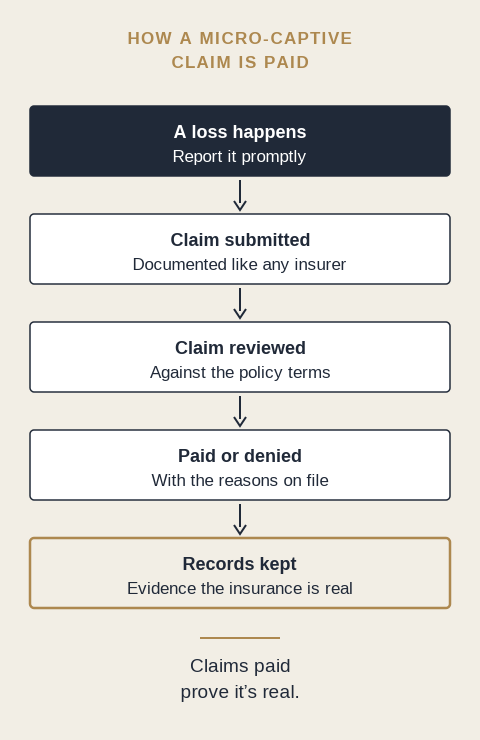
Step one: a loss happens
A claim starts with a loss: an event that may be covered by one of the captive’s policies. That might be a deductible the business paid under its commercial program, an interruption in income, a contract dispute, a lost key customer, a regulatory action, or another risk the captive insures. The first question is simply whether the loss might fall within a policy, and the answer is in the policy wording.
Owners should know what their captive covers well enough to recognize a potential claim. If nobody in the business can describe the captive’s coverages, the captive is unlikely to be receiving the claims it should. A practical step is to give the people who handle losses day to day — the controller, the operations lead, whoever deals with the commercial insurer — a plain summary of the captive’s coverages and a simple way to report a possible claim. Losses tend to surface in those parts of the business long before they reach the owner.
Step two: the claim is submitted
The business reports the loss to the captive, following the notice procedures in the policy. A good submission describes what happened and when, identifies the policy that may apply, and includes supporting documents: invoices, financial records, photographs, correspondence, or whatever shows the loss and its cost.
Prompt notice matters. Policies usually require notice within a reasonable time, and a captive should hold its own insured to those terms. Late notice of a loss the business knew about for months looks like a claim filed for convenience rather than for coverage.
Step three: the claim is reviewed
The captive reviews the claim against the policy. Is the event covered? Is the loss within the policy period? Do any exclusions apply? How much was actually lost, after any deductible and after any amounts paid by other insurance? The captive manager usually oversees this review, sometimes with a third-party claims administrator or an adjuster, and larger or unusual claims are often reported to the captive’s board.
The review should be the same review a commercial insurer would perform. If the captive would question a stranger’s documentation, it should question the owner’s too.
Measurement deserves particular care. For a deductible reimbursement, the amount is usually clear from the commercial carrier’s records. For a business interruption or lost-customer claim, the loss has to be calculated from financial records before and after the event, adjusted for expenses the business no longer incurred. Whoever reviews the claim should be able to show how the figure was reached, and the method should match the one the policy describes.
Step four: paid or denied, with reasons
The captive decides. If the claim is covered, the captive pays the amount owed under the policy, and the payment is recorded. If it is not covered, or only partly covered, the captive explains why in writing, citing the policy terms.
Denials are not a failure of the captive. They are evidence that it is behaving like an insurer. A captive that pays everything its owner submits, regardless of the policy, is behaving like a bank account. A captive that never pays anything is not insuring anything. A real claims history usually includes both payments and denials, each with a documented reason.
Step five: records kept
Files should be kept for as long as the captive’s records policy and its regulator require, and organized so any claim can be reconstructed from its file alone, without relying on anyone’s memory. Every claim file should show the full story: the notice, the documentation, the review, the decision, the reasons, and the payment or denial letter. Those records serve the auditor, the actuary, the regulator, and anyone who later asks whether the captive is a real insurer.
The NAIC’s overview of captive insurance companies describes how captives are regulated as insurers. A captive’s claims files are part of what makes that description true in practice. Our post on what a captive manager does explains the manager’s role in keeping them.
Why claims matter so much in a micro-captive
In cases reviewing micro-captive arrangements, courts have looked at whether the captives behaved like insurers, and claims history is part of that picture. Captives that received few or no claims over many years, while collecting large premiums, have been part of the patterns the IRS has focused on. Our post on what the IRS targets in micro-captives explains those patterns.
Claims also feed the actuary. Each year’s claims experience informs the next year’s pricing. A captive whose losses are never reported cannot be priced accurately, which undermines the insurance case further. Our post on what a captive actuary does explains that connection.
None of this changes the order of things. If a micro-captive qualifies as insurance, it can make the §831(b) election, which affects how it is taxed, provided its premiums stay within the limit for the tax year — $2.9 million for the 2026 tax year (Rev. Proc. 2025-32, indexed annually). The election follows from genuine insurance, and genuine insurance pays claims. Our page on micro-captives and the 831(b) election explains the structure. This is general information, not legal or tax advice — see our disclosures.
Common mistakes
- Not knowing what the captive covers. Covered losses go unreported because nobody thought to check the captive’s policies.
- Absorbing small claims. The business pays a covered loss itself to avoid the paperwork, leaving the captive without a claims record.
- Rubber-stamping. Every claim the owner submits is paid in full, without review.
- Timing claims for tax reasons. Filing or paying claims to manage the captive’s results rather than because a loss happened.
- Thin files. Payments with no documentation of the loss or the review.
Each of these makes a captive look less like an insurer. The fix is the same in every case: a written claims procedure, followed consistently, for every claim. Disputes should have a path too. If the owner disagrees with a decision, the procedure should say how the claim is reconsidered and by whom, just as a commercial policy would.
Claims and the commercial program
Many micro-captives cover risks alongside the business’s commercial insurance, such as deductibles, excluded perils, or coverage above or below commercial limits. Claims often involve both. The captive should coordinate with the commercial carrier, avoid paying amounts another insurer has paid, and understand where its coverage begins and ends. The NAIC’s small business insurance resources explain how commercial coverages are typically structured.
Our post on captive deductible reimbursement walks through one of the most common claim types in detail.
Coordination also matters for the order in which coverage responds. If the commercial policy pays first and the captive covers what is left, the captive needs the commercial carrier’s settlement before it can measure its own share. If the captive covers a peril the commercial policy excludes, the commercial carrier’s denial letter is often part of the captive’s file. Either way, the captive’s claim should fit cleanly alongside the commercial claim, with no gaps and no double payment.
Where to start
If you own a micro-captive, ask to see its claims procedure and its claims history, and check whether the business has had losses the captive should have heard about. If you are considering one, ask any prospective manager how claims are handled and what a claim file looks like. A feasibility study designs coverage around losses your business actually suffers, which is what makes a claims process meaningful.
Frequently asked questions
Can I file a claim against my own micro-captive?
Yes. The operating business is the insured, and when it suffers a loss covered by the captive’s policy, it should file a claim just as it would with any insurer. Covered claims should be filed and paid. A captive that never receives claims raises the question of whether it insures anything real.
Can a micro-captive deny a claim from its own owner?
It should, when the claim is not covered by the policy. A captive that pays everything its owner submits, regardless of the policy terms, is not behaving like an insurer. Denials should be based on the policy wording, explained in writing, and recorded in the claim file.
Who decides whether a micro-captive claim is paid?
The captive’s claims process, usually overseen by the captive manager and sometimes handled by a third-party claims administrator or adjuster, reviews the claim against the policy. Larger or unusual claims are often reported to the captive’s board. The process should be consistent and documented regardless of who the insured is.
Should I file a small claim with my captive or just absorb it?
If the loss is covered and above any deductible, file it. Absorbing covered losses quietly deprives the captive of the claims record that shows it functions as an insurer, and it distorts the data the actuary uses to price future coverage. Report losses promptly and let the claims process decide.
Feasibility Study
See whether a captive fits your business.
Every engagement starts with a feasibility study — an honest read on whether a captive is right for you before anything is formed.