

Hiring a Micro-Captive Attorney
Yes — a micro-captive owner should have independent tax counsel who represents them and no one else, separate from the manager who builds and runs the captive. That attorney reviews the structure before you sign, advises you on the tax position, and represents you if the IRS ever examines the arrangement. The manager cannot play that role for you, and a sound manager will not try.
If you searched for a “micro-captive law specialist,” you are probably at one of two moments: weighing a captive someone has pitched to you, or already owning one and wanting a second set of eyes. Either way, this piece covers what that specialist actually does, why their independence matters more than their price, and how to tell a qualified one from someone who will simply bless whatever is put in front of them.
Why a micro-captive needs its own counsel
A micro-captive is a small insurance company, owned by or related to the business it insures, that can make the §831(b) election if it qualifies as insurance. That election, and the arrangement around it, sit in an area the IRS has watched closely for years. Our page on micro-captives and the 831(b) election explains the structure, and our compliance page explains why the scrutiny exists.
Scrutiny is not a reason to avoid captives, but it is a reason to have someone whose only job is protecting you. The IRS has repeatedly placed abusive micro-captive arrangements on its annual “Dirty Dozen” list; in its 2024 Dirty Dozen release it described abusive micro-captive transactions as a continuing high-priority enforcement area. When an arrangement is questioned, the owner is the one who answers for it.
What your attorney does at each stage
Good counsel is not a one-time sign-off. Their work follows the life of the captive.
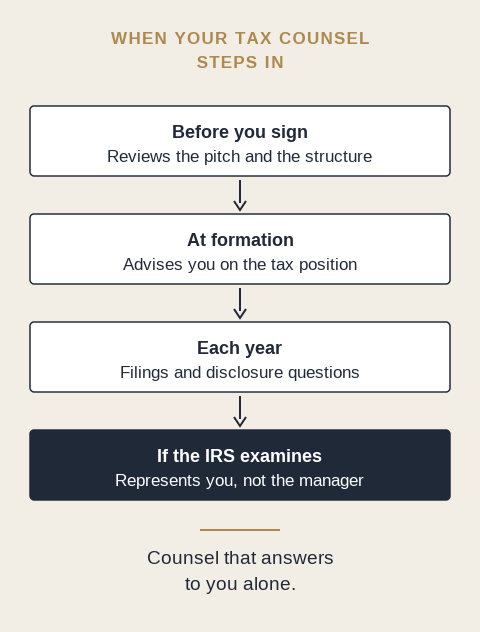
Before you sign. This is where counsel adds the most value. They read the proposal, the coverages, and the way the premiums were set, and they ask whether the arrangement is genuine insurance or a tax result wearing insurance clothes. A weak design is cheap to fix or abandon on paper and expensive to defend later.
At formation. Counsel advises you on the tax position the captive will take, the documents you are signing, and what records the captive needs to keep to support that position over time.
Each year. Returns get filed, and disclosure questions have to be answered for the tax year at hand. Those rules have been actively litigated and have changed in recent years, so this is current-counsel work, not something to settle once and forget. Our post on captive insurance and taxes covers why the disclosure picture keeps moving.
If the IRS examines. Counsel represents you. Under the IRS’s Circular 230 rules, the practitioners who represent taxpayers before the IRS are mainly attorneys, CPAs, and enrolled agents, and those rules govern how they practice. You want that person to be someone who has been working for you from the beginning, not someone meeting the file for the first time.
This is general information, not legal or tax advice — see our disclosures.
Why counsel must be separate from the manager
A captive manager builds and runs the insurance company: underwriting, feasibility, administration, and keeping the captive in good standing with its regulator. That is valuable work, and it is not the same as advising you on your tax exposure.
The problem with combining the roles is simple: the people who designed and sold the arrangement are the least well placed to tell you it is flawed. A tax opinion supplied by the promoter, paid for as part of the package, is written by someone whose business depends on the package selling. Courts reviewing failed arrangements have looked at how premiums were set and whether the insurance was real, and in cases such as Avrahami v. Commissioner, 149 T.C. 144 (2017), the arrangement was found not to be insurance at all. An opinion that never asked those questions protected no one.
At Tessera, separation of functions is how we work: independent actuaries price the risk, independent auditors audit the captive, and the owner’s own tax counsel confirms the tax position. We would rather you hear “this does not work” from your own lawyer before formation than from an examiner years later.
How to vet a micro-captive attorney
Ask questions that reveal whether they understand the insurance, not just the tax.
Can they explain what makes a captive insurance? The legal test turns on risk shifting and risk distribution, rooted in Helvering v. Le Gierse, 312 U.S. 531 (1941). A qualified attorney explains both in plain language and tells you how your proposed structure meets them.
Have they represented clients in captive examinations? Drafting documents is one skill; defending an arrangement before the IRS is another. Ask what that work looked like, without needing client names.
Who pays them, and who do they answer to? If the answer involves the promoter or the manager, keep looking. Their engagement letter should name you as the client.
Will they tell you no? Ask what would make them advise against a captive. A good attorney has a ready answer — and you should want to hear it.
How do they work with the rest of the team? A micro-captive involves an actuary, an auditor, a captive manager, and often a CPA who knows insurance-company accounting. Good counsel expects to read the actuarial work and talk to the manager directly, and is comfortable asking hard questions of both. An attorney who only wants to see the tax projections is looking at the wrong pages.
What to bring to your first meeting
You will get far more from the first conversation if counsel can see what you have been shown, not a summary of it. Bring:
- The proposal or pitch materials, including anything that describes expected tax results. How a captive is sold tells counsel a great deal about how it was designed.
- The list of coverages and how premiums were set. Counsel will want to see the pricing support, not just the premium total, and whether the coverages match risks your business actually faces.
- Any feasibility study or actuarial report. If no independent feasibility work has been done, that is itself a finding.
- The risk-distribution arrangement. If the captive will participate in a pool or reinsurance arrangement, bring those documents too; that is where weak structures tend to hide.
- Your existing commercial insurance. Counsel and the actuary need to see what you already buy, so the captive does not duplicate it.
If you already own a micro-captive
Owners who formed a captive years ago sometimes ask whether it is worth a fresh review. It usually is. The rules around micro-captives have moved, the business the captive insures may have changed, and an arrangement that seemed fine when it was sold may not hold up as well under today’s questions.
A second-opinion review looks at the same things as a pre-formation review, with the benefit of history: whether premiums have stayed supported by the risk, whether claims have actually been paid when they should have been, whether the captive’s money has stayed in the captive, and how disclosure obligations were handled in past years. The answers may confirm the captive is sound, point to changes, or suggest an orderly exit. Our post on captive exit strategy covers what that last option involves.
Warning signs in a pitch your attorney should catch
Part of counsel’s value is spotting what a sales process glosses over. Our post on questions to ask before starting an 831(b) captive covers the owner’s side; here are the patterns counsel looks for on the paper:
- Premiums that seem set to reach a tax number rather than priced from the risk.
- Coverages for risks the business does not realistically face, or that duplicate coverage it already buys.
- A risk-distribution arrangement that exists on paper but moves little real risk.
- Money that flows from the business into the captive and back out to the owner.
- Promises of tax savings, or language like “audit-proof.” There is no such thing.
Our post on what the IRS actually targets goes deeper on each of these.
What a good attorney will not do
A good micro-captive attorney will not guarantee you a tax outcome, will not tell you an arrangement cannot be examined, and will not let the tax result drive the design. They will tell you that the §831(b) election follows the insurance, never the other way around, and that the captive has to make sense as insurance for your business before anything else matters.
That is the same standard we hold ourselves to, and it is why the right attorney and the right captive manager tend to get along: both start from the insurance.
How your attorney and the feasibility study fit together
The best time to bring counsel in is alongside a feasibility study, before anything is formed. The study answers whether a captive fits your business as insurance; counsel reviews that answer and the proposed structure from your side of the table. If both say yes, you proceed with confidence. If either says no, you have saved yourself a problem. Our questions to ask before choosing a captive manager pair well with the vetting questions above.
Frequently asked questions
Do I really need my own attorney if the captive manager has lawyers?
Yes. The manager’s lawyers, and any tax opinion a promoter supplies, work for the people who built and sold the arrangement. Your own tax counsel works for you. Their job includes telling you when something in the structure or the pitch does not hold up — which is exactly the advice someone selling the captive has the least reason to give. Independent counsel is part of a sound micro-captive, not an optional extra. This is general information, not legal or tax advice — see our disclosures.
What kind of lawyer handles micro-captives?
Usually a tax attorney with specific experience in captive insurance and in representing clients before the IRS. Some owners pair that attorney with a CPA who knows insurance-company accounting. The right person can explain the insurance requirements a captive must meet, not just the tax result, and can name the court cases that turned on those requirements without reaching for notes.
When should I bring the attorney in?
Before you sign anything. The most valuable review happens while the structure, the coverages, and the pricing are still on paper, because that is when a weak design can be fixed or walked away from cheaply. After formation, counsel stays involved for annual filings and disclosure questions, and becomes essential if the IRS ever examines the arrangement.
Can my attorney tell me whether I have to file a disclosure form?
That is one of the most important things they do. The IRS disclosure rules for micro-captive transactions have been actively litigated and have changed in recent years, so the answer for a given tax year should come from current counsel applying the rules in force for that year to your facts — not from a web page or a sales deck. This is general information, not legal or tax advice — see our disclosures.
Will hiring an attorney make my captive audit-proof?
No, and no one should promise that. There is no such thing as an audit-proof captive. What good counsel does is help make sure the arrangement is genuine insurance from the start, that its records support that, and that you are properly represented if it is ever reviewed. Anyone selling certainty about the IRS outcome is selling something other than legal advice.
Feasibility Study
See whether a captive fits your business.
Every engagement starts with a feasibility study — an honest read on whether a captive is right for you before anything is formed.