
Dealer-Owned Reinsurance Companies for Car Dealers
A dealer-owned reinsurance company is an insurer owned by a dealer or dealer principal that reinsures the risk on products the dealership sells — most commonly vehicle service contracts. An administrator and an insurer issue the contracts and handle claims, part of the premium is ceded to the dealer’s reinsurer, and the dealer’s company keeps the underwriting result: it profits when claims run lower than expected and pays when they run higher. It works as genuine insurance only when the risk is real, priced honestly, and claims are paid fairly.
Car dealers sell more than cars. Service contracts, often called extended warranties, and similar products generate premium every month, and that premium carries real risk: engines fail, transmissions wear out, and claims get filed. Traditionally that underwriting result went to the insurer behind the product. A dealer-owned reinsurance company lets the dealer participate in it. This piece explains how the structure works, what makes it real insurance, where the tax rules come in, and what a dealer should ask before forming one.
How the structure works
The arrangement has several parties, and each has a defined role.
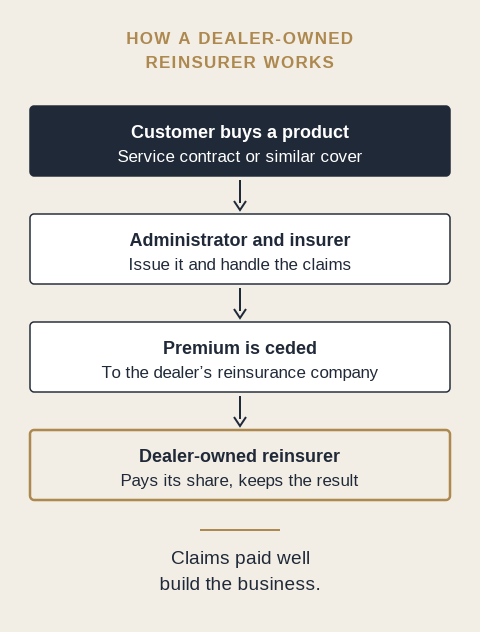
The customer buys a product at the dealership — typically a vehicle service contract. The Federal Trade Commission’s consumer guidance on auto service contracts explains what customers are buying.
The administrator and insurer issue the contract, manage it, and handle claims. A licensed insurer stands behind the obligation.
The dealer’s reinsurance company takes on part of the risk through a reinsurance agreement, receives the corresponding premium, and pays its share of claims.
The dealer owns the reinsurer and, over time, keeps the underwriting result if the products perform well.
The products a dealer reinsurer typically covers
Vehicle service contracts are the most familiar product in these programs: the promise to pay for covered repairs after the manufacturer’s warranty ends. Depending on the dealership and the program, a dealer reinsurer may also participate in other products sold at the point of sale, such as coverage that pays the difference between a loan balance and a vehicle’s value after a total loss, or protection for tires, wheels, and similar items. Each product has its own claims pattern, its own regulation, and its own administrator requirements.
Those differences matter for pricing and reserving. A service contract may produce claims for years after it is sold, as the vehicle ages and parts wear. Other products may produce fewer, larger claims. A sound program prices each product separately from its own experience and holds reserves that match how long its claims take to arrive. A program that lumps everything together, or that cannot show claims history by product, is harder to run as genuine insurance.
What makes it genuine insurance
A dealer-owned reinsurance company has to work as insurance, not as a way to move money. The essentials are:
- Real risk. Claims on the products are uncertain and genuinely borne by the reinsurer, not guaranteed back by another party.
- Honest pricing. Product rates are set from claims experience, so the reinsurer’s premium reflects the risk it takes on.
- Fair claims handling. Claims are decided by the contract terms through the administrator, not by the dealer’s interest in a better result.
- Adequate capital and reserves. The reinsurer holds enough to pay claims that arrive years after a contract was sold.
- Real governance. Board decisions, audited financial statements, actuarial review, and regulatory filings, done every year.
Our explainer on what a captive insurance company is covers the insurance principles — risk shifting and risk distribution — that sit underneath all of this.
Where the 831(b) election comes in
Some dealer reinsurance companies make the §831(b) election, which changes how the reinsurer itself is taxed. The election is available only to companies that qualify as insurance companies and meet the statute’s requirements, including the premium limit for the tax year — $2.9 million for the 2026 tax year (Rev. Proc. 2025-32, indexed annually). You can read the statute itself, 26 U.S.C. §831, to see that it applies only to insurance companies.
The election follows the insurance; it never substitutes for it. A dealer reinsurer that would not make sense without the tax treatment is not one to build. Disclosure rules for these transactions have been actively litigated and have changed in recent years, so current counsel should confirm your obligations for each tax year. Our page on micro-captives and the 831(b) election explains how the election works, and our post on captive insurance and taxes covers what is real and what is hype. How any of it applies to your company is a question for your own tax counsel. This is general information, not legal or tax advice — see our disclosures.
Customer trust is the business
A dealer reinsurance company has an unusual feature: its results depend partly on how the dealership treats its own customers. A service department that pushes marginal claims through, or an administrator that denies valid ones, both damage the program — the first by inflating losses, the second by eroding the customer relationship that keeps people buying cars and service from you.
The strongest programs separate the claims decision from the dealer’s financial interest, sell products that genuinely fit customers, and explain coverage clearly at the time of sale. Products customers value, sold honestly and paid fairly, are what make the reinsurance results worth owning. A program built on that principle tends to produce steadier claims experience, because customers buy coverage they understand and use it as intended.
What goes wrong in a poorly built program
Most of the problems with dealer reinsurance programs come from treating the reinsurer as a place to accumulate money rather than an insurer with obligations. The warning signs are familiar:
- Rates set to produce a result rather than priced from claims. If product prices were chosen to move a target amount of premium into the reinsurer, the risk transfer is suspect.
- Reserves that are thin for the claims still to come. Service contracts can produce claims long after the sale; a reinsurer that distributes its surplus before those claims are known is taking a gamble with its policyholders’ protection.
- Money moving back to the owner too quickly. Funds that leave the reinsurer soon after they arrive, or that are lent back to the dealership, look less like insurance every year. Our post on how a captive manages its cash explains how an insurer should hold its funds.
- Claims influenced by the reinsurance result. When the people deciding claims have a stake in denying them, customers and regulators both notice.
- No independent review. Pricing, reserves, and financial statements should be checked by independent actuaries and auditors.
A program built the right way avoids all of these. One built around the tax result tends to have several of them at once.
Who fits
A dealership tends to fit when it sells enough of these products to produce credible claims experience, has stable ownership and long-term plans, works with an established administrator and insurer, and is prepared to run the reinsurer as a real insurance company every year. A small or new dealership, or one that sells few products, may not have the volume to justify the costs. Our post on how much it costs to start a captive lays out the cost categories, and our post on a captive’s annual requirements covers the recurring work.
When you sell the dealership
Dealerships change hands, and contracts sold before a sale can produce claims for years afterward. The reinsurer may run off those obligations, be transferred to the buyer, or have its liabilities moved to another insurer. The decision belongs early in the deal, not at closing. Our post on captive exit strategy explains the routes out.
Questions to ask before forming one
- Who administers the products and handles claims, and how are claims decided?
- How are product rates set, and who reviews them independently?
- How much capital and reserve will the reinsurer need, and for how long?
- What happens to existing obligations if the dealership is sold?
- Who is your own tax counsel? Our post on hiring a micro-captive attorney explains why that person should answer only to you.
Where to start
A feasibility study looks at your product volume, claims experience, administrator relationship, and long-term plans, and can conclude that a reinsurance company does not fit your dealership yet. If it does, the study is the foundation for building it correctly.
Frequently asked questions
What is a dealer-owned reinsurance company?
It is a reinsurance company owned by a dealer or dealer principal that reinsures the risk on products the dealership sells, such as vehicle service contracts. An administrator and an insurer issue the product and handle claims, and part of the premium and risk is ceded to the dealer’s reinsurer. If claims run lower than expected, the dealer’s company keeps the underwriting result; if they run higher, it pays.
Can a dealer reinsurance company make the 831(b) election?
Some do, where the company qualifies as an insurance company and meets the statute’s requirements, including the premium limit for the tax year — $2.9 million for the 2026 tax year (Rev. Proc. 2025-32, indexed annually). Whether a particular structure qualifies, and how it should be reported, is a question for your own tax counsel. This is general information, not legal or tax advice — see our disclosures.
Does the dealer handle claims on the service contracts?
Usually not directly. An administrator handles the contracts and claims, and the dealership’s service department may perform covered repairs. That separation matters: claims should be decided by the contract terms, not by the dealer’s interest in its reinsurance results. Customers whose valid claims are denied are customers who do not come back.
What happens to the reinsurance company if I sell the dealership?
The contracts already sold remain in force, and claims on them can come in for years. The reinsurance company may run off those obligations, be transferred as part of the deal, or have its liabilities moved to another insurer. Treat it as part of the transaction from the start, with your counsel and the buyer’s.
Feasibility Study
See whether a captive fits your business.
Every engagement starts with a feasibility study — an honest read on whether a captive is right for you before anything is formed.