
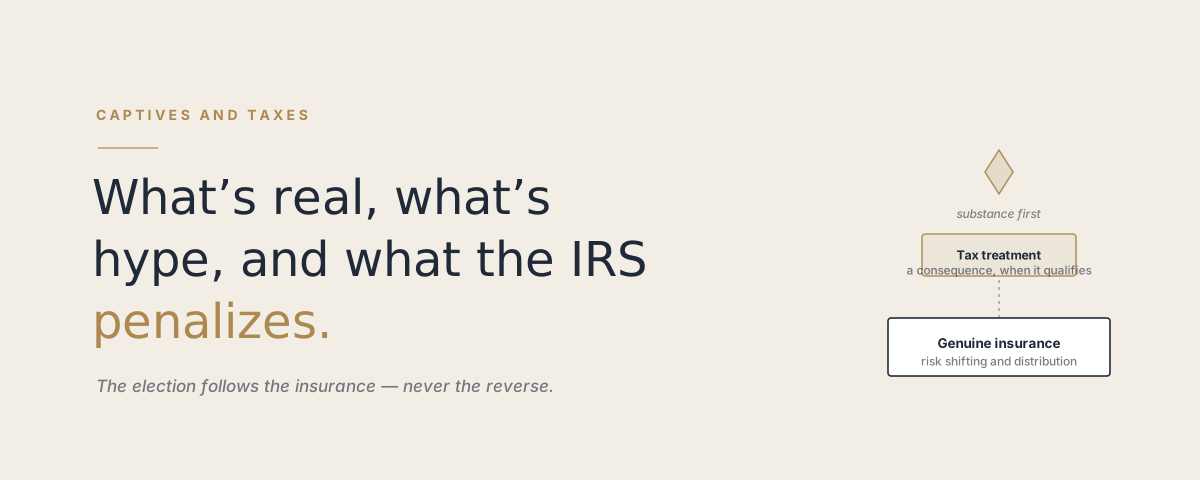
Captive Insurance and Taxes: What’s Real, What’s Hype, and What the IRS Penalizes
If you found this piece by searching some version of “captive insurance tax savings,” you are exactly the reader this is written for — and the first honest thing to say is that the search itself is where people get into trouble. Captive insurance does have real tax consequences. It also attracts more hype, and more outright sales nonsense, than almost any tool in the small-business world, because the tax angle is easy to oversell and hard for a busy owner to check. The promoters the IRS worries about make their living in exactly that gap.
So this piece does something a sales pitch never will: it separates the three things that usually get blurred together. What’s real — the legitimate tax mechanics, stated plainly and conditionally. What’s hype — the pitches that sound like free money and aren’t. And what the IRS actually penalizes — drawn straight from its own enforcement record and the leading court cases. Read in that order, the whole subject gets simpler, because the same principle runs underneath all three.
That principle is the one to settle before anything else: a captive is real insurance first, and any tax treatment is a consequence of that — never the purpose. Get that order right and the tax story is durable. Get it backward and you have built the exact thing the IRS is hunting. This is general educational information, not legal or tax advice — outcomes depend on your specific facts, and any tax position should be reviewed with your own qualified advisors. See our disclosures.
What’s real
Let’s give the legitimate mechanics their due, because they are real and there’s no need to be coy about them — as long as every one is stated in the right order, tied to the insurance requirement that makes it available.
Start with what a captive is. It’s an insurance company you own. Instead of paying an outside carrier for risks you understand better than they do, your business forms its own licensed insurer, writes real policies, sets premiums for the actual risk, holds reserves, and pays its own claims. (For the ground-level version of that idea, see our plain-English explainer on what a captive is.) From there, three tax consequences may follow — each conditional on the insurance being genuine.
Premiums for genuine insurance are generally deductible. When a business pays a premium for real coverage of a real risk, that premium is generally an ordinary, deductible business expense — the same as a premium paid to any commercial carrier. The operative words are genuine and real: the deduction follows from the arrangement actually being insurance, with risk that genuinely shifts and distributes. It is not a deduction you manufacture by labeling a transfer of cash a “premium.”
Underwriting profit may be retained in a company you own. A commercial carrier that collects more in premium than it pays in claims keeps the difference. When your business insures its own risk through a captive, that underwriting profit — premiums minus claims minus expenses — stays in an insurance company you own rather than leaving with an outside carrier, where it may build the captive’s balance sheet over time. Whether any of it ever comes back to you is a separate, regulator-gated question that depends on actual losses and your domicile’s approval; it is never a guaranteed yearly check.
A qualifying small insurer may elect Section 831(b). This is the election the hype is usually built around, so it’s worth stating precisely. Section 831(b) of the Internal Revenue Code lets a qualifying small non-life insurance company elect to be taxed only on its investment income rather than on its underwriting income, provided its net written premiums (or direct written premiums, whichever is greater) stay at or below a statutory ceiling — $2.9 million for the 2026 tax year (Rev. Proc. 2025-32, indexed annually) — and it satisfies the diversification requirements added by the Protecting Americans from Tax Hikes (PATH) Act of 2015.
Read that sequence carefully, because the order is the entire point. The 831(b) election is available to a company that already qualifies as an insurance company. It is not a structure you build to reach a tax result; it is a tax treatment that becomes available once a captive operates as genuine insurance. The election follows the insurance — never the reverse. That single sentence is the difference between the “real” column and the “penalized” one, and it’s worth keeping in front of you for the rest of this piece. Again: general information, not legal or tax advice — every one of these consequences depends on your facts and proper structure, and should be reviewed with your own advisors. See our disclosures.
What’s hype — and what the IRS penalizes
Here is where the same mechanics get bent into something else. The hype doesn’t invent new tax rules; it takes the real ones above and quietly reverses the order — making the tax result the purpose and treating the insurance as a formality to be satisfied on paper. That reversal is the whole problem, and it’s exactly what the IRS penalizes.
A few pitches should make you close the brochure:
- “Guaranteed savings,” or tax as the headline. Any presentation that leads with a deduction, a dollar figure of “savings,” or a promise of a tax outcome has the order backward before the insurance is even discussed. There are no guaranteed tax outcomes here; there are conditional consequences of real insurance. A guarantee is a sign someone is selling the tax result, not the coverage.
- Premiums set to the ceiling rather than the risk. When the proposed premium reaches up toward the §831(b) limit instead of being set down to what the risk actually costs — priced by an independent actuary — the arrangement is being engineered from a tax number. The courts have seen this exact move and named it.
- Implausible or duplicative coverage. Insuring risks no one would seriously insure against, or simply re-buying coverage the business already carries commercially, is a tell that the “policies” exist to move money, not to finance a genuine exposure.
- Circular flows. Money that leaves the business as “premium” and circles back to related parties — often through a “pool” or “reinsurance” arrangement that exists mainly on paper — isn’t risk distribution. It’s a loop, and the courts have treated it as one.
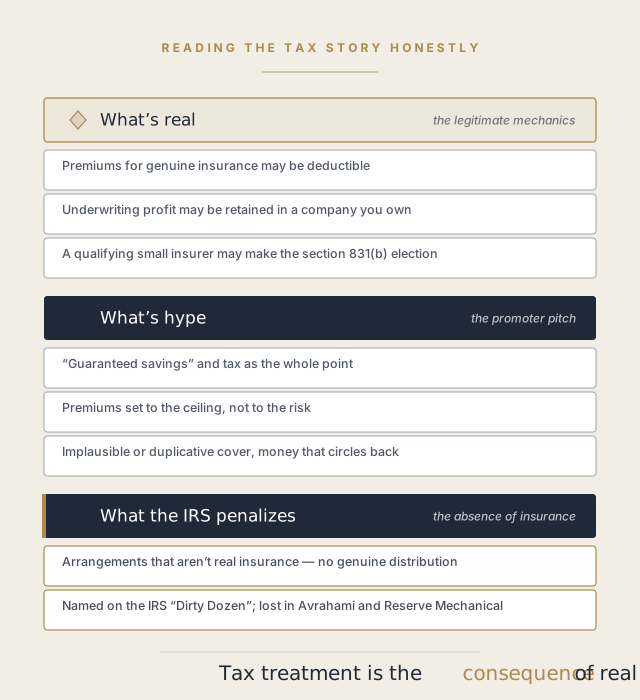
None of that is a guess about IRS intent; it’s the IRS’s own description. The agency has named abusive micro-captive insurance arrangements on its annual “Dirty Dozen” list of tax scams — first in 2015, and still on the list as recently as 2024. In its descriptions, the arrangements it pursues share a profile: they lack the attributes of genuine insurance — implausible risks, coverage that duplicates what the business already carries, and excessive premiums that aren’t set at arm’s length. The IRS has also backed that posture with enforcement, standing up dedicated micro-captive examination teams and running time-limited settlement initiatives for taxpayers under exam.
The leading court cases read like a field guide to the same failure. In Avrahami v. Commissioner, 149 T.C. 144 (2017) — the first major Tax Court loss for a micro-captive — the arrangement was held not to be insurance: it lacked risk distribution, the premiums jumped sharply once the captive appeared and tracked the §831(b) ceiling rather than the risk, the pricing wasn’t actuarially supported, and a reinsurance “pool” functioned as a circular flow of funds rather than a bona fide insurer. In Reserve Mechanical Corp. v. Commissioner, T.C. Memo. 2018-86 (affirmed by the Tenth Circuit at 34 F.4th 881 (2022)), the captive failed again on two independent grounds — inadequate risk distribution and policies that weren’t insurance in the commonly accepted sense — with a pool the court again found to be a circular flow and premiums that weren’t arm’s length.
Notice what the IRS won on. Not “captives are bad.” It won because those specific arrangements weren’t real insurance — premiums reverse-engineered from a tax number, no genuine distribution, money circling back to related parties, and tax as the actual point of the exercise. (For the fuller treatment of which arrangements the IRS targets and why, see are micro-captives legal? what the IRS actually targets, and for the deeper regulatory and case-law detail, our compliance and legitimacy page.)
One case in this area is routinely overstated, so it’s worth a clarification before anyone uses it as cover. CIC Services, LLC v. IRS, 593 U.S. 209 (2021), was a unanimous Supreme Court ruling — but a purely procedural one. It held that the Anti-Injunction Act didn’t bar taxpayers from challenging an IRS reporting requirement in court before being penalized. It was not a ruling that micro-captives are legitimate, and it should never be cited as the Supreme Court blessing captives or their tax treatment.
A related point you should not freeze from any article: the disclosure rules are their own moving piece. The IRS finalized disclosure regulations in 2025, but in 2026 a federal court vacated the listed-transaction designation while leaving the transaction-of-interest designation in place — and both sides have appealed. So the precise current reporting obligation for any given captive is genuinely in flux and changing; the right move is to confirm specifics with current tax counsel for the relevant tax year rather than rely on anything evergreen. This is general information, not legal or tax advice — see our disclosures.
The reframe: the election follows the insurance
Put the three parts back together and the lesson is a single sentence: tax treatment is the consequence of real insurance, never the purpose of it. Every legitimate mechanic in the “real” section is available because the arrangement is genuine insurance — risk that actually shifts off your business, distributed across enough independent exposures that the law of large numbers can work, priced at arm’s length, run like the insurer it is. Every penalized arrangement is the same mechanics with that foundation hollowed out and the tax result moved to the front.
So the useful question is not “how much will a captive save me?” It’s “do I have a genuine risk worth financing through an insurer I own?” If the answer is yes, the tax consequences may follow as a matter of course, conditional on your facts — and you won’t need anyone to promise you a number, because you’ll be standing on the insurance, not on the deduction. If the answer is no, no election rescues it, and the most valuable thing anyone can tell you is that a captive isn’t your tool. (For the order the work actually happens in, see how to start an 831(b) captive; for the single-owner structure specifically, micro-captives and §831(b).)
That’s also why Tessera runs one front door rather than a sales funnel: the feasibility study. It tests the insurance case honestly, before anything is formed, and it’s willing to reach a negative conclusion. It is not a tax-savings calculator, and it won’t hand you a guaranteed number — because the honest version of this subject doesn’t have one. What it gives you is a clear answer to the only question that matters: whether a genuine captive fits your risk, with the tax treatment left where it belongs, as a consequence of getting the insurance right.
For the regulatory and tax position in full — and the reminder, one more time, that none of this is legal or tax advice and should be confirmed with your own qualified advisors — see our disclosures.
Frequently asked questions
Does a captive lower my taxes?
That is the wrong first question, and answering it carefully is what protects you. A captive is a way to finance your own risk through an insurance company you own. When — and only when — it operates as genuine insurance, certain tax consequences may follow: premiums paid for real coverage are generally deductible business expenses, and a qualifying small insurer may elect under Section 831(b) to be taxed only on its investment income. But those are consequences of real insurance, not the reason to build one, and they depend entirely on your facts and proper structure. A captive built to chase a deduction is the exact pattern the IRS penalizes. This is general information, not legal or tax advice — see our disclosures.
What is the Section 831(b) election, in plain terms?
Section 831(b) of the Internal Revenue Code lets a qualifying small non-life insurance company elect to be taxed only on its investment income rather than on its underwriting income, provided its premiums stay at or below a statutory ceiling — $2.9 million for the 2026 tax year (Rev. Proc. 2025-32, indexed annually). The order is the whole point: the election is available to a company that already qualifies as an insurance company. It is not a structure you build to reach a tax result; it is a tax treatment that becomes available once a captive operates as genuine insurance. The election follows the insurance, never the reverse. This is general information, not legal or tax advice.
What kind of captive does the IRS actually penalize?
The IRS targets arrangements that wear the insurance label without doing the insurance work — not captives as a category. In its own descriptions, the abusive ones lack the attributes of genuine insurance: implausible risks that don’t match a real business need, coverage that merely duplicates policies the business already carries, and excessive premiums that aren’t set at arm’s length. That maps almost exactly onto why the leading Tax Court cases were lost — inadequate risk distribution, premiums reaching for the Section 831(b) ceiling rather than pricing the risk, and pooling arrangements the courts found were circular flows. The IRS has named abusive micro-captives on its annual “Dirty Dozen” list of tax scams since 2015. The common thread is the absence of real insurance substance.
Is a captive a “tax shelter” or a “loophole”?
No — and using those words is the fastest route to the kind of arrangement the IRS pursues. A captive is a risk-financing tool. Any tax treatment is a consequence of operating as genuine insurance: real risk shifting, real risk distribution, arm’s-length pricing, an entity run like the insurer it is. When a structure is built backward from a desired deduction rather than from a real risk to finance, it fails — which is precisely what happened in Avrahami v. Commissioner and Reserve Mechanical Corp. v. Commissioner. The honest framing is the only durable one: lead with the risk, and treat tax as a downstream consequence. This is general information, not legal or tax advice — see our disclosures.
Are the disclosure rules settled, so I know what to report?
No — they are actively litigated and changing, so the honest answer is to confirm specifics with current counsel rather than rely on an evergreen article. The IRS finalized disclosure regulations in 2025, but in 2026 a federal court vacated the listed-transaction designation while leaving the transaction-of-interest designation in place, and both sides have appealed. Because the precise current obligations are a moving target, verify any reporting requirement for the relevant tax year with qualified tax counsel. This is general information, not legal or tax advice — see our disclosures.
Feasibility Study
See whether a captive fits your business.
Every engagement starts with a feasibility study — an honest read on whether a captive is right for you before anything is formed.