
Can a Captive Insure Your Business’s Cyber Risk?
Yes, in part. A captive can insure a business’s cyber risk by funding the retention beneath a commercial cyber policy and by covering specific gaps the commercial market excludes or sublimits — but the severe breach should stay transferred to commercial insurers and reinsurers, and the business’s own security controls come first. For most businesses, a captive works alongside cyber insurance, not instead of it.
Cyber has become one of the risks business owners worry about most. Ransomware, business email compromise, data breaches, and system outages can halt operations and generate costs from forensic work, legal advice, customer notification, and lost income. Commercial cyber insurance has grown quickly, but it has also tightened, with higher retentions, more exclusions, and stricter underwriting. That leaves gaps, and owners with captives naturally ask whether their captive can fill them. This piece explains where a captive fits, where it does not, and how to approach the decision.
Where a captive fits in cyber risk
The useful way to think about cyber is in layers, the same way a captive approaches any risk.
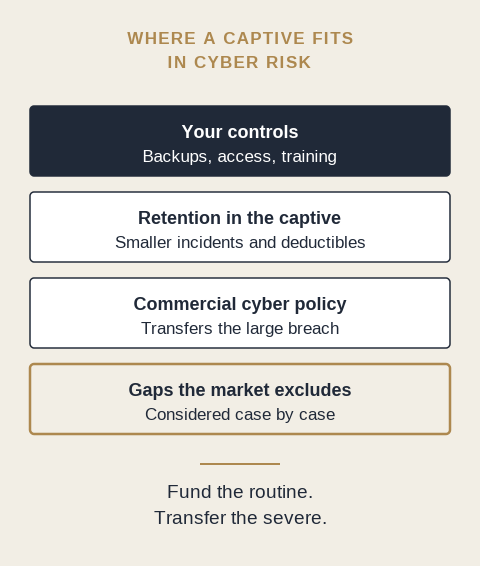
Your controls. No insurance structure replaces good security. Backups, access management, multifactor authentication, patching, and staff training determine how often incidents happen and how bad they get.
The retention. Commercial cyber policies increasingly carry meaningful deductibles or retentions. A captive can fund that layer from premium the business pays it, so smaller incidents are financed in a planned way rather than absorbed by the operating budget. Our post on deductible reimbursement explains the mechanics.
The commercial policy. The large breach — the event that can produce costs many times a year’s premium — belongs with insurers that can spread it across a much larger pool and that provide breach response services in a crisis.
The gaps. Commercial policies exclude or sublimit some exposures. A captive can consider those case by case, where the risk is real and can be priced.
Why the severe layer belongs elsewhere
Cyber has two features that make the catastrophic layer difficult for a small insurer. First, losses can be very large relative to the size of a business. Second, cyber events can hit many businesses at once, through a shared software vendor or a widespread attack, which undermines the diversification insurance depends on.
A captive that holds a large share of its owner’s cyber risk is concentrating exactly the exposure it is least able to absorb. That is why sound designs keep the captive in the predictable layer and buy commercial cyber coverage and reinsurance for the severe end. The NAIC’s guide to cyber insurance explains what commercial cyber policies typically cover.
Controls come first
Commercial cyber underwriters increasingly ask about specific controls before offering coverage, and for good reason: they make a large difference to how often incidents occur and how costly they become. A business funding its own cyber layer has even more reason to invest in them. The Cybersecurity and Infrastructure Security Agency offers free guidance for small and medium businesses on the basics.
The habits that tend to matter most include multifactor authentication on email and remote access, tested and isolated backups, prompt patching, limiting administrative access, training staff to recognize phishing and payment fraud, and having an incident response plan that people have actually practiced. In a captive, each of those investments lowers the losses that fall on the owner’s own insurer, and that is a better return than most security budgets can show.
What a cyber coverage in a captive must look like
A cyber coverage written by a captive has to meet the same tests as any other captive coverage:
- It matches a real exposure. The business genuinely faces the risk, and the coverage is written for how that risk would actually occur.
- It is priced from evidence. An independent actuary sets the premium from incident history, industry data, and the business’s controls — not from a target premium.
- It pays claims. When a covered incident happens, the business files a claim and the captive pays it under the policy terms. Our post on how claims work in a micro-captive explains why that matters.
- It does not duplicate other coverage. Paying twice for the same risk is a sign the coverage exists for reasons other than insurance.
Coverage written for implausible events, or priced to reach a number, is one of the patterns that draws scrutiny. Our post on what the IRS targets in micro-captives explains why.
Which businesses fit
A captive’s cyber layer tends to make sense for businesses that already have a captive or are forming one for other reasons, carry meaningful retentions on their commercial cyber policy, have sound controls and incident history that an actuary can use, and see real gaps in the commercial coverage available to them. A business that has not yet invested in basic controls is usually better served doing that first; no insurance structure makes up for weak security.
Data matters here more than in many lines. Cyber is a young line of insurance, and a single business may have little incident history of its own. An actuary will combine what the business has with broader industry information and the quality of its controls. A business that tracks even minor incidents — phishing attempts that got through, outages, near misses — gives the actuary much more to work with than one that records only major events.
Businesses in the same industry sometimes share cyber retentions through a group captive, while a single business with distinctive exposures might use a single-owner micro-captive. Either way, the captive complements rather than replaces commercial cyber insurance.
Business interruption from cyber events
One of the most damaging cyber outcomes is lost income while systems are down. Commercial cyber policies often cover some of that, subject to waiting periods and sublimits. A captive may help with the portion the commercial policy leaves uncovered, if it is priced from the business’s actual dependence on its systems. Our post on non-damage business interruption explores the wider category of income losses that occur without physical damage.
How the layers work together after an incident
It helps to walk through what happens when something goes wrong. Suppose a business suffers a ransomware attack. Its incident response plan kicks in: systems are isolated, backups are checked, and the commercial cyber insurer is notified, often bringing in its panel of forensic investigators and legal counsel. The commercial policy responds to covered costs above its retention. The business pays the retention, and if its captive writes a cyber retention coverage, it submits a claim to the captive for reimbursement.
If the attack interrupts operations, the commercial policy may cover lost income after its waiting period and up to its sublimit. Any defined gap the captive covers responds under its own policy terms. Throughout, each policy pays according to its wording, and the claims are documented so that the captive’s payments are clearly tied to real losses.
The value of this structure is clarity. Each layer knows what it covers, the captive’s role is defined in advance, and the business is not left absorbing an unplanned share of the loss.
Questions to ask before adding cyber to a captive
- What does our commercial cyber policy actually cover? Read the retention, the sublimits, and the exclusions before deciding what the captive should do.
- What incidents have we had, and what did they cost? The actuary needs history, even if it is limited.
- Would the captive survive a bad year? If a single severe incident could exhaust it, the captive is holding too much.
- Are we meeting the controls insurers expect? Investing in controls usually reduces risk more than any financing structure.
- Who prices the coverage? It should be an independent actuary, working from evidence.
Tax is not the reason
Where tax treatment applies, it follows from genuine insurance, never the other way around. A cyber coverage added to a captive mainly to increase premium is exactly the kind of coverage that does not hold up. This is general information, not legal or tax advice — see our disclosures.
Where to start
A feasibility study looks at your cyber controls, incident history, current commercial coverage and its gaps, and whether a captive layer makes sense at all. It can conclude that improving your controls and your commercial policy is the better move. If you are new to captives, start with what a captive insurance company is.
Frequently asked questions
Should a captive replace my commercial cyber insurance?
Generally no. A serious breach can produce costs far larger than a small or mid-size captive should hold, and commercial cyber policies often include breach response services — forensic investigators, legal counsel, notification vendors — that are valuable in a crisis. Most businesses use a captive alongside a commercial policy, funding the retention and specific gaps rather than replacing the transfer.
What cyber costs can a captive cover?
Depending on how the coverage is written, a captive may fund the deductible or retention on a commercial cyber policy, certain business interruption from a system outage, or gaps the commercial policy excludes or sublimits. Each coverage must match a real exposure and be priced by an independent actuary. Coverage for risks the business cannot realistically suffer, or priced to reach a premium target, does not hold up.
Is cyber risk too unpredictable for a captive?
The severe end can be. Cyber losses can be large, can hit many businesses at once, and depend on fast-changing threats, which makes the catastrophic layer hard to price for a small insurer. The more frequent, smaller incidents are more manageable. That is why a captive usually funds the predictable layer and leaves the catastrophic layer to the commercial and reinsurance markets.
Does putting cyber in a captive change my security requirements?
It should raise your own standards, because losses that fall in the captive are your own money. Commercial cyber insurers increasingly require controls such as multifactor authentication and tested backups before they will offer coverage. A business funding its own cyber layer has every reason to meet or exceed those standards.
Feasibility Study
See whether a captive fits your business.
Every engagement starts with a feasibility study — an honest read on whether a captive is right for you before anything is formed.