
Can a Captive Cover Product Recall and Warranty Risk?
Yes — a captive can cover product recall expense and warranty claims, two risks the commercial market often limits or excludes, as long as the coverage is written for the business’s real exposure and priced from its own claims and quality data. Recall coverage pays the cost of notifying customers and retrieving and replacing product; warranty coverage pays the cost of repairs promised to customers. Injuries caused by a defective product stay with the liability insurance program.
For businesses that make, import, or sell products, two risks fall between the cracks of a standard insurance program. A recall can be expensive even when nobody is hurt, and warranty obligations generate a steady stream of repair costs. Standard liability policies are not built for either. A captive is one way to finance them deliberately. This piece explains what each risk involves, where a captive fits, how the coverage is priced, and who it suits.
Two risks the market often limits
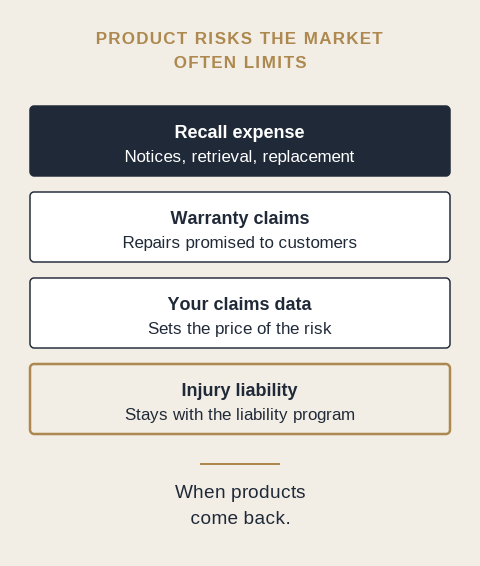
Recall expense. When a product has to be withdrawn, the business pays to notify customers and distributors, retrieve or destroy affected units, replace or repair them, and manage the disruption. Product liability policies generally pay for injury and damage the product causes, not the cost of pulling it back.
Warranty claims. A business that promises to repair or replace products that fail within a stated period carries a predictable, ongoing cost. Warranty claims are usually frequent and modest, which makes them easier to price than catastrophic risks.
Recall: obligations and exposure
Recall decisions are not always the business’s alone. Manufacturers and sellers of consumer products have reporting obligations; the U.S. Consumer Product Safety Commission explains the duty to report potentially hazardous products. Vehicles and vehicle equipment fall under the National Highway Traffic Safety Administration, which maintains resources on investigations and recalls for manufacturers.
The cost of a recall depends heavily on how much product is in the field and how quickly it can be identified. A business with precise lot and serial tracking can target a recall narrowly; one without it may have to pull far more product than was ever affected. That is why traceability is as important to the price of recall coverage as the product itself.
What a recall actually involves
A recall is rarely a single expense. It is a project that touches nearly every part of the business, and each part has a cost.
- Notification. Customers, distributors, and retailers must be told what is affected and what to do, sometimes through several channels at once.
- Retrieval and disposal. Affected product has to be collected, shipped back, stored, and destroyed or reworked.
- Replacement or repair. Customers usually receive a replacement, a repair, or a refund, each with its own logistics.
- Investigation. The business needs to find the root cause, often with outside engineers or laboratories.
- Business disruption. Production may pause, inventory may be quarantined, and staff time is consumed for weeks.
Some of those costs are easy to estimate from the business’s own operations; others depend on how widely the product travelled and how quickly customers respond. A recall policy should state which of these costs it pays and which it leaves out, so the owner knows exactly what the captive will reimburse. Lost future sales and damage to reputation are usually the hardest to insure and are often excluded.
Warranty: predictable and priceable
Warranty claims behave differently. They arrive steadily as products age, their cost can be tracked by product line and model, and their history is usually rich. That makes warranty risk one of the more straightforward risks to price in a captive.
How warranties are regulated depends on the product and the state, and some warranty programs involve third-party administrators and separate rules. The captive’s role is to insure the business’s cost of honoring its obligations, not to replace the administration of the program. Counsel should review the structure before it is used.
Warranty programs also change over time. A new product line has no claims history of its own, a change of supplier can alter failure rates, and an extended warranty offered to win sales adds exposure that did not exist before. The actuary should revisit warranty pricing at each renewal, using the latest claims, so the premium keeps pace with what the business is actually promising its customers.
How the coverage is priced
An independent actuary prices recall and warranty coverage from evidence:
- For recall: product volumes and distribution, traceability, quality control results, any past recall or withdrawal events, and the estimated cost of notification, retrieval, and replacement. Because recalls are infrequent for any one business, the actuary will combine the business’s own data with broader information about the product category.
- For warranty: claims history by product line and model, failure patterns over time, repair costs, and changes in product design or suppliers.
The policy itself also needs careful wording. A recall policy should define what triggers coverage — a regulator’s order, the business’s own decision, or a confirmed defect — and how costs are documented. A warranty policy should match the warranty the business actually offers customers, no broader and no narrower. Clear definitions make claims easier to handle and the coverage easier to defend.
Coverage priced from that evidence is genuine insurance. Coverage written for events the business could never realistically face, or priced to reach a premium target, is the kind that draws scrutiny. Our post on what the IRS targets in micro-captives explains why.
Quality control is the economics
In a captive, the business keeps the results of its own quality program. Fewer defects mean fewer recalls and fewer warranty claims. Better traceability means smaller, more targeted recalls. Supplier qualification keeps defective components out of finished products. A captive makes the payoff of that discipline visible, because the savings flow to the owner rather than to an outside carrier.
It also sharpens attention. When recall and warranty costs are the business’s own money, root-cause analysis of failures becomes a priority rather than an afterthought.
That discipline also shows up in the premium. An actuary pricing recall coverage will look closely at how the business tests incoming components, inspects finished goods, and tracks lots through distribution. Documented controls support a lower expected loss; gaps in them support a higher one.
Who it suits
Recall and warranty coverage in a captive tends to suit manufacturers, importers, and distributors with:
- Meaningful exposure that the commercial market limits or prices poorly.
- Good data, especially warranty claims history and traceability.
- A strong quality program that keeps the risk manageable.
- The scale to justify a captive’s fixed costs, often alongside other coverages.
Our post on captive insurance for manufacturers discusses how recall coverage fits alongside product liability retentions. Dealers that sell service contracts face a related but distinct risk; our post on dealer-owned reinsurance companies covers that structure.
Businesses that sell mainly to other businesses face a variation: a component supplier’s defect can force its customer into a recall, and the supply contract may make the supplier responsible for the customer’s recall costs. Those contractual obligations are worth reviewing with counsel, because they can be a larger exposure than the supplier’s own recall.
Single-owner or group
A business with distinctive products and enough scale may write recall and warranty coverage through its own micro-captive. Businesses with similar products sometimes share recall risk through a group captive, which helps with the infrequency problem: a group sees more events than any one member. The right structure depends on the products and the members.
In a group, members typically agree on minimum standards for quality and traceability, because each member’s recall affects the others. That shared discipline can be one of the group’s most useful features, but it also means members must be comfortable with their peers’ practices before they join.
Questions to ask before covering these risks
- Does our commercial program already cover any recall or warranty costs, and on what terms?
- Can we identify affected product quickly and precisely?
- What would a realistic recall cost us, and how often might one happen?
- Do we have warranty claims history by product line?
- Who prices the coverage, and can we see the actuarial work?
Tax treatment is not the reason to add these coverages. Where tax treatment applies, it follows from genuine insurance. This is general information, not legal or tax advice — see our disclosures.
Where to start
A feasibility study looks at your products, your traceability and quality programs, your warranty history, and your current coverage, and recommends whether recall or warranty coverage belongs in a captive. It can conclude that improving your commercial program is the better move.
Frequently asked questions
Why don’t standard liability policies cover recalls?
Product liability policies are designed to pay for injury and damage caused by a product, not the cost of withdrawing the product itself. Many standard policies exclude the expense of recalling, retrieving, or replacing products. Recall coverage is available in the commercial market, but it can be limited or costly, which is why some businesses finance it through a captive.
Can a captive pay warranty claims to my customers?
A captive can insure the business’s cost of honoring its warranty obligations, when the coverage is written for that purpose and priced from the business’s warranty claims history. How warranties are regulated depends on the product and the state, and some warranty programs involve administrators and separate rules. The structure should be reviewed by counsel before it is used.
What data does a captive need to price recall risk?
Product volumes and distribution, traceability capabilities, quality control results, past recall or withdrawal events, and the likely cost of notifying customers, retrieving product, and replacing or repairing it. Because recalls are infrequent for any one business, the actuary will combine the business’s own data with broader information about the product category.
Does recall coverage in a captive replace my product liability insurance?
No. Bodily injury and property damage caused by a defective product stay with the liability insurance program, which is built for those claims. Recall coverage in a captive addresses the separate cost of pulling and replacing product. The two work side by side.
Feasibility Study
See whether a captive fits your business.
Every engagement starts with a feasibility study — an honest read on whether a captive is right for you before anything is formed.