

Captive vs. Risk Retention Group: What’s the Difference?
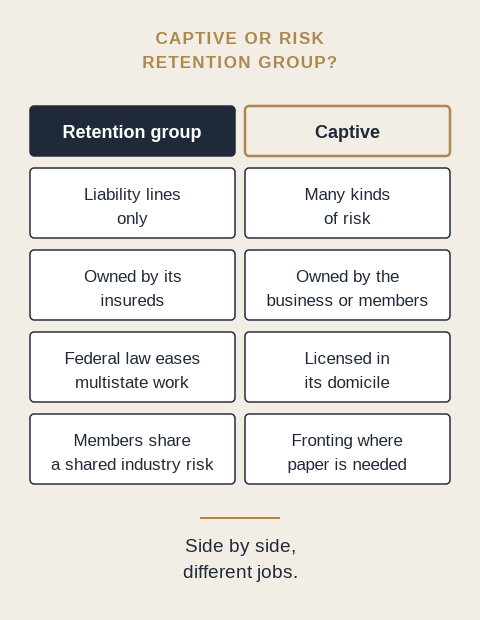
A risk retention group is a liability insurer owned by its insureds — businesses in the same industry with similar liability risks — that federal law allows to operate in many states after being licensed in just one. A captive is a broader category: an insurer owned by the business or businesses it insures, licensed in its domicile, and generally able to insure many kinds of risk, including property, workers’ compensation, and enterprise risks a risk retention group cannot touch. The two overlap, since many risk retention groups are formed under captive laws, but they solve different problems.
Owners researching alternative risk financing often run into both terms and assume they mean the same thing. They do not. Choosing the wrong structure can mean an insurer that cannot write the coverage you need, or a structure far more complicated than your problem requires. This piece explains each structure, how they compare, and how to tell which, if either, fits your business.
The short version: if your main problem is liability insurance for a business that operates in many states, and peers in your industry share that problem, look at risk retention groups. If your problem is broader — workers’ compensation, property, deductibles, or risks the commercial market will not cover — look at captives.
The comparison at a glance
What a risk retention group is
Risk retention groups exist because of federal law. The Liability Risk Retention Act, codified at 15 U.S.C. §3901 and following sections, defines a risk retention group as an insurer whose primary activity is assuming the liability exposure of its members, and whose members are its owners. Once a risk retention group is chartered and licensed in one state, federal law limits how much other states can regulate it, which lets it insure members in many states without obtaining a full license in each one.
The NAIC’s overview of risk retention groups describes how they are regulated: primarily by their chartering state, with other states retaining certain limited powers. Risk retention groups have been used widely by healthcare providers, contractors, and other industries where liability insurance has at times been hard to find or afford.
A related structure, the risk purchasing group, uses the same federal law to let businesses with similar liability exposures buy insurance together from a commercial insurer. A purchasing group does not take on risk itself; it negotiates coverage as a group. It is worth knowing the difference, because the names are similar and the commitments are not.
What a captive is
A captive is an insurance company owned by the business or businesses whose risks it insures. It is licensed by the regulator of its domicile and operates under that domicile’s captive law. A captive can be owned by a single business, as with a micro-captive, or by many businesses, as with a group captive.
Captives can generally insure a wide range of risks — liability, property, workers’ compensation, deductibles, business interruption, and other enterprise risks — subject to the domicile’s rules. Where a captive’s policies need to be issued by a locally licensed, rated insurer, it typically works through a fronting carrier. Our post on what a fronting carrier is explains how that works, and our page on what a captive insurance company is covers the basics.
Where they differ
Lines of coverage. A risk retention group insures liability exposures of its members and nothing else. A captive can write many kinds of risk. A business that needs property, workers’ compensation, or enterprise coverage cannot get it from a risk retention group.
Ownership. A risk retention group must be owned by its insureds. A captive is owned by the business or members it insures, but captive structures offer more variety: a single parent, an association, a group of unrelated businesses, or a sponsored cell.
Multistate operation. This is the risk retention group’s defining advantage. Federal law lets it insure members across states after a single license. A captive is licensed in its domicile and, to provide coverage in other states, usually relies on a fronting carrier or on insuring risks in ways the other states permit.
Membership. Risk retention group members must share similar liability exposures, typically within one industry. A captive’s owners can be a single business with diverse risks, or a group of businesses with related or even unrelated risks, depending on the structure.
Where they overlap
Many risk retention groups are formed under a domicile’s captive law and managed much like group captives, with boards, managers, actuaries, auditors, and annual filings. Both require capital, independent actuarial pricing, and genuine risk sharing. Both reward members who manage their risks well. The difference is less in how they operate day to day than in what they are allowed to insure and where.
The overlap also means a business can use both. A healthcare organization might insure its professional liability through a risk retention group with peers while financing its own deductibles or enterprise risks through a single-owner captive. A contractor might share liability risk through a risk retention group and workers’ compensation through a group captive. The structures are tools, and a business’s risks do not have to fit into only one of them.
Capital, governance, and regulation
Both structures ask members to commit capital and to take governance seriously, but the details differ.
A risk retention group’s members are its owners, so joining usually means contributing capital and accepting a say in how the group is run. The chartering state regulates its solvency, and other states where it operates can require registration, certain filings, and compliance with some of their rules. Members should understand both the group’s financial condition and how it is overseen.
A captive’s capital comes from its owner or owners and is set by the domicile regulator, informed by actuarial analysis. Its governance runs through its board, and its regulation runs through its domicile, with fronting carriers adding their own oversight where they issue policies. In a single-owner captive the owner carries that responsibility directly; in a group captive it is shared. Our post on what a captive owner must do every year covers the recurring obligations.
Which fits your business
Start with two questions: which risks do you need to finance, and where do you operate?
- Liability risk, shared with peers across many states. A risk retention group may fit, especially when liability coverage is hard to find or priced poorly and your industry has enough similar businesses to form or join one.
- Workers’ compensation, property, or a mix of risks with peers. A group captive may fit. Our post on how group captive insurance works explains the model.
- Your own business’s enterprise risks, uninsured or underinsured commercially. A single-owner micro-captive may fit.
- None of the above. A well-structured commercial program may be the right answer. Our post on whether captive insurance is worth it covers the trade-offs.
Questions to ask about a risk retention group
- Which liability exposures does it insure, and do they match yours?
- Who are the other members, and how similar are their risks to yours?
- How is your premium priced, and how are results shared?
- What capital or contribution is required to join?
- What happens if you leave? Our post on captive exit strategy explains why exit terms matter for any member-owned insurer.
A note on taxes
Both structures are insurance first. Tax treatment, where it applies, follows from genuine insurance and depends on the structure, the risks, and the rules that apply to each. A risk retention group is not a tax strategy, and neither is a captive. Our post on captive insurance and taxes covers what is real and what is hype. This is general information, not legal or tax advice — see our disclosures.
Where to start
A feasibility study starts with your risks and your footprint and recommends the structure that fits — a risk retention group, a group captive, a single-owner captive, or none. If liability coverage across many states is your main concern, ask whether peers in your industry already have a risk retention group you could join before forming anything new. Joining an established group is usually faster and less costly than forming one, and an existing group’s track record tells you far more than a projection can. Our post on how long it takes to form a captive explains why.
Frequently asked questions
Is a risk retention group a type of captive?
A risk retention group is often formed as a captive insurer under a domicile’s captive law, so the two overlap. What makes it a risk retention group is federal law: it is owned by its insureds, insures their liability exposures, and can operate in multiple states under federal rules after being licensed in one. Many captives are not risk retention groups.
Can a risk retention group cover workers’ compensation or property?
No. Under federal law, risk retention groups insure the liability exposures of their members. Workers’ compensation, property, and other non-liability coverages are outside their scope. A captive, by contrast, can generally insure many kinds of risk, subject to its domicile’s rules.
Why would a business choose a risk retention group over a captive?
Mainly to provide liability coverage directly to members in many states without a separate license in each one and without a fronting carrier. Businesses in the same industry with similar liability exposures — such as healthcare providers or contractors — have used risk retention groups for that reason.
Can a micro-captive be a risk retention group?
The two serve different purposes. A micro-captive typically insures a single business’s enterprise risks, while a risk retention group pools liability risk among many members of one industry. A business considering either should start with which risks it needs to finance and how widely it operates.
Feasibility Study
See whether a captive fits your business.
Every engagement starts with a feasibility study — an honest read on whether a captive is right for you before anything is formed.