

How Long Does It Take to Form a Captive?
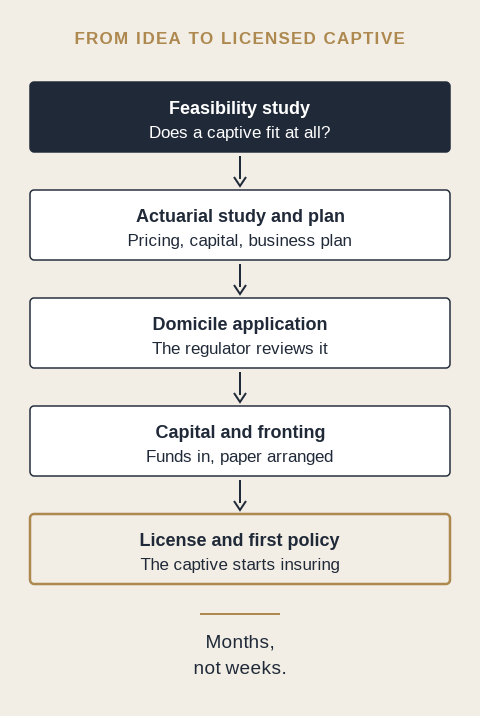
Forming a captive takes months, not weeks. The work runs in sequence: a feasibility study to decide whether a captive fits, an actuarial study and business plan, an application to the domicile regulator and its review, capitalization and any fronting arrangement, and finally the license and the first policy. The pace is set by how quickly the owner provides information and makes decisions, and by the regulator’s review. Joining an existing group captive is usually faster than forming a single-owner captive.
Owners who decide a captive makes sense often want it in place at their next renewal. Sometimes that is realistic and sometimes it is not, depending on where the renewal falls and how prepared the business is. Understanding the steps, and what drives each, is the best way to plan. This piece walks through the sequence, the factors that speed it up or slow it down, and how joining a group differs from forming your own.
The sequence
Each step depends on the one before it, which is why formation cannot be rushed without skipping something important. Some work can overlap — fronting conversations and collateral can begin during the regulatory review, for example — but the core sequence cannot be reordered. The regulator will not license a captive without a business plan, and the actuary cannot price coverages that have not been chosen.
Step one: the feasibility study
The feasibility study answers the threshold question: does a captive fit this business at all? It examines the business’s risks, loss history, current insurance program, financial capacity, and objectives, and it recommends a structure — or recommends against one. Our post on what happens in a captive feasibility study explains the process in detail.
The study’s speed depends mostly on the owner. Loss runs, financial statements, insurance policies, and a clear picture of the operations let the work move quickly. Missing or messy data slows it down. Our page on the feasibility study describes how we approach it.
This is also where the owner learns whether the risks it wants to finance suit a captive at all. Some risks are better left with the commercial market; some are too small to justify the cost of a captive; some belong in a group rather than a single-owner structure. Settling those questions at the start prevents expensive changes later.
Step two: actuarial study and business plan
If the study says yes, an independent actuary prices the coverages the captive will write and estimates the capital it needs. The business plan describes what the captive will insure, how it will operate, how it will hold its assets, and who will run it. Our post on what a captive actuary does explains the actuary’s role.
This step is where many decisions get made: which coverages, at what limits, with what retentions, under which structure. Owners who make those decisions promptly keep the process moving.
The actuarial work is also what the regulator will rely on when it reviews the application, so it needs to be thorough. An actuary working from complete loss data and settled coverage decisions can finish faster, and produce a stronger report, than one working from estimates. If the coverages change after the study is done, the pricing has to be revisited, which adds time.
Step three: the domicile application
The captive is licensed by the insurance regulator of the jurisdiction where it is formed. The application typically includes the business plan, the actuarial work, financial projections, information about the owners and the people who will run the captive, and the proposed governing documents. The regulator reviews it, often asks questions, and may request changes. The NAIC’s overview of captive insurance companies describes how captives are licensed and overseen.
Review timing varies by domicile and by how complete the application is. Prompt, complete answers to the regulator’s questions are one of the biggest factors the owner controls.
Choosing the domicile is part of this step. Domiciles differ in their capital requirements, their experience with particular kinds of captives, the style and pace of their review, and their ongoing reporting expectations. The right choice depends on the captive’s purpose and the owner’s circumstances, and it should be made with the owner’s own counsel.
Step four: capital and fronting
Before it can write business, the captive must be capitalized as the regulator requires. Where the captive’s policies need to be issued by a licensed, rated insurer — for lenders, contracts, or statutory coverages — a fronting arrangement must be negotiated and signed. Our post on what a fronting carrier is explains that process, which can take its own time because the fronting carrier underwrites the arrangement too.
Fronting carriers often require collateral as well, typically in a form such as a letter of credit or a trust, and arranging that collateral with a bank can take time of its own. The source of the captive’s capital should also be documented carefully. Starting those conversations early, in parallel with the regulatory review, avoids a delay at the end.
Step five: license and first policy
With the license issued, capital in place, and any fronting arranged, the captive can issue its first policies. From there, the ongoing work begins: board meetings, audits, actuarial reviews, regulatory filings, and claims handling. Our post on a captive’s annual requirements covers that recurring work.
The first policy year is also when habits form. Captives that start with clear procedures for premium payment, claims reporting, and recordkeeping tend to run smoothly; those that treat the license as the finish line often struggle with their first audit. Formation should end with a calendar for the year ahead, not just a license.
What speeds formation up, and what slows it down
Most of what sets the pace is within the owner’s control. The regulator’s review is not, but even that moves faster when the application is complete. These help:
- Clean, complete data. Loss runs, financial statements, and policies gathered before the study begins.
- Clear objectives. Knowing which risks you want to finance and why.
- Prompt decisions. Coverage choices, ownership structure, and domicile settled without long gaps.
- Responsive advisers. Your own counsel and CPA engaged early, not brought in at the end.
- Fast answers to regulators. Questions answered completely the first time.
These slow it down:
- Missing or inconsistent loss history.
- Unresolved ownership or structural questions.
- Changing the coverages after the actuarial work is done.
- Fronting negotiations started late.
- Starting too close to the commercial renewal, which forces a rushed decision or a one-year delay.
Joining a group versus forming your own
Joining an existing group captive is usually faster than forming a single-owner captive, because the group is already licensed and operating. Joining still involves underwriting by the group, documentation, and funding a loss fund and capital or collateral, and many groups admit new members only at set times. Forming a single-owner micro-captive involves the full licensing process from the start.
Groups also underwrite each prospective member, and a business with poor loss history or weak safety practices may be declined or asked to make changes first. Preparing for that review — with clean loss runs and evidence of the business’s risk management — is the group equivalent of preparing for a feasibility study.
Either way, the timeline should be planned backward from the commercial renewal, with the feasibility study started early enough to leave room for a decision.
Why rushing is a warning sign
A promoter who promises a captive in a few weeks, or who skips the feasibility study, is describing something other than a carefully built insurance company. Those shortcuts tend to produce the weaknesses that draw scrutiny: coverages that do not match real risks, premiums not supported by independent pricing, and thin documentation. Our post on questions to ask before starting an 831(b) captive is a useful checklist. A realistic timeline is a sign of a careful manager, not a slow one. This is general information, not legal or tax advice — see our disclosures.
Where to start
The best time to start is well before your next renewal. A feasibility study is the first step, and it can conclude that a captive is not right for you — which is worth knowing early. If your renewal is close, the study is still worth starting now: it sets up a well-prepared formation for the following year rather than a rushed one this year. If you are new to the topic, start with what a captive insurance company is.
Frequently asked questions
Can a captive be formed in a few weeks?
Not responsibly. Forming a captive involves a feasibility study, an actuarial study and business plan, a regulatory application and review, capitalization, and often a fronting arrangement. Each step depends on the one before it. Anyone promising a captive in a few weeks is either skipping steps or describing something other than a properly formed insurance company.
What slows down captive formation the most?
Usually incomplete information. Missing loss history, unclear ownership structures, unresolved questions about which risks the captive will cover, and slow responses to regulator questions all add time. Owners who gather their data early and make decisions promptly tend to move fastest.
Is joining a group captive faster than forming my own?
Often, because the group captive already exists and is licensed. Joining still involves underwriting, documentation, and capital or collateral, and many groups admit members only at certain times of year. Forming a single-owner captive involves the full licensing process from the start.
When should I start if I want coverage at my next renewal?
Well before the renewal — ideally many months ahead. The feasibility study should be finished early enough to make a decision, and the remaining steps need time to complete before the commercial policies renew. Starting late usually means renewing the commercial program as-is and forming the captive for the following year.
Feasibility Study
See whether a captive fits your business.
Every engagement starts with a feasibility study — an honest read on whether a captive is right for you before anything is formed.