

What Does a Captive Manager Do Day to Day?
A captive manager runs the captive insurance company day to day: it keeps the captive in good standing with its regulator, maintains its books and records, coordinates its independent actuary, auditor, counsel, and claims handlers, and manages underwriting and renewals so coverage keeps tracking the business. The manager is the operator of the insurer. It is not the actuary who prices the risk, the auditor who checks the books, or the owner’s tax counsel — and keeping those roles separate is one of the most important protections a captive owner has.
Most business owners have never owned an insurance company, so it is natural to wonder what the firm managing one actually does. The answer is a mix of regulatory work, accounting, coordination, and insurance operations that most owners would rather not handle themselves. This piece walks through each part of the job, what a good manager looks like, and what a manager should not do. It also explains why the choice of manager matters as much as the choice of structure.
The four parts of the job
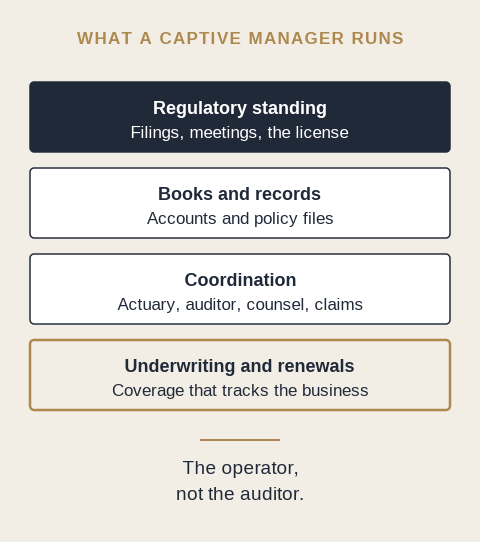
Regulatory standing
A captive is a licensed insurer, and keeping that license in good standing is a continuous job. The manager typically prepares and files the reports the domicile regulator requires, schedules and documents board meetings, tracks deadlines, responds to regulator questions, and handles changes to the business plan when the captive’s coverage or operations change. The NAIC’s overview of captive insurance companies describes how captives are regulated in their domicile.
Missing a filing or failing to hold required meetings can put a captive’s standing at risk. A good manager keeps the calendar and makes sure the owner never has to.
Regulators also examine captives periodically, and the manager typically prepares for and supports those examinations, assembling records and answering questions. A captive whose records are kept current all year handles an examination far more easily than one that reconstructs its history when the regulator calls.
Books and records
The manager usually maintains the captive’s accounting: premium received, claims paid, reserves, investment activity, and expenses. It keeps the policy files, the claims files, the board minutes, and the correspondence with the regulator. Those records are what the auditor examines, what the actuary relies on, and what the owner would need if the captive were ever reviewed.
The manager also oversees the captive’s cash and investments within the limits of the business plan and the regulator’s rules, making sure enough liquid assets are available to pay claims. Our post on captive insurance cash management explains why that discipline matters.
Good records are also what make a captive look like an insurer, because they show premium priced and received, claims reported and paid, and decisions made and documented. Our post on how claims work in a micro-captive explains why that record matters.
Coordination
A captive relies on several independent professionals: an actuary who prices the risk and reviews reserves, an auditor who examines the financial statements, the owner’s own tax counsel and CPA, a fronting carrier where one is used, claims administrators, and often an investment adviser. The manager coordinates them — gathering information, keeping timelines aligned, and making sure each has what it needs.
In practice, this is much of the manager’s year. The audit needs financial records and confirmations; the actuarial review needs claims data and exposure updates; the owner’s CPA needs information for tax filings; the board needs materials for its meetings. Each depends on the others, and the manager keeps the sequence on track so deadlines are met without last-minute scrambles. Our post on a captive’s annual requirements lays out that cycle.
Coordination is not control. The manager should make it easy for the independent parties to do their jobs, not shape their conclusions. Our post on what a captive actuary does explains one of those independent roles.
Underwriting and renewals
A captive’s coverage should follow the business. When the business opens a location, adds a product line, sells a division, or changes how it operates, the captive’s coverage may need to change too. The manager typically runs the underwriting and renewal process: gathering updated exposure information, working with the actuary on pricing, preparing the policies, and making sure the commercial program and the captive still fit together.
A renewal that simply repeats last year’s coverage without asking whether it still matches the business is a missed opportunity, and over time it can leave a captive insuring risks the business no longer has.
Underwriting also means saying no. If the owner asks to add a coverage that does not match a real exposure, or to raise a premium without an actuarial basis, a good manager pushes back. That independence protects the owner as much as the captive.
Claims oversight
Claims are where a captive proves it is an insurer. The manager typically sets up the claims procedures, receives notice of losses, coordinates with any third-party administrator or adjuster, and makes sure each claim is reviewed against the policy and documented from start to finish. When a claim is paid, the file should show what happened, what the policy covers, how the loss was measured, and why the amount was right. When a claim is denied, the file should show why.
That consistency matters more in a captive than almost anywhere else, because the owner of the business and the owner of the insurer are related. A claims process that treats the owner’s claims exactly as a commercial insurer would — no faster, no looser, no slower — is the clearest evidence that the arrangement is real.
What a captive manager should not do
The most important line in captive management is between running the captive and grading it. A manager should not:
- Price its own captive’s risk without an independent actuary.
- Audit its own work or select an auditor that is not independent.
- Provide the owner’s tax opinion in place of independent counsel.
- Promise tax outcomes or describe a captive as “audit-proof.” There is no such thing.
That separation of functions is how we work at Tessera: we run the captive, and independent actuaries, auditors, and counsel check it. Our page on our approach to compliance explains why, and our post on hiring a micro-captive attorney explains why the owner’s counsel should answer only to the owner. Circular 230 governs those who practice before the IRS; the IRS’s Office of Professional Responsibility and Circular 230 page explains the rules.
What a good manager looks like
Owners can usually tell a good manager by how it communicates. Expect regular financial reports you can understand, advance notice of meetings and filings, prompt updates on claims, clear requests for the information audits and actuarial reviews need, and a renewal process that asks hard questions about whether the coverage still fits. A good manager also tells you when something is wrong — a coverage that no longer makes sense, a filing at risk, a structure that should change — rather than waiting for you to discover it.
Our post on questions to ask before choosing a captive manager gives you the questions that reveal those qualities before you hire.
It also helps to ask how the manager is paid. Fees tied to the size of premiums can create pressure to recommend larger premiums; flat or service-based fees avoid that pressure. Neither arrangement is automatically wrong, but the owner should understand the incentives.
Single-owner and group captives
In a single-owner micro-captive, the manager works closely with one owner and its advisers. In a group captive, the manager also handles member underwriting, loss fund accounting for each member, pooled-layer results, and communication across many owners. The core job — keeping the insurer licensed, accurate, coordinated, and aligned with the risks it covers — is the same.
Some managers specialize in one or the other, and the skills overlap but are not identical. An owner considering either structure should ask how many captives of that kind the manager runs and how long it has run them.
This is general information, not legal or tax advice — see our disclosures.
Where to start
If you are considering a captive, the manager is one of the most important choices you will make. A feasibility study is a good way to see how a manager thinks before you commit. Ask to meet the people who would actually run your captive, not only those who sell it. Our about page explains who we are and how we work.
Frequently asked questions
Is a captive manager the same as an insurance agent or broker?
No. An agent or broker places insurance with carriers on a client’s behalf. A captive manager runs the captive insurance company itself: its regulatory standing, books, coordination with advisers, and underwriting operations. Some firms do both, but the roles are different, and the owner should understand which role each firm is playing.
Does the captive manager decide claims?
The manager typically oversees the claims process and makes sure claims are handled according to the policies and the captive’s procedures, sometimes working with a third-party claims administrator. Claims decisions should follow the policy terms and be documented. In a well-run captive, the process is consistent and independent of anyone’s interest in the result.
Should the captive manager also price the risk and audit the books?
No. Pricing should be done by an independent actuary and the financial statements audited by an independent auditor, with tax advice from the owner’s own counsel. Separating those functions means no single party grades its own work, which is one of the strongest protections an owner has.
What should I expect to hear from my captive manager during the year?
Regular financial reports, notice of upcoming board meetings and filings, updates on claims, reminders about information needed for audits and actuarial reviews, and a renewal process that revisits whether the coverages still match the business. A good manager also tells you when something is wrong.
Feasibility Study
See whether a captive fits your business.
Every engagement starts with a feasibility study — an honest read on whether a captive is right for you before anything is formed.