
What a Captive Actuary Does and Why It Matters
A captive actuary is the independent professional who tests whether a captive makes sense, prices its premiums at arm’s length, estimates the reserves it needs for claims, and checks that its capital is adequate for the risks it carries. That work matters because a captive’s owner and its insured business are related. Without an independent actuary, nothing stops a premium from being set to reach a number rather than to match a risk — which is exactly the pattern that courts and the IRS have treated as a sign the arrangement is not insurance.
Most owners meet the actuary early, during the feasibility study, and then hear about the actuary’s work mostly at renewal. But the actuary’s conclusions run through everything the captive does: how much it charges, how much it holds for claims, how much capital it keeps, and how credible it looks to a regulator or an examiner. This piece explains each part of the job, what good actuarial work looks like, and how to tell when it is missing.
The four checkpoints
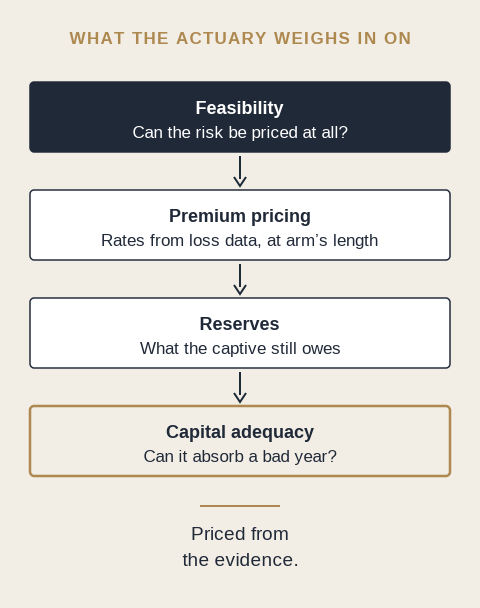
Feasibility: can these risks support a captive?
Before a captive is formed, the actuary looks at the risks the owner wants to finance and asks whether they can support an insurance company. That means examining loss history, exposures, the commercial coverage already in place, and the gaps the captive would fill. It also means asking whether enough risk exists to price credibly, and whether the captive’s expected losses, expenses, and capital needs hang together.
The answer can be no. A business whose real uninsured risks are small, or whose losses are too unpredictable to price from available data, may be better served by adjusting its commercial program. Our post on what happens in a captive feasibility study explains how the actuarial work fits into the broader study.
Pricing: premiums set at arm’s length
Pricing is the part of the actuary’s work owners notice most. For each coverage, the actuary estimates how likely a loss is and how much it would cost, then builds a premium that covers expected losses, expenses, and a reasonable margin for uncertainty. The evidence comes from the business’s own loss history where it exists, and from industry data, commercial rates for similar coverage, and judgment where it does not.
The standard is arm’s length: the premium should be what an unrelated insurer would reasonably charge for the same coverage. That standard protects the owner. A premium built backward from a target — a desired deduction, a round number, the maximum the election allows — is the clearest single sign that an arrangement is not insurance. In cases such as Avrahami v. Commissioner, 149 T.C. 144 (2017), the Tax Court examined how captive premiums were set and found the pricing wanting. Our post on what the IRS targets in micro-captives explains the patterns.
Some coverages have little data behind them. A business may never have suffered the loss a captive policy covers, or the commercial market may not offer comparable coverage to benchmark against. In those cases the actuary relies more on industry information and reasoned judgment, and should say so plainly in the report. Thin data is not a reason to guess high; it is a reason to be explicit about the assumptions and to revisit them as experience builds.
Good pricing also explains itself. The actuary’s report should show the data used, the assumptions made, and how each coverage’s premium was derived. If no one can explain why a premium is what it is, that is a reason to stop.
Reserves: estimating what claims will cost
Insurance claims are rarely paid the day a loss happens. Some are reported late; some take time to investigate; some, like liability claims, can stay open for years. Reserves are the captive’s estimate of what it will ultimately pay for claims that have happened, whether or not they have been reported yet.
The actuary estimates those reserves and reviews them regularly. Reserves that are too low overstate the captive’s financial strength; reserves that are too high distort its results in the other direction. Because reserves are estimates, they are adjusted as claims develop, and the history of those adjustments is itself useful evidence about the quality of the original work.
Many domiciles require a formal opinion on the captive’s reserves. The American Academy of Actuaries publishes a practice note on statements of actuarial opinion for property and casualty loss reserves, which describes how actuaries approach that work. It is guidance for practitioners, not a binding rule, but it shows how seriously the profession treats reserve opinions.
Capital: can the captive absorb a bad year?
Premiums are priced for expected losses, but actual losses vary. Capital is what lets a captive pay claims in a year that turns out worse than expected. The actuary helps estimate how much capital the captive needs, given the coverages it writes, the limits it offers, its reinsurance, and how volatile its losses could be.
Regulators set minimum capital requirements, and the NAIC’s overview of captive insurance companies describes how captives are licensed and overseen in their domicile. But the minimum is not always enough. A captive writing volatile coverage with high limits may need more than the minimum to be genuinely sound, and the actuary’s analysis is what shows it.
Reinsurance and limits are part of the same analysis. A captive that buys reinsurance above a certain level needs less capital for the risk it passes on; a captive that writes high limits with no reinsurance needs more. The actuary helps the owner see how those choices trade off against each other, so that the structure is sound rather than merely compliant.
Why independence matters
The actuary’s value depends on independence. An actuary who is paid by a promoter whose fees grow with the premium, or who is told the answer before the analysis starts, is not providing a check. Owners should ask who engaged the actuary, who pays the actuary, and whether the actuary has any interest in the size of the premium.
That separation of functions is how we work at Tessera. We run the captive; independent actuaries price it, independent auditors examine its books, and the owner’s own counsel advises on tax. Our page on our approach to compliance explains why, and our post on what a captive manager does describes the manager’s side of that line.
What good actuarial work looks like
Owners do not need to be actuaries to judge the work. Look for:
- A written report that shows the data, the assumptions, and the method for each coverage.
- Pricing tied to evidence, including the business’s own loss history where it exists.
- Coverages that match real exposures, not a list of remote events added to reach a premium.
- Regular review, with premiums and reserves revisited as the business and its claims change.
- Willingness to say no to a coverage or a premium the evidence does not support.
And watch for the opposite: premiums that land neatly on a round number or a statutory limit, coverages with no connection to the business, reports that never change from year to year, and an actuary nobody has spoken to.
How the 831(b) election fits
For a micro-captive, actuarial pricing is the foundation of the insurance case. If a captive qualifies as insurance, it can make the §831(b) election, which affects how it is taxed, provided its premiums stay within the limit for the tax year — $2.9 million for the 2026 tax year (Rev. Proc. 2025-32, indexed annually). The limit is a ceiling, not a target. Premiums should be whatever the actuary’s evidence supports, which for many businesses is well below it. Our page on micro-captives and the 831(b) election explains the structure.
In a group captive, the actuary also prices each member’s contribution and the shared layer, and reviews how the group’s results are allocated. That allocation matters to every member, because a group whose pricing favors some members over others will not hold together for long. The independence standard is the same.
This is general information, not legal or tax advice — see our disclosures.
Where to start
The actuary’s first contribution comes in the feasibility study, where the question is whether your risks can support a captive at all. If you are reviewing an existing captive or a proposal, ask to see the actuarial report and read it with the checklist above. Our post on questions to ask before starting an 831(b) captive covers the questions to put to anyone proposing one.
Frequently asked questions
Does every captive need an actuary?
In practice, yes. Domicile regulators generally expect actuarial work in the application and on an ongoing basis, and a captive’s premiums and reserves need a defensible basis. Beyond the rules, independent pricing is one of the clearest signs that a captive is a real insurer rather than an arrangement built around a premium target.
What does “arm’s length” pricing mean for a captive?
It means the premium is what an unrelated insurer would reasonably charge for the same coverage, based on the likelihood and cost of losses. In a captive, the business and the insurer are related, so the premium must be set from evidence by someone independent, not from what the owner would like to pay or deduct.
Should the actuary work for the captive manager?
The actuary should be independent of anyone who benefits from a particular premium. Many captives use actuarial firms unaffiliated with the manager or promoter. Owners should ask who engaged the actuary, who pays them, and whether the actuary has any interest in the size of the premium.
What happens if the actuary’s reserves turn out to be wrong?
Reserves are estimates, so they are reviewed and adjusted as claims develop. If reserves were too low, the captive strengthens them; if too high, they are released over time. What matters is that each estimate is made in good faith from the evidence available and revisited regularly.
Feasibility Study
See whether a captive fits your business.
Every engagement starts with a feasibility study — an honest read on whether a captive is right for you before anything is formed.