

Captive Insurance for Medical Practices and Physicians
Medical practices and physician groups use captives in two main ways: groups of physicians, practices, or health systems finance their malpractice risk together through a group captive or a risk retention group, and individual practices sometimes use a single-owner captive for the enterprise risks around the practice that commercial insurance handles poorly. Employee health benefits are a separate question with separate rules. The right structure depends on which risk you are trying to finance.
Health care is one of the oldest homes of alternative risk financing. When professional liability coverage has been hard to find or volatile in price, physicians have repeatedly banded together to insure themselves. That history makes captives a natural conversation for practice owners, but it also means there are several different structures that sound alike. This piece sorts out which risk belongs where, who fits, and what to watch for.
The three kinds of risk a practice carries
It helps to separate a practice’s risks before talking about structures, because each kind tends to belong somewhere different.
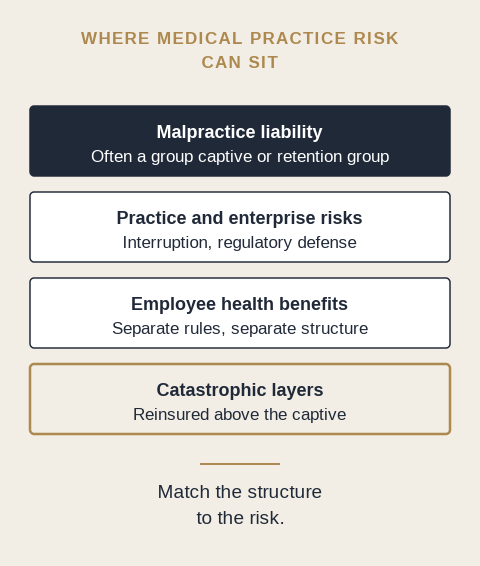
Malpractice liability is the core professional risk. It is often financed collectively, because one practice rarely has enough claims experience to price it alone.
Practice and enterprise risks — interruption, regulatory and licensing defense, cyber events involving patient data, deductibles on the commercial program — are the risks around the practice. These are where a single-owner captive is sometimes considered.
Employee health benefits sit under a different body of law and are usually financed through stop-loss coverage for a self-funded plan, which our post on medical stop-loss captives covers.
Malpractice: group captives and risk retention groups
Physicians who finance malpractice together usually use one of two structures. A group captive is an insurer owned by its members that can write many kinds of risk, typically behind a fronting carrier where admitted paper is required. A risk retention group is a group-owned insurer limited to liability coverage, allowed by a federal law to operate across states once chartered in one. The NAIC’s overview of risk retention groups describes how they are regulated.
Both share the same core idea: practices with good risk management stop paying for the market’s worst results and keep more of their own.
The practical differences matter. A risk retention group can only write liability coverage, so it suits malpractice well but cannot also hold a practice’s property or workers’ compensation risk. A group captive can be broader, but it usually needs a fronting carrier to issue policies in states where it is not licensed. Which fits depends on the states where members practice, the coverages they want to share, and how much regulatory structure they are prepared to run. Our post comparing a captive and a risk retention group explains the differences in detail.
Practice risks and the single-owner captive
A practice with real enterprise risks may consider a single-owner micro-captive for them. Done right, it covers exposures the practice genuinely faces, priced by an independent actuary, with claims paid when they occur. Done wrong, it is a tax pitch, and professional practices hear a lot of those.
The tests are the same ones any owner should apply: Are the risks real? Are premiums priced from the risk rather than from a tax number? Would the practice really file claims? Are the advisors independent? Our post on micro-captives for dental practices walks through those tests for a closely related kind of practice.
Who fits
A group of practices tends to fit a group captive or risk retention group when its members share risk standards, have enough combined loss history to price the risk, are willing to underwrite and police each other, and can commit capital for the long term.
An individual practice tends to fit a single-owner captive only when it has meaningful uninsured or underinsured risks and enough scale to justify a captive’s fixed costs. Many practices do not, and a sound adviser will say so.
Governance and peer review
Physician-owned insurers live or die by risk management. Groups that do well tend to take credentialing, peer review, documentation, and patient communication seriously, because those habits drive malpractice results. In a captive, that discipline pays the members directly.
That also means members should expect to be asked about their practices before they join and to be held to standards after they do. One member’s claims affect everyone in the pool.
Good governance shows up in small, steady habits: documenting informed consent carefully, following up on abnormal results, communicating honestly with patients when something goes wrong, and reviewing near misses rather than only claims. None of these is new to a well-run practice. What a captive changes is who benefits when they are done well. In the commercial market, a practice’s good habits help a carrier’s results; in a physician-owned insurer, they help the physicians.
It also changes how members think about each other. In a commercial program, another practice’s claims are invisible. In a group captive, members see the pool’s results and have a stake in raising standards across it. Groups that embrace that tend to stay healthy; groups that avoid hard conversations about weak members tend not to.
How a physician group captive is run
A group captive or risk retention group for physicians is a real insurance company, and it needs the same machinery any insurer does. Typically that includes:
- A board drawn from the members, often with physicians who take an active role in setting risk standards and reviewing results.
- An underwriting process for new members: claims history, specialty, procedures performed, and risk management practices.
- Claims handling and defense counsel experienced in medical professional liability, because how claims are defended shapes results as much as how many occur.
- Risk management programs that members are expected to use, from documentation standards to patient communication training.
- Independent actuarial, audit, and management services, kept separate so no single party grades its own work.
Physicians who join should expect to participate, not just pay. The members who do well tend to be the ones who treat the captive as their own insurer, because it is.
When practices are acquired or merge
Health care has been consolidating for years, and practice ownership changes affect a captive. A practice that is acquired by a hospital system may move to the system’s own insurance program. A merger between groups may combine two sets of coverage with different histories. Claims from the years a practice was insured by the captive can take time to resolve, and somebody has to stay responsible for them.
The time to think about this is before you join or form, not when a transaction is already under way. Membership agreements should say what happens when a member is acquired or leaves, and a single-owner captive should have an exit plan from the start. Our post on captive exit strategy explains the routes out, including running off old claims and transferring them to another insurer.
Questions for a practice considering a captive
Before going further, a practice or group should be able to answer:
- Which risk are we actually trying to finance? Malpractice, enterprise risk, and benefits each point to a different structure.
- Do we have the data? Claims history that an actuary can price is the price of admission.
- Are we willing to underwrite and police each other? A group is only as strong as its standards.
- Can we fund losses and capital without straining the practice?
- Who are our independent advisors? Our post on hiring a micro-captive attorney explains why a single-owner captive needs counsel that answers only to the owner.
The tax question
Tax treatment is not the reason to form a captive. For a single-owner captive that qualifies as insurance, the §831(b) election can affect how the captive is taxed, but it follows the insurance, never the other way around. Our post on captive insurance and taxes covers what is real and what is hype. This is general information, not legal or tax advice — see our disclosures.
Where to start
The first question is which risk you want to finance. If it is malpractice for a group, the conversation is about pooling and governance. If it is enterprise risk for one practice, it is about whether those risks are real and large enough. Either way, a feasibility study is where the answer comes from. The NAIC’s captive overview is a useful primer on how captives are licensed and regulated.
Frequently asked questions
Can physicians insure malpractice through a captive?
Yes, and it is one of the longest-standing uses of captives in health care. Physician groups and health systems often finance professional liability through a group captive or a risk retention group, which is a liability-only form of group-owned insurer allowed to operate across states under federal law. Which structure fits depends on the group’s size, specialty mix, and states of practice.
Is a micro-captive a good idea for a single physician practice?
Sometimes, for the enterprise risks around the practice rather than core malpractice — and only when those risks are real, priced independently, and large enough to justify a captive’s fixed costs. Professional practices are a frequent target of tax-motivated pitches, so a sound proposal starts from the practice’s risks and never from its tax bill.
Can a captive cover our employees’ health benefits?
Employee health benefits follow a separate set of federal and state rules, and they are usually handled through a different structure, such as stop-loss coverage for a self-funded plan. Our post on medical stop-loss captives explains how that works. Keep benefits planning separate from property and casualty captive planning, and involve benefits counsel.
What does a group of practices need to start a captive together?
Shared risk standards, enough combined premium and loss history to price the risk, a willingness to underwrite and police each other’s practices, capital, and long-term commitment. The feasibility study answers whether the group fits and which structure — a group captive or a risk retention group — suits what it wants to insure.
Feasibility Study
See whether a captive fits your business.
Every engagement starts with a feasibility study — an honest read on whether a captive is right for you before anything is formed.