
Medical Stop-Loss Captives for Employee Health Plans
A medical stop-loss captive is a group captive through which employers that self-fund their employee health plans share part of their stop-loss risk. Each employer pays its employees’ ordinary claims through its own plan and buys stop-loss coverage to protect itself from large claims; the participating employers then share mid-size stop-loss claims in a captive layer, with reinsurance above for the very large claim. Employees’ benefits do not change. What changes is how the employer finances the risk of unpredictable, expensive claims.
Health benefits are one of the largest and fastest-growing costs many employers carry. Large employers have long self-funded their health plans — paying claims directly rather than buying a fully insured policy — and protecting themselves with stop-loss coverage. Mid-size employers have often found self-funding too volatile on their own. Stop-loss captives emerged to bridge that gap. This piece explains how they work, who fits, and why they sit under different rules from the property and casualty captives discussed elsewhere on this site.
Self-funding and stop-loss, briefly
In a fully insured health plan, the employer pays a premium and the insurer pays the claims. In a self-funded plan, the employer pays its employees’ claims directly, usually through a third-party administrator, and keeps the savings in a good year. The risk is volatility: a few very expensive claims, such as a serious illness or a premature birth, can produce a year far worse than expected.
Stop-loss coverage limits that volatility. It reimburses the employer when an individual’s claims exceed a set level, or when total claims exceed an expected level, depending on how the coverage is written. It protects the employer, not the plan or the employees.
Specific and aggregate stop-loss
Stop-loss coverage usually comes in two forms, and a captive can be built around either or both.
Specific stop-loss protects against a single large claim. When one person’s claims in a plan year pass the employer’s chosen threshold, the coverage reimburses the excess. It is the protection against the catastrophic case — the serious diagnosis, the long hospital stay, the costly specialty drug.
Aggregate stop-loss protects against a bad year overall. When the plan’s total claims pass an expected level set at the start of the year, the coverage reimburses the excess. It protects against many moderate claims adding up, rather than one large one.
Most stop-loss captives focus on the specific layer, because large individual claims are what make self-funding feel risky for a mid-size employer, and because pooling those claims across many employers is where a group adds the most stability. How the layers are set, and where the captive’s band sits within them, should come from actuarial analysis of the members’ claims, not from a standard template.
How a stop-loss captive is layered
A stop-loss captive adds a shared layer between what each employer retains and what the commercial market covers.
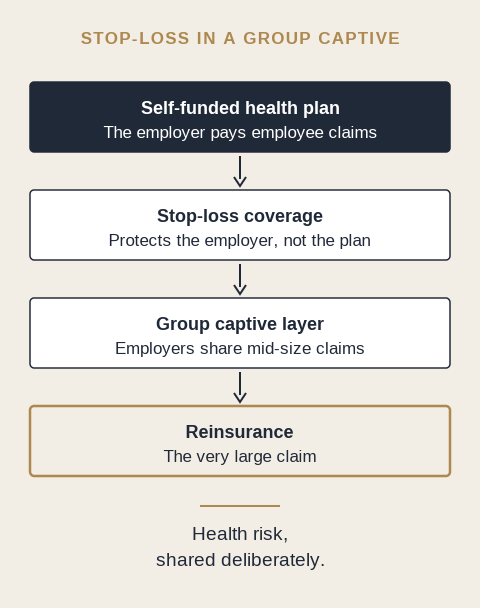
The employer’s plan pays ordinary claims. That is the employer’s retained layer.
The captive layer covers stop-loss claims in a defined band above each employer’s retention. Participating employers share those claims, so a bad year for one is cushioned by the others.
Reinsurance covers the very large claims above the captive layer, so one catastrophic case cannot overwhelm the group.
Over time, if the group’s claims in the captive layer come in better than expected, the members may share in the result. That return is conditional and depends on the group’s experience. Our post on how group captive insurance works explains the general model.
Why benefits are different from property and casualty
Most of what this site discusses — workers’ compensation, liability, property, enterprise risks — falls under property and casualty insurance. Health benefits are a different world:
- Federal benefits law governs most private employer health plans, including reporting, fiduciary duties, and participant protections. The U.S. Department of Labor’s compliance guide, Health Benefits Coverage Under Federal Law, summarizes many of those rules.
- State insurance law regulates the stop-loss coverage itself, and states differ in how they treat it.
- Plan design and administration — eligibility, covered services, networks, claims administration — are their own disciplines.
That combination means a stop-loss captive needs benefits counsel and advisers experienced in employee benefits, alongside the captive structure. It is not a property and casualty captive with health claims added.
Administration matters too. A self-funded plan typically relies on a third-party administrator to process claims, a pharmacy benefit manager, and provider networks, each under its own contract. The captive sits alongside those arrangements rather than replacing them, and the data they produce is what the captive’s actuary uses to price the coverage.
Who fits
An employer tends to fit a stop-loss captive when:
- It has enough employees for claims to be reasonably predictable at the plan level.
- It can absorb its retained claims and cash flow ups and downs as claims arrive.
- It is willing to manage its plan actively, including plan design, wellness, and care management.
- It has data, including claims history, that an actuary can price.
- It is prepared to stay for several plan years, since one year rarely tells the full story.
Employers with very small workforces, or without appetite for active plan management, are usually better served by fully insured plans or other arrangements. Our post on whether captive insurance is worth it covers the general trade-offs of retaining risk.
Managing claims you now own
Self-funding changes how an employer thinks about health costs. When claims are the employer’s own money, plan design, pharmacy management, care coordination for chronic and complex conditions, and employee engagement in their own health all affect results directly. Employers that do well in stop-loss captives tend to treat their health plan as something to manage, not just something to buy.
The captive layer adds a second reason to pay attention. Each member’s experience affects the group, so strong groups share practices and data on what works. Many groups set expectations for members — a sound plan design, an experienced administrator, programs for managing high-cost conditions — because one poorly managed plan can weigh on everyone. An employer joining a group should expect to be asked about its plan and to share information, and should welcome a group that asks. A group with no standards for its members is pooling risk without managing it.
What a feasibility review looks at
Before an employer joins a stop-loss captive, a review should examine:
- The workforce. Size, demographics, and locations.
- Claims history, including large claims and their causes.
- The current plan design and how it would change under self-funding.
- Cash flow capacity to pay claims as they arise.
- The group’s structure, including its retention levels, the captive band, reinsurance, and how results are shared.
The review can conclude that a fully insured plan remains the better answer. A sound adviser will say so.
Questions to ask a stop-loss group
- How are members selected, and how is each employer’s risk priced?
- Where does each employer’s retention end and the captive layer begin?
- Who administers claims, and what data will you receive?
- How are results shared, and when?
- What happens if you leave? Our post on captive exit strategy explains why exit terms matter.
The trade-offs
A stop-loss captive asks more of an employer than a fully insured plan. Retained claims vary from year to year, the employer takes on fiduciary and administrative responsibilities, and any return from the captive layer is conditional and never guaranteed. For the right employer, the payoff is more control over plan design, more visibility into what drives costs, and a share in the results of managing them well.
There is also a timing consideration. Self-funded claims are paid as they arrive, and stop-loss reimbursements follow after the claims are submitted and reviewed, so an employer needs the cash flow to carry large claims for a period. Contracts should be reviewed carefully for how claims incurred in one year and paid in the next are handled, and for what happens to coverage at renewal if a member has an ongoing large claim. Those details rarely appear in a marketing summary, and they matter most in exactly the years an employer needs the protection.
Tax treatment is not the reason to join, and benefits taxation has its own rules. This is general information, not legal, tax, or benefits advice — see our disclosures.
Where to start
Start with your benefits counsel and a review of whether self-funding fits your workforce. If it does, a feasibility study can examine whether a group stop-loss captive adds value over standalone stop-loss coverage. Our page on group captives explains how group structures work generally.
Frequently asked questions
What is a medical stop-loss captive?
It is a group captive through which employers that self-fund their employee health plans share part of their stop-loss risk. Each employer keeps paying its own employees’ ordinary claims through its plan, buys stop-loss coverage to protect itself from large claims, and participates in a captive layer where the members share mid-size stop-loss claims. Reinsurance covers the very large claims above that.
Does a stop-loss captive change my employees’ benefits?
No. Stop-loss coverage protects the employer, not the plan participants, and the employees’ benefits are set by the plan document. The captive changes how the employer finances the risk of large claims, not what employees receive. Plan design, compliance, and administration remain the employer’s responsibility under federal benefits law.
How large does an employer need to be to self-fund?
There is no single threshold. Self-funding requires enough employees for claims to be reasonably predictable, the financial strength to pay claims as they arise, and the willingness to manage a health plan actively. Group stop-loss captives have made self-funding more accessible to mid-size employers, but a feasibility study and benefits counsel should confirm the fit for your workforce.
Who regulates stop-loss coverage?
Stop-loss insurance is regulated by the states, while the employer’s self-funded health plan is governed largely by federal benefits law. That combination is one reason stop-loss captives require benefits counsel and an adviser experienced in both. The rules differ meaningfully from those that apply to property and casualty captives.
Feasibility Study
See whether a captive fits your business.
Every engagement starts with a feasibility study — an honest read on whether a captive is right for you before anything is formed.