

Captive Insurance for Real Estate Investors and Landlords
Real estate investors and landlords use captives mainly to fund the deductibles and retentions on their commercial property and liability programs, to cover hard-to-place property risk where the commercial market has pulled back, and to fill specific liability gaps priced from their own history. Catastrophe — windstorm, earthquake, flood — stays transferred to reinsurers. A captive suits portfolios large enough and disciplined enough to own part of their risk on purpose.
Property owners have watched insurance costs climb and deductibles rise across much of the market, especially in regions exposed to severe weather. Many already retain more risk than they used to, simply because the market forced them to. A captive gives that retained risk a formal home and lets a well-maintained portfolio keep the results of its own maintenance and tenant management. This piece explains what a real estate captive can hold, what it should not, and who fits.
What a real estate captive can hold
A real estate captive is rarely a replacement for commercial insurance. It is usually a layer within the program.
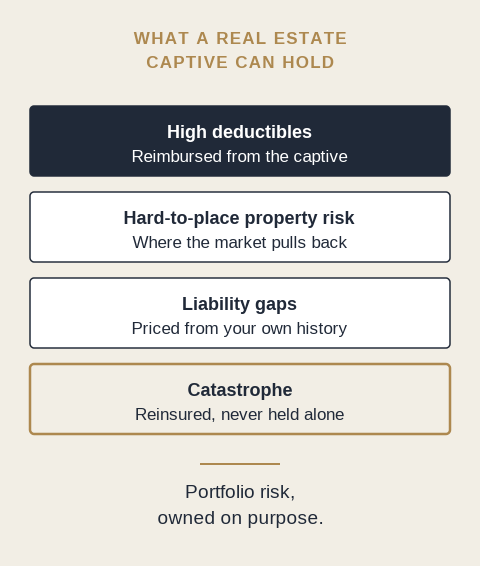
High deductibles. When the commercial market pushes deductibles up, the owner retains that risk whether or not it has planned to. A captive can reimburse those deductibles from premium the owner pays it, so retained losses are funded rather than absorbed by the operating budget. Our post on deductible reimbursement explains how.
Hard-to-place property risk. Some property types and regions are difficult to insure on reasonable terms. A captive can take a defined share of that risk, priced from the owner’s actual loss experience.
Liability gaps. Exclusions and sublimits in commercial liability policies leave gaps that a captive can fill when the risk is real and measurable.
Catastrophe. Severe weather and earthquakes can produce losses far larger than any small captive should hold. Those risks belong with reinsurers and the commercial market, not concentrated in the owner’s own insurer.
Lenders, leases, and paper
Real estate is financed, and lenders have insurance requirements. Most loan documents require property coverage from an insurer meeting specific rating and licensing standards, with the lender named on the policy. Leases add their own requirements for tenants and landlords.
That shapes how a captive fits. Often the commercial policy stays in place to satisfy the lender, written with a higher deductible, and the captive funds that deductible. In other cases, a licensed fronting carrier issues the required policy and reinsures part of the risk to the captive. Our post on what a fronting carrier is explains that arrangement. Read your loan documents before relying on any structure.
Flood and other catastrophic perils
Flood is a good example of a peril that should not sit in a small captive alone. Standard property policies typically exclude flood, and the National Flood Insurance Program, administered by FEMA, is one source of coverage; FloodSmart’s overview of the program explains how it works. Many owners combine federal or private flood coverage with a captive that funds deductibles or a defined excess gap.
The same logic applies to windstorm and earthquake. A captive can participate in catastrophe risk only if it is reinsured and capitalized for a severe event. The feasibility study should model how a bad catastrophe year would affect the captive before any of that exposure is retained.
Maintenance and tenant management are the economics
In a real estate captive, the owner’s operating discipline drives results. Roofs that are inspected and replaced on schedule, plumbing that is maintained, parking lots that are lit and repaired, and tenants who are screened and held to their lease obligations all reduce claims. A captive makes the payoff of that discipline visible, because the results stay with the owner instead of going to an outside carrier.
It also makes neglect visible. A portfolio with deferred maintenance will see it in its own loss fund, which is one reason a captive suits owners who already run their properties carefully.
Water damage is a good example. Leaking supply lines, failed water heaters, and roof leaks are among the most common property claims in many portfolios, and they are largely preventable through inspection, replacement schedules, and leak detection. An owner with a captive has a direct financial reason to invest in those measures, because the savings show up in the owner’s own results rather than a carrier’s.
Property types and how the risk differs
Different kinds of real estate carry very different risk, and a captive’s design has to follow the portfolio. Multifamily properties tend to produce frequent tenant-related liability and water damage claims. Office and retail properties carry premises liability from the public and depend on tenants’ own insurance. Industrial and warehouse properties raise questions about tenant operations and the condition of large roofs. Hospitality properties combine guest liability with significant property values. Mixed portfolios combine all of these.
Tenant mix matters as much as building type. A property leased to a restaurant carries different fire and liability exposure than one leased to a professional office, and how well tenants carry their own insurance affects how much risk flows back to the owner. Leases that require tenants to insure properly, and an owner who checks that they do, reduce what the captive has to absorb.
That variety is why a real estate captive should be built from the portfolio’s own claims history and property schedule, not from a template. Two owners with the same number of buildings can have very different risks, and very different reasons to consider a captive.
What a feasibility study looks at for a property portfolio
For a real estate owner, a feasibility study usually examines:
- The property schedule. Locations, construction, age, occupancy, and values, with attention to exposure to severe weather.
- Loss history by property and peril. Water damage, fire, wind, liability, and how each has developed over time.
- The current insurance program. Deductibles, retentions, sublimits, and where the commercial market has pulled back.
- Lender and lease requirements, which determine what the commercial policy must continue to provide.
- Maintenance and tenant management practices, as they actually run.
- Financial capacity to fund losses and capital alongside debt service.
The study may recommend a captive, a change in deductibles or limits, or no change at all.
Who fits
A real estate owner tends to fit a captive when:
- The portfolio is large enough that its retained risk justifies a captive’s fixed costs.
- Loss history is credible, with claims data by property and peril.
- Maintenance and tenant management are disciplined and documented.
- The owner can fund losses and capital without straining operations or loan covenants.
- The owner is in for the long run, since captives reward discipline over years.
Owners of a small number of properties are often better served by improving their commercial program. Our post on whether captive insurance is worth it covers the honest trade-offs. The NAIC’s guide to small business insurance is a useful refresher on the commercial coverages a captive works alongside.
Questions to ask before forming a real estate captive
Before committing, an owner should be able to answer:
- Which retained risks are we trying to fund? Deductibles, specific gaps, and hard-to-place properties each lead to a different design.
- How would the captive fare in a bad catastrophe year? If a single storm could exhaust it, the reinsurance or the retention needs to change.
- What do our lenders and leases require? The structure must keep the owner in compliance with every loan and lease.
- Is our data good enough? Claims history by property and peril is what an actuary needs to price the risk.
- What happens when we sell properties? Portfolios change, and claims on properties already sold can still arrive. Our post on captive exit strategy explains the options.
Single-owner or group
A large portfolio may justify a single-owner captive for its deductibles and gaps. Smaller owners sometimes participate in group arrangements with other property owners. Our page on micro-captives and the 831(b) election covers the single-owner route, and our page on group captives covers the group route.
Tax is not the reason to form either. Where tax treatment applies, it follows from genuine insurance. This is general information, not legal or tax advice — see our disclosures.
Where to start
A feasibility study looks at your portfolio, your current deductibles and gaps, your catastrophe exposure, and your lender requirements, and it can conclude that a captive is not the right step yet. If you are new to the idea, start with what a captive insurance company is.
Frequently asked questions
Can a captive replace property insurance on my buildings?
Rarely in full. Lenders typically require property coverage from a rated insurer, and catastrophic perils such as windstorm, earthquake, and flood can produce losses far larger than a captive should hold alone. Most real estate captives fund deductibles, retentions, and specific gaps beneath or beside the commercial program, with catastrophe risk transferred to reinsurers.
How many properties do I need before a captive makes sense?
There is no fixed number. What matters is whether the portfolio carries enough real, insurable risk — in deductibles, retentions, and gaps — to justify a captive’s fixed costs, and whether the owner can fund losses and capital. A feasibility study answers that for your specific portfolio, and it may conclude that improving your commercial program is the better move.
Will my lender accept a captive?
Lenders usually require coverage from an insurer that meets their rating and licensing standards, often with the lender named on the policy. A captive can work alongside that requirement — typically by funding deductibles under a compliant commercial policy, or behind a fronting carrier that issues the required paper. Check your loan documents before relying on any structure.
Can a captive cover flood risk?
It can participate in flood risk, but flood is a catastrophic peril that should not sit in a small captive without reinsurance. Many owners combine federal flood coverage or private flood coverage with a captive that funds deductibles or excess gaps. The feasibility study should model how a severe flood would affect the captive before any flood exposure is retained.
Feasibility Study
See whether a captive fits your business.
Every engagement starts with a feasibility study — an honest read on whether a captive is right for you before anything is formed.