
Captive Insurance for Manufacturers: Product Liability
Manufacturers use captives mainly to finance the product liability retention beneath their commercial liability tower and to cover product risks the commercial market limits or excludes — recall expense and warranty claims above all. The commercial tower still handles the large claim. Quality control is what makes the model work: a manufacturer whose products rarely fail keeps more of its own results.
Manufacturers live with product risk in a way most businesses do not. Every product that leaves the plant carries the possibility of a defect claim, an injury lawsuit, or a recall, sometimes years after it was made. Commercial insurers price that risk, but they also limit what they will cover, especially for recalls. A captive is one way for a manufacturer with a strong quality program to take more control. This piece explains where a captive fits in a manufacturer’s program, who fits, and what to watch.
Where a captive sits in a manufacturer’s program
Most manufacturers do not replace their commercial liability insurance with a captive. They use the captive alongside it.
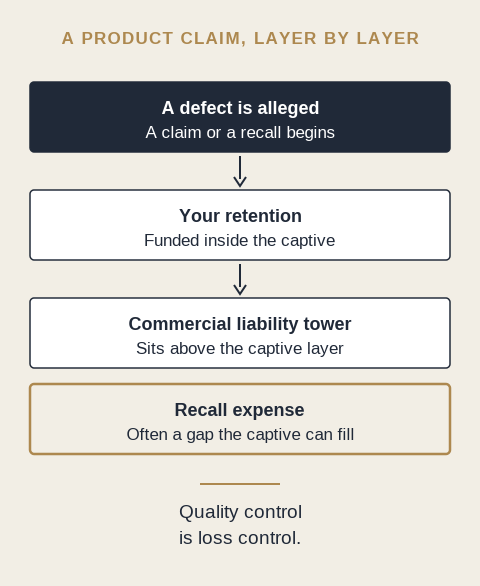
The retention. Many manufacturers already carry a sizable deductible or self-insured retention on product liability. A captive gives that retention a formal home: premium goes in, claims are paid from it, and good results stay with the owner rather than disappearing into the operating budget.
The commercial tower. Large product liability claims are what commercial insurance and reinsurance are built for, and the tower stays in place above the captive layer.
The gaps. Recall expense and some warranty risks are often limited or excluded by commercial policies. These are where a captive can add coverage the market does not offer on workable terms. Our post on product recall and warranty coverage covers those risks in depth.
Recall: the gap that brings manufacturers to captives
A recall can be expensive even when nobody is hurt: notifying customers, retrieving product, replacing or repairing it, and managing the disruption. Manufacturers of consumer products also carry reporting obligations; the U.S. Consumer Product Safety Commission explains the duty to report potentially hazardous products.
Recall exposure is hard for commercial insurers to price, because recalls are infrequent for any one manufacturer and their cost depends on how much product is in the field and how quickly it can be found. Many standard liability policies exclude the cost of the recall itself, covering injuries from a defective product but not the expense of pulling it back. That leaves a gap exactly where a manufacturer with good traceability has the most information about its own risk.
A captive can be written to cover defined recall expenses, priced from the manufacturer’s actual history and controls. The policy language matters: what triggers coverage, which costs are included, and what is excluded should be clear before a recall happens, not argued about after.
Who fits
A manufacturer tends to fit a captive when:
- Its quality program is strong and documented. Testing, traceability, supplier controls, and the ability to identify affected product quickly.
- It has credible loss data. Claims history by product line that an actuary can use to price the risk.
- It already retains meaningful risk. A retention that is currently funded informally is a natural starting point.
- It can fund losses and capital. A captive ties up money that would otherwise stay in the business.
A captive is usually the wrong answer for a manufacturer with poor product data, weak quality controls, or a hope that a new structure will make a bad loss record go away.
Scale matters too, but not in the way owners often assume. A captive carries fixed costs every year — management, actuarial work, audit, and regulatory fees among them — so the risks it finances have to be large enough to justify them. A smaller manufacturer with modest retentions may get more value from tightening its contracts and its commercial program than from forming an insurer. Our post on how much it costs to start a captive lays out the cost categories, and our post on whether captive insurance is worth it covers the honest trade-offs.
Single-owner captive or group captive
A manufacturer with distinctive product risks and enough scale may form a single-owner captive for its retention and gaps. Manufacturers with more ordinary working-layer risks — workers’ compensation for plant employees, auto for delivery fleets — sometimes share those through a group captive. Some use both. Our post on workers’ comp captive insurance covers the plant-floor side.
Contracts, suppliers, and who really carries the risk
A manufacturer’s product liability exposure depends heavily on its contracts. Suppliers of components may agree to indemnify the manufacturer for defects in their parts; customers and distributors may demand indemnity from the manufacturer in turn. Each of those promises shifts risk, and each depends on the other party having the insurance and the financial strength to honor it.
That matters for a captive in two ways. First, a manufacturer with strong contracts and well-insured suppliers retains less of its own product risk, which changes what the captive should cover and how it should be priced. Second, a manufacturer that lets supplier certificates lapse or signs away more than it intended may find its captive paying claims it expected someone else to pay. The feasibility study should read the contracts, not just the loss runs.
What a feasibility study looks at for a manufacturer
For a manufacturer, a feasibility study usually examines:
- Product lines and markets. What you make, who uses it, and where it is sold all shape the liability profile.
- Loss history by line. Product liability, recall events, warranty claims, and workers’ compensation, year by year.
- The current insurance program. Retentions, limits, exclusions, and where the commercial market is pulling back.
- Quality and recall readiness. Testing, traceability, supplier controls, and how quickly affected product can be identified and pulled.
- Financial capacity. The ability to fund a loss fund and post capital without straining working capital.
The study may recommend a single-owner captive, participation in a group, a change to the commercial program alone, or nothing at all. A study that only ever concludes “form a captive” is not really a study; our page on the feasibility study explains why an honest no is a good outcome.
Warranty risk
Many manufacturers also carry warranty obligations: promises to repair or replace products that fail within a stated period. Warranty claims are often frequent and predictable, which makes them easier to price than catastrophic liability, and some manufacturers finance them through a captive. The details depend on how the warranty is written and how claims are administered. Our post on product recall and warranty coverage covers both risks together.
Quality control is loss control
In a manufacturer’s captive, the quality program is the economics. Fewer defects mean fewer claims; faster traceability means smaller recalls; good documentation means better defense when a claim does come. A captive makes the payoff of that discipline visible, because the results flow back to the owner rather than to an outside carrier.
The habits that matter most are familiar to any plant manager: testing that catches problems before product ships, lot and serial tracking that tells you exactly which units are affected, supplier qualification that keeps bad components out, and clear warnings and instructions for the people who use what you make. When a claim does arrive, records that show what was made, when, from which parts, and how it was tested are what let defense counsel respond with facts.
There is also a cultural side. A manufacturer that owns its captive tends to see product claims differently. Instead of a carrier’s problem handled at arm’s length, each claim is the company’s own money, and that tends to sharpen attention on root causes. Owners who already think this way are the ones a captive rewards.
Tax is not the reason
Where tax treatment applies at all, it follows from genuine insurance, never the other way around. Our post on captive insurance and taxes covers what is real. This is general information, not legal or tax advice — see our disclosures.
Where to start
A feasibility study looks at your product lines, loss history, current retentions, and recall exposure, and recommends what — if anything — belongs in a captive. It can conclude that your commercial program already serves you well. If you are new to captives, start with what a captive insurance company is.
Frequently asked questions
Does a captive replace my product liability insurance?
Usually not entirely. Most manufacturers keep a commercial liability tower for large claims and use a captive to fund the retention beneath it, or to cover risks the tower excludes, such as some recall expense. The captive and the commercial program work together, and the feasibility study recommends where the line between them should sit.
Can a captive pay for a product recall?
It can, when the coverage is written for it and priced from the manufacturer’s real exposure. Recall expense is often limited or excluded in standard liability policies, which makes it a common reason manufacturers look at captives. The policy has to define what it covers — notification, retrieval, replacement — and the captive has to be capitalized to pay.
Should a manufacturer use a single-owner captive or a group?
It depends on what you want to finance. A manufacturer with distinctive product risks and enough scale may use a single-owner captive. Manufacturers in a similar line of business sometimes share working-layer risks such as workers’ compensation through a group captive. Some use both. The feasibility study is where that choice gets made.
What do manufacturers need to provide for a feasibility study?
Loss history by line, details of your products and markets, your current insurance program and its retentions, your quality control and recall procedures, and financial statements showing your capacity to fund losses and capital. The better your data, the more confidently an actuary can price the risk.
Feasibility Study
See whether a captive fits your business.
Every engagement starts with a feasibility study — an honest read on whether a captive is right for you before anything is formed.