
How Does Captive Insurance Work? A CFO’s Guide
If you sit in the finance seat, you already think about risk as a line you fund, not a thing that simply happens. You carry deductibles, you self-insure some exposures whether you call it that or not, and every renewal you write a premium check whose size you only partly control. Somewhere in that process a colleague, a broker, or a peer at another company has probably said the word captive — and left you wondering whether it is a sophisticated risk-financing tool or a clever tax maneuver dressed up as one.
This guide answers the question the way a CFO would want it answered: in plain terms, with the money and the company explained, and without a single fabricated number. The short version is that a captive is an insurance company your business owns. The longer version — how the cash actually moves, why it has to be real insurance, and how to judge it against your whole cost of risk rather than one premium line — is the rest of this piece. (For a from-scratch primer on the concept itself, our what is a captive page is the foundational explainer; this assumes you want the finance lens.)
Where does a captive sit among your options? Briefly: every business finances its risk somewhere between pure risk transfer (buy a commercial policy) and pure risk retention (absorb losses yourself), and a captive is the structured middle — the formalized, licensed end of the risk you are already retaining, rather than informally going bare. For the full picture of where a captive sits among your risk-financing options — transfer, retention, and self-insurance — see what is risk financing. This guide assumes you already want the finance lens, so it leads with the mechanics.
How a captive actually works — the company and the cash
Strip away the jargon and a captive does exactly what any insurance company does. What changes is who owns it and who, in effect, is its main customer. Here is the sequence in finance terms.
You form and capitalize a licensed insurer. The captive is a real company, chartered in a domicile — a U.S. state or an offshore jurisdiction with a captive statute — and funded with enough capital to credibly stand behind the claims it will insure. Capitalization is sized to the risk, not to a marketing number; a company that could not actually pay a loss is not really insurance.
Your operating business pays it real premiums. The premiums are set at arm’s length for the actual risk, and — like premiums paid to any insurer — they are generally deductible business expenses of the operating company. This is the part that makes a CFO sit up: money that used to leave the business entirely now moves to an entity the business owns.
The captive underwrites real coverage and pays real claims. It issues policies covering specific exposures, holds and invests reserves between claims, and pays losses when covered events occur. Between the premium coming in and the claim going out, it behaves like the insurer it is — because that is exactly what it has to be.
The underwriting result stays inside a company you own. In a year with few claims, the difference between premiums earned and losses paid — the underwriting profit a commercial carrier would have pocketed — instead accumulates as surplus inside your captive, alongside the investment income on its reserves. That surplus is genuinely at risk in a bad loss year; that is precisely what makes it insurance rather than a deposit. But over time, retaining your own underwriting result instead of surrendering it is the core of the economic case.
That is the whole mechanism. A captive is not a product you buy; it is a company you build and run. And like any insurer, it has ongoing obligations — actuarial pricing, claims handling, financial statements, regulatory filings, and tax compliance — which is why a captive is managed as an operating insurance company indefinitely, not stood up once and forgotten.
Why it has to be real insurance — not a place to park money
This is the part finance leaders most need to internalize, because it is where the whole structure stands or falls. A captive earns its treatment as insurance only if it genuinely is insurance. There is no statutory definition to hide behind; the controlling rule comes from the Supreme Court, which held that an arrangement is insurance only if it involves both risk shifting and risk distribution (Helvering v. Le Gierse, 312 U.S. 531 (1941)). The IRS and the Tax Court apply that through a working framework: genuine insurance risk, risk that actually shifts from the insured to the insurer, risk distributed across a pool of independent exposures, and an arrangement that looks like insurance in its commonly accepted sense.
In plain terms: risk shifting means the financial consequence of a loss truly moves off your books and onto the insurer. Risk distribution means the insurer pools enough independent, unrelated exposures that the law of large numbers makes losses predictable — the many premiums pay the few losses. Take away shifting and you have a savings account; take away distribution and you have a bet. (Our what is a captive page teaches both from the ground up with everyday examples, so we will not re-explain them here.)
The reason this matters to a CFO is risk, not theory. Captive arrangements that were engineered backward from a tax result — with pricing that was not arm’s length and “pools” that were really circular flows of the same money — have lost in court, on the merits of insurance, in cases like Avrahami v. Commissioner (149 T.C. 144 (2017)) and Reserve Mechanical Corp. v. Commissioner (T.C. Memo. 2018-86, aff’d 34 F.4th 881 (10th Cir. 2022)). Both failed for the same reason: the risk was not genuinely distributed and the structure did not behave like real insurance. The lesson is not that captives are suspect — it is that the discipline is the point. A captive built as insurance first is durable; one built as a tax structure first is fragile.
A word on tax, since a finance leader will reasonably ask. A small captive that qualifies as genuine insurance and keeps its premiums under the statutory ceiling may elect Section 831(b) treatment — meaning it is taxed only on its investment income, not its underwriting income. The ceiling is $2.9 million for the 2026 tax year (Rev. Proc. 2025-32, indexed annually). But read the order carefully: the election is available to a company that already qualifies as an insurance company. It is a consequence of operating real insurance, never the reason to build one. And the disclosure rules around micro-captives sit under active IRS scrutiny — the regime has changed more than once and parts of it are being litigated and on appeal as of 2026 — which is exactly why structure and documentation matter, and why you confirm your own obligations with current tax counsel. This is general educational information, not legal or tax advice — see our disclosures.
The CFO’s real lens: total cost of risk, not the premium line
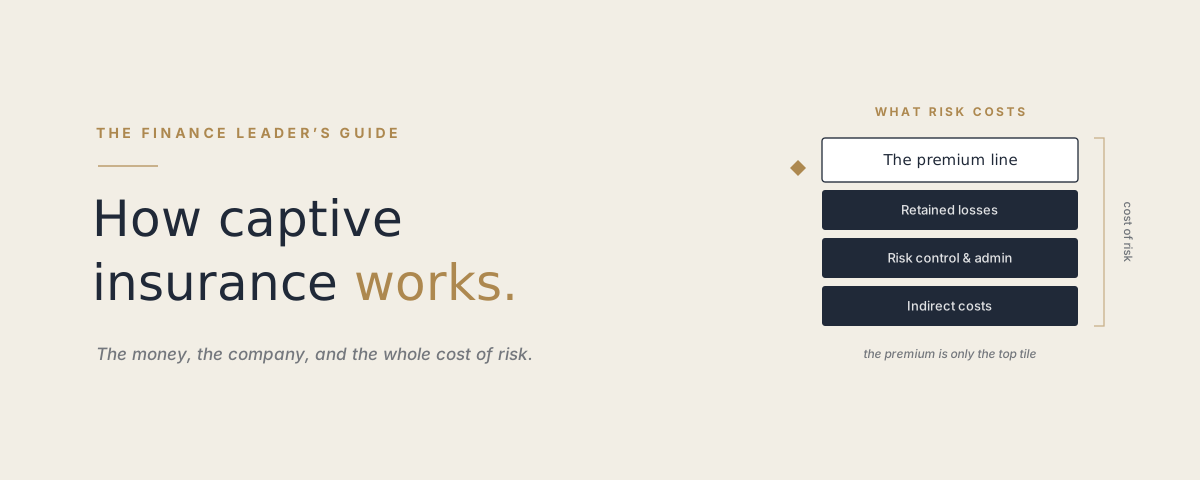
Here is the shift in perspective that makes the captive question tractable for a finance leader. The instinct at renewal is to judge insurance by the premium — one number, easy to compare year over year. But premium is only one component of what risk actually costs the business. The more complete measure is total cost of risk (TCOR): a concept introduced by Douglas Barlow at Massey-Ferguson in 1966 that adds up the whole picture — your insurance and risk-financing costs, plus the losses you retain (deductibles, self-insured retentions, and uninsured events), plus the cost of risk control and administration, plus the indirect costs a loss imposes on the operation.
Through that lens, the premium line is often the visible tip of a much larger cost. A company can show a comfortable premium with a quietly large retained-loss and risk-control bill underneath it — or pay a rich premium that subsidizes the market’s worse risks while its own losses run low. A captive becomes interesting precisely when the whole cost of risk, not just the premium, suggests you are financing risk inefficiently: paying away your good years, carrying genuine exposures the market underprices or will not write, or both.
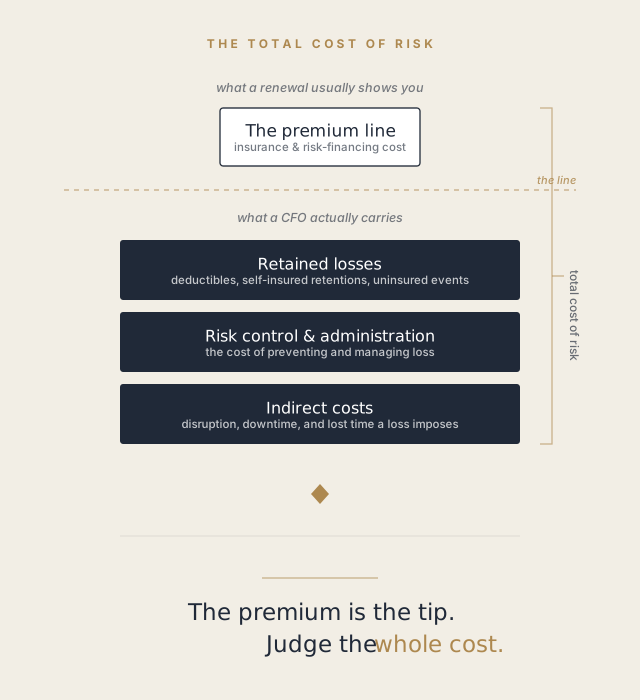
The honest discipline here is that TCOR is a lens, never a number we can quote you in the abstract. Anyone who tells you a captive “cuts your cost of risk by X percent” is selling, not advising. What a captive does to your total cost of risk depends entirely on your loss history, your premium relative to your losses, the lines and limits involved, and the structure that fits — all of which are modeled against your actual numbers in a feasibility study, and only then. The value of the TCOR lens is not a figure; it is the better question: not “is my premium lower this year?” but “across everything risk costs us, are we financing it the smartest way?”
The two Tessera routes — which path fits your company
If the mechanics and the total-cost-of-risk lens point toward owning more of your risk financing, the next question is which kind of captive. Tessera works in two structures, and they answer different problems.
A single-owner micro-captive (831(b))
A micro-captive is owned by a single business. It tends to finance the enterprise and uninsured risks the commercial market excludes, sublimits, or prices past reason — the exposures you may be retaining today without ever having funded them. Because it is small, a micro-captive that qualifies as genuine insurance may elect Section 831(b) treatment and be taxed only on its investment income. The hard part for a single owner is risk distribution: one business rarely has enough independent exposures on its own, so distribution is typically built in through a genuine, arm’s-length third-party risk pool. If you want the procedural walk-through, our cornerstone guide on how to start an 831(b) captive lays out the path in order, and the micro-captives & 831(b) pillar covers the structure in depth.
A member-owned group captive
A group captive takes the opposite ownership shape: many unrelated mid-market businesses co-own one insurer and pool their working-layer risks — most often workers’ compensation, general liability, and commercial auto. For a CFO frustrated at paying the market’s price for someone else’s bad risk, the appeal is direct: inside a selectively underwritten pool, your cost is driven much more by how your own business and your peers actually perform. Distribution is largely inherent in the membership rather than engineered after the fact, which is a genuine structural strength. Our cornerstone on group captive insurance for mid-market businesses explains the layered loss-fund mechanics and the conditional economics, and the group captives pillar covers who it fits.
Neither route is right for every business, and the responsible answer is sometimes neither. A captive of either kind has to work as real insurance, hold real capital, and earn its place against your total cost of risk. The way to find out which path — if any — fits is the same single front door for both: a feasibility study that tests the idea against your actual risk and numbers before anything is formed, and tells you plainly when the answer is no. For a finance leader, that is the version of the captive question worth asking: not whether a captive sounds clever, but whether, across everything risk costs your business, owning the mechanism is the smarter way to finance it.
Frequently asked questions
In plain terms, how does captive insurance work?
Your business forms its own licensed insurance company — the captive — and pays it real premiums to cover real risks. The captive issues policies, holds reserves, and pays claims like any insurer. The difference is ownership: in a good year, the underwriting profit and investment income that a commercial carrier would keep instead build value inside a company you own. It only works if it operates as genuine insurance, with real risk transfer and risk distribution, rather than as a place to park money.
Is a captive just a way to lower our tax bill?
No, and framing it that way is how captives get into trouble. A captive is a risk-financing tool first; any tax treatment is a downstream consequence of operating genuine insurance. A small captive that qualifies as insurance and stays under the premium ceiling may elect Section 831(b) tax treatment — taxed only on its investment income — but the election follows the insurance, never the other way around. Structuring a captive backward from a tax number is the exact pattern courts have rejected.
How is a captive different from just self-insuring?
Informal self-insurance means absorbing losses out of pocket with no separate company, reserves, or structure — you are effectively going bare and hoping. A captive is the formalized, licensed end of that same instinct: a real insurer you own that issues policies, holds funded reserves, is regulated in its domicile, can reach reinsurance, and — when it qualifies — is treated as insurance. It is structured self-financing of risk you are already carrying, not an informal gamble.
What is total cost of risk, and why should a CFO care?
Total cost of risk (TCOR) is the complete measure of what risk costs the business — not just the premium line, but retained losses such as deductibles and uninsured events, plus risk-control and administrative costs, plus the indirect costs a loss creates. The term traces to Douglas Barlow at Massey-Ferguson in 1966. The point for a finance leader is that judging insurance by premium alone misses most of the picture; a captive is evaluated against the whole cost of risk, modeled to your numbers in a feasibility study — never a generic figure.
Which captive structure would fit our company?
It depends on whether you are insuring one company’s risks or pooling with others. A single-owner micro-captive is owned by one business and, if it qualifies as insurance and stays small enough, may elect Section 831(b) treatment; it tends to finance enterprise and uninsured exposures. A member-owned group captive is co-owned by many unrelated mid-market businesses pooling working-layer lines such as workers’ compensation, general liability, and auto. The honest way to tell which fits — or whether neither does — is a feasibility study against your actual numbers.
Feasibility Study
See whether a captive fits your business.
Every engagement starts with a feasibility study — an honest read on whether a captive is right for you before anything is formed.