
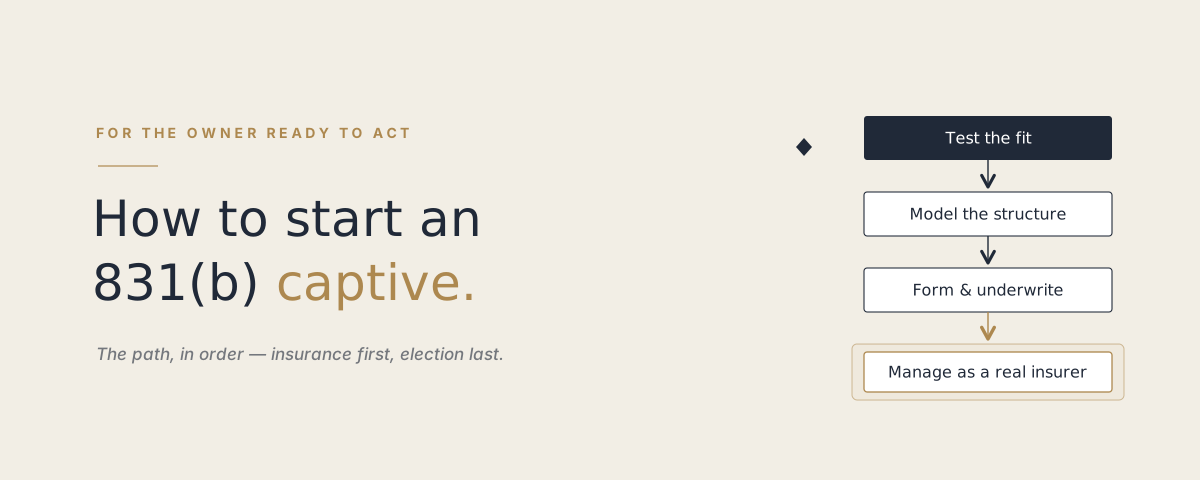
How to Start an 831(b) Captive Insurance Company
If you’ve reached the point of asking how to start an 831(b) captive, you’ve usually already decided the why: your business carries real risks the commercial market underprices, excludes, or won’t write, and you’d rather finance them through an insurance company you own than absorb them silently on the balance sheet. This is a procedural walk-through for that owner — what an 831(b) captive actually is, who it genuinely fits, the order the work happens in, and the honest scrutiny that comes with it.
One thing to settle at the outset, because it shapes everything below: a captive has to work as real insurance before anything else about it matters. The tax election that makes these structures attractive is a consequence of operating genuine insurance — not the reason to build one. Get that order wrong and the whole thing is fragile. Get it right and you have a durable risk-financing tool.
What an 831(b) captive actually is
A captive is an insurance company you own. Instead of paying an outside carrier for risks it understands less well than you do, your business forms its own licensed insurer, writes real policies, sets arm’s-length premiums, and pays its own claims. A micro-captive is simply a small one — small enough that its annual premiums fall under a statutory threshold, which makes a particular tax election available.
That election is the one named in the title. Section 831(b) of the Internal Revenue Code lets a qualifying small non-life insurance company elect to be taxed only on its investment income rather than on its underwriting income. To be eligible, the company’s net written premiums (or direct written premiums, whichever is greater) must fall at or below the limit — $2.9 million for the 2026 tax year (Rev. Proc. 2025-32, indexed annually) — and it must satisfy the diversification requirements added by the Protecting Americans from Tax Hikes (PATH) Act of 2015.
Read that sequence carefully, because the order is the whole point. The 831(b) election is available to a company that already qualifies as an insurance company. It is not a structure you build to reach a tax result; it is a tax treatment that becomes available once a captive operates as genuine insurance. This is general educational information, not legal or tax advice — see our disclosures, and review any election with your own qualified advisors.
So what makes something “insurance” in the eyes of the IRS and the courts? There is no statutory definition. The controlling source is the Supreme Court’s holding that an arrangement is insurance only if it involves both risk shifting and risk distribution (Helvering v. Le Gierse, 312 U.S. 531 (1941)). The IRS and the Tax Court apply that through a working framework: there must be genuine insurance risk, the risk must actually shift from the insured to the insurer, the insurer must distribute that risk across a pool of independent exposures, and the arrangement must look like insurance in its commonly accepted sense. Those are substantive requirements, not boxes to check.
Who an 831(b) captive genuinely fits
A micro-captive tends to fit a profitable, closely held business already absorbing meaningful risk out of pocket — because the commercial market excludes it, sublimits it, or prices it past reason. Before you think about formation, it’s worth being honest about whether you’re actually a candidate. The strongest ones share three things.
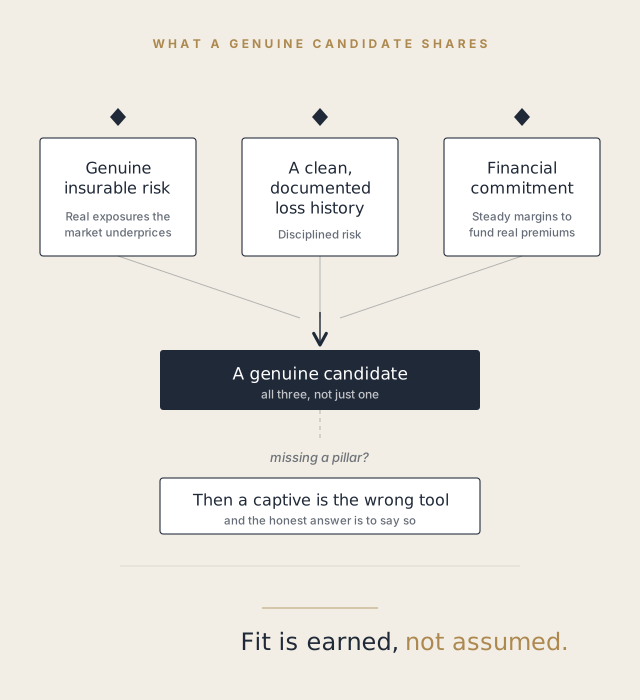
Genuine insurable risk. There have to be real exposures to finance — risks with an actual trigger that the commercial market handles badly or not at all. Non-damage business interruption, the loss of a key contract or customer, audit and administrative defense, cyber response beyond a thin commercial limit, warranty obligations sitting unfunded on the balance sheet. If you can’t name the specific, uninsured risks a captive would write, you don’t yet have a captive — you have an idea looking for a justification.
A clean, documented loss history. A captive is built on the premise that you understand and manage your own risk well enough to price it. That case is far easier to make when your loss history is clean, well-documented, and backed by disciplined risk management. The history is also what an actuary works from to set defensible premiums, and what a regulator and the IRS will look at if the structure is ever examined.
Financial commitment. Premiums have to be real and paid year after year, and the captive has to hold enough surplus to credibly pay the claims it insures. A business that can’t fund premiums without strain, or that quietly intends to treat the captive as a savings account, isn’t a fit. The surplus is genuinely at risk — that’s what makes it insurance rather than a deposit — and the commitment has to be one you can sustain through a bad loss year.
The honest counterpart matters just as much: if the real motivation is a deduction rather than a risk to finance, if there are no genuine uninsured exposures, or if no credible path to risk distribution exists, a captive is the wrong tool. Saying so is part of the job, and it’s cheaper to hear it before you spend on formation than after.
The formation path, in order
When a captive does fit, the work happens in a deliberate sequence. Each stage earns the next, and skipping ahead — especially jumping to formation before the feasibility work is done — is how captives end up fragile.
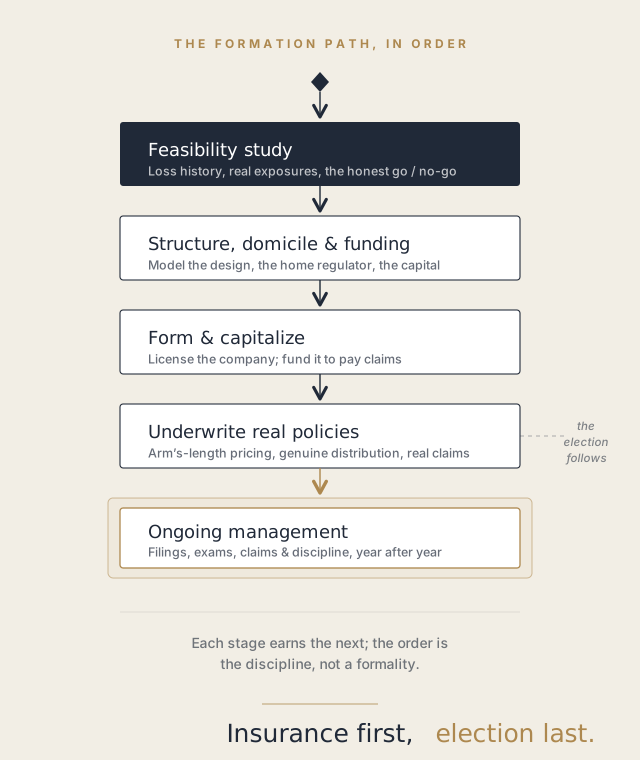
1. The feasibility study — first, always
You don’t begin by forming a company. You begin by testing whether a captive is the right answer for your risk at all. A feasibility study examines your loss history and exposures, identifies which risks are genuinely insurable, and models whether a credible structure — including real risk distribution — can actually be built around them. It’s diagnostic work, and its most valuable output is sometimes the word no.
This is the single most important discipline in the whole process, so it gets its own emphasis below. If you take one thing from this piece: the study comes first.
2. Model the structure, domicile, and funding
If the study points toward a captive, the next stage is design. What lines does the captive write, and at what limits? How is risk distribution achieved — most often by adding unrelated risk through a genuine pool or reinsurance arrangement, not from one business alone? Where is the company domiciled? Both U.S. states with captive statutes and offshore jurisdictions license captives, and each sets its own capital minimums, premium tax, and reporting rules — so domicile is compared against your specific facts rather than defaulted to one jurisdiction. And how much capital does the company need to credibly stand behind its policies?
These questions are modeled together because they interact. The lines you write drive the capital you need; the domicile shapes the cost and the rules; the funding has to be sustainable. This is where the abstract idea becomes a concrete, numbers-on-paper design — built as insurance, with the tax election treated as a downstream consequence.
3. Form and capitalize the company
Only now does an entity come into existence. The captive is licensed in its chosen domicile and capitalized — funded with enough surplus to pay the claims it insures. A thinly funded company that couldn’t actually cover a loss undercuts the entire case that it’s real insurance, so capitalization is sized to the risk, not to a marketing number. Formation also means the governance, the service providers, and the operating apparatus of an actual insurer are put in place.
4. Underwrite real policies
A formed captive that doesn’t behave like an insurer is just a shell. So the captive issues real policies, with arm’s-length pricing supported by an actuary, covering the genuine exposures the feasibility study identified. Premiums are set to the risk assumed — not reverse-engineered from a tax ceiling, the precise pattern the courts rejected in Avrahami v. Commissioner (149 T.C. 144 (2017)) and Reserve Mechanical Corp. v. Commissioner (T.C. Memo. 2018-86, aff’d 34 F.4th 881 (10th Cir. 2022)). In both, the arrangements failed for the same reason: the risk wasn’t genuinely distributed, the pricing wasn’t arm’s length, and the pool meant to supply distribution was a circular flow of funds rather than a bona fide insurer. Underwriting real policies, priced honestly, on real risk is what makes the difference.
5. Manage it as a real insurer — indefinitely
An operating insurance company has ongoing obligations: actuarially supported pricing each year, policy issuance, claims handling, annual financial statements, regulatory filings and exams in its domicile, and tax compliance. Letting any of these lapse is exactly what undermines a captive under scrutiny. A captive isn’t a project you complete; it’s an insurer you run — and the discipline of running it well, year after year, is what keeps it defensible.
The feasibility study, first — because an honest “no” is a good answer
It’s worth slowing down on the first stage, because it’s the one most often skipped and the one that protects you most. The decision to form a captive is a serious, long-term financial commitment, and the only responsible way to make it is to test the idea rigorously before anything is built.
A good feasibility study is willing to reach a negative conclusion. If your risk doesn’t support a credible structure, if distribution can’t be honestly achieved, or if the economics don’t hold up on their own insurance merits, the right outcome is to walk away — plainly, before you’ve spent on formation. That’s not a failure of the process; it is the process working. A captive that shouldn’t exist is far more expensive than the study that talked you out of it.
This is why Tessera runs a single, deliberate front door: the feasibility study. It’s where the question “should I start an 831(b) captive?” gets an honest answer, in either direction. If a captive fits, you leave with a structure designed as insurance from the ground up. If it doesn’t, you leave knowing why, and what would serve you better. Either way, you know where you stand — which is the entire point.
The IRS scrutiny, handled head-on
No responsible walk-through of this subject would skip the scrutiny, so here it is plainly. Micro-captives have faced significant IRS attention, and the disclosure rules that govern them have been actively litigated and are changing. The first attempt to force disclosure by sub-regulatory notice (Notice 2016-66) was struck down on procedural grounds in 2022. The IRS then issued final disclosure regulations in January 2025 (T.D. 10029) to cure that defect — and parts of that regime have since been challenged in court and are on appeal as of 2026. In other words, the precise current disclosure obligations are genuinely in flux, which is why you should confirm your own with current tax counsel rather than rely on anything frozen into evergreen copy.
It’s easy to misread the case law here, so two clarifications. The Supreme Court has weighed in on a micro-captive reporting rule — but only on procedure. In CIC Services, LLC v. IRS (593 U.S. 209 (2021)), the Court held that taxpayers could challenge an IRS reporting requirement in court before being penalized; it said nothing about whether any captive is legitimate. And the cases the IRS has won — Avrahami and Reserve Mechanical — were lost by the taxpayers on the merits of insurance: inadequate risk distribution, pricing that wasn’t arm’s length, and pooling arrangements that didn’t hold up.
The throughline is the same one running under every section above. The captives that get into trouble are the ones engineered backward from a tax number, with risk distribution and pricing treated as formalities. The way through scrutiny isn’t to avoid captives or to hide the history — it’s to build one that genuinely shifts and distributes risk, prices at arm’s length, holds adequate capital, and operates as a real insurer. Legitimacy is the answer, not avoidance. And the only way to know whether your business can build one that meets that standard is to start where every honest version of this process starts: with the study.
Frequently asked questions
What is the very first step to starting an 831(b) captive?
A feasibility study — not forming a company. Before any entity exists, the study examines your loss history and real exposures, tests whether a credible insurance structure with genuine risk distribution can be built, and compares domiciles against your facts. The honest output may be that a captive doesn’t fit, which is a useful answer in itself. You can begin with our feasibility study.
Is the 831(b) election the reason to start a captive?
No. Section 831(b) is a tax treatment available to a small company that already qualifies as genuine insurance — the election follows the insurance, never the other way around. If the underlying risk financing doesn’t make sense on its own merits, the election doesn’t rescue it. Structuring a captive backward from a tax number is the exact pattern the courts have rejected in cases like Avrahami v. Commissioner (U.S. Tax Court, 2017).
Who is a genuine candidate for an 831(b) captive?
Typically a profitable, closely held business already absorbing meaningful risk out of pocket — because the commercial market excludes it, sublimits it, or prices it past reason. The strongest candidates share three things: genuine insurable exposures, a clean and documented loss history, and the financial commitment to fund real premiums year after year. Missing any one of them usually means a captive is the wrong tool.
How does a single-owner captive achieve real risk distribution?
Distribution rarely comes from one business alone — a captive insuring only its related companies has very few independent exposures, which is where the leading cases turned. It’s typically achieved by adding unrelated risk through a genuine third-party risk pool or reinsurance arrangement, priced at arm’s length and able to actually pay claims. A pool that exists only on paper is exactly what failed in Avrahami and Reserve Mechanical Corp. v. Commissioner (U.S. Tax Court, 2018; affirmed by the Tenth Circuit, 2022).
Are 831(b) captives still under IRS scrutiny?
Yes. Micro-captives have faced significant IRS scrutiny, and the disclosure rules governing them have been actively litigated and are changing — the regime has been revised more than once and parts of it are on appeal as of 2026. That isn’t a reason to avoid a captive or to paper over the history; it’s the reason genuine structure, arm’s-length pricing, and disciplined documentation matter. Confirm your specific obligations with current tax counsel and see our disclosures.
Feasibility Study
See whether a captive fits your business.
Every engagement starts with a feasibility study — an honest read on whether a captive is right for you before anything is formed.