
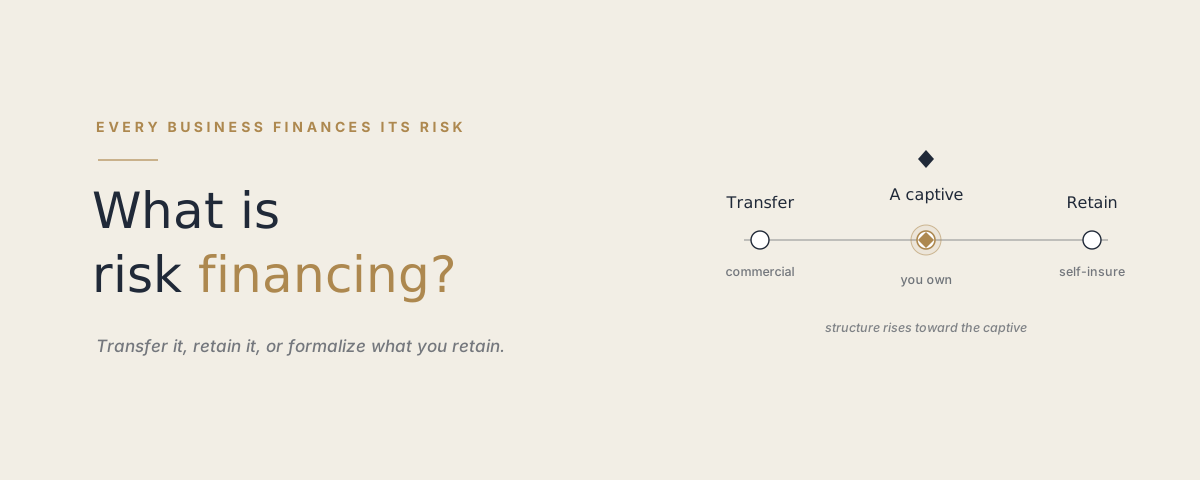
What Is Risk Financing? Self-Insurance vs. Captives vs. Traditional Coverage
Every business finances its risk somehow. That sentence is easy to skip past, but it is the foundation of everything else here, so it is worth sitting with. Your company faces losses it cannot perfectly predict — a fire, a lawsuit, an injured worker, a contract that falls through. Whether you have ever framed it this way or not, you have already made decisions about how the money to cover those losses will be there when one happens. That set of decisions has a name: risk financing. The only real question is not whether you finance your risk, but how — and most businesses have never deliberately chosen.
This is the earliest, most foundational way to think about captive insurance, so it is where an honest explanation should start. Before you can sensibly ask whether a captive fits your business, it helps to see the whole landscape a captive sits inside. Once that landscape is clear, a captive stops looking exotic and starts looking like what it is: one deliberate, structured point on a spectrum you are already standing somewhere on.
Risk financing: the discipline of covering your losses
Risk financing is the discipline of arranging the least-cost coverage of your loss exposures while making sure funds are actually available after a loss. Strip away the jargon and it is a practical question every owner faces: when something goes wrong, where does the money come from?
There are broadly two answers, and everything else is a refinement of them. You can transfer the risk — hand it to someone else to bear, in exchange for a payment. Or you can retain it — keep it on your own books and pay for losses yourself when they come. Most businesses do some of both without ever naming it. The deductible on your commercial policy is retained risk. The coverage above the deductible is transferred risk. The exposure the policy excludes entirely — the risk no carrier would write for you, or priced so high you walked away — is retained too, whether you planned for it or not.
Naming these moves is the first step to making them on purpose instead of by default. So let us take them one at a time.
Transferring risk: commercial insurance
Risk transfer means moving the risk of loss to another party — typically a professional risk bearer, a commercial insurer — by contract. This is the approach nearly every business knows, because it is what buying insurance means. You pay a premium; in exchange, the insurer agrees to bear specified losses if they occur. The risk leaves your balance sheet and lands on theirs.
For a great many exposures, this is exactly the right move, and nothing here suggests otherwise. Transfer is efficient when a risk is severe but unlikely, when you could not comfortably absorb the loss yourself, or when the market prices the coverage fairly relative to your actual exposure. A catastrophic, low-frequency risk is the textbook case for transferring it to someone with the balance sheet to carry it.
The trade-off is that, in a good year, the premium is gone. When you transfer risk and few claims occur, the insurer keeps the difference as profit — a fair deal for risks you genuinely want off your books. It becomes a worse deal when you consistently pay far more in premium than you suffer in losses, year after year. At that point you are financing someone else’s worse risks through your premium, and a reasonable owner starts to wonder whether there is a more deliberate way to handle risk they are clearly managing well.
Retaining risk: self-insurance, formal and informal
The other answer is to keep the risk yourself. Risk retention is the planned, conscious acceptance of some or all of your losses rather than transferring them — through deductibles, self-insured retentions, deliberate non-insurance, or loss-sensitive arrangements. Self-insurance is the broad name for a retention program: setting aside the means to pay your own losses instead of, or alongside, buying commercial cover.
The word planned is carrying weight in that definition, because retention comes in two very different forms. At one end is informal self-insurance — and it is more common than most owners realize. A business that simply pays losses out of pocket as they happen, with no separate structure and no dedicated reserve, is self-insuring informally. So is the company carrying a real, recurring exposure the commercial market excludes or sublimits, absorbing those losses silently on the balance sheet. This is sometimes called going bare: retaining risk with no structure behind it. It is not a strategy so much as a default — and its hidden cost is that a bad year arrives with no reserve set against it.
At the other end is formalized retention: actually funding for the losses you intend to keep, setting aside reserves, building structure around the risk so that the money is genuinely there when a loss lands. The further you move toward this formal end, the more retention starts to look like running your own insurance operation — which is precisely what it becomes when it reaches its most structured form.
The spectrum: transfer, a captive you own, self-insurance
Here is the framing that ties it together, and it is the most useful mental model an owner can carry out of this piece. Picture the ways of financing risk as a single spectrum.
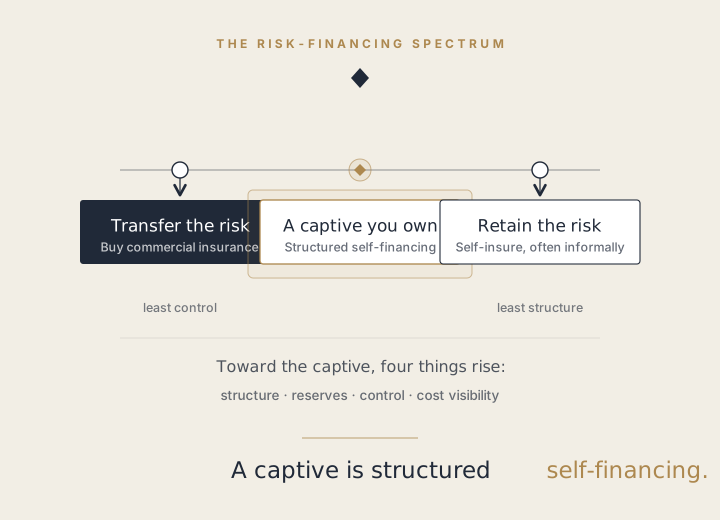
On one end is full commercial transfer: you pay a premium and the risk is someone else’s. On the other end is informal self-insurance: you keep the risk with little or no structure, and pay losses as they come. These ends are familiar; most businesses live somewhere between them without thinking about it.
A captive you own sits deliberately in the middle — and it is best understood as the structured, formalized end of retaining risk. Instead of informally absorbing the risk you are keeping, you finance it through an insurance company you own: real policies, real reserves, real regulation. The captive does not replace the idea of keeping your own risk; it gives that idea structure, discipline, and the standing of an actual insurer. As you move from informal self-insurance toward a captive, four things rise together — structure (an organized program instead of an ad-hoc one), reserves (funds genuinely set against future losses), control (you own the mechanism and its results), and cost visibility (you can see what your risk actually costs rather than guessing). That is the real distinction between “going bare” and owning a captive: not whether you keep the risk, but whether you keep it with structure.
This is the point that trips people up, so it is worth stating flatly: a captive is still real insurance. It is not a clever way to skip insurance and keep the money. Courts treat an arrangement as insurance only when it genuinely shifts risk away from the insured and distributes that risk across a pool of independent exposures — and otherwise looks like real insurance (Helvering v. Le Gierse, 312 U.S. 531 (1941)). A properly built captive is designed to meet those substantive requirements. It issues policies, prices them at arm’s length, holds reserves, and pays claims, like any insurer. The difference from commercial transfer is not that it is less insurance — it is that you own the insurer. (We walk through those two ideas, risk shifting and risk distribution, from the ground up in what is a captive insurance company?.)
This is also why captive insurers belong to a broader family that risk managers call alternative risk financing — risk-financing mechanisms that do not rely on a commercial insurer, a group that also includes risk pools, risk retention groups, and individual self-insurance. A captive is simply the most formalized, licensed member of that family: a way to finance your own risk through an insurance company you control rather than renting coverage from the open market or absorbing losses unstructured.
Total cost of risk: the lens that makes the choice make sense
If the spectrum is the map, total cost of risk is the lens you read it with. It is the single most useful idea for deciding which point on the spectrum actually serves you — and most owners have never been shown it.
Total cost of risk is the complete measure of what risk costs your business, not just the premiums you pay. The term traces to Douglas Barlow, a risk manager at Massey-Ferguson, who introduced it in 1966 precisely because looking at premiums alone hid the true picture. The full picture has several parts: your risk-financing costs (premiums, and a captive’s contributions, sit here), the losses you retain (deductibles, self-insured retentions, and uninsured exposures you absorb), the cost of controlling and administering risk, and the indirect costs a loss creates beyond the direct hit.
The premium line — the number you write a check for — is only one component of that total. And this is exactly why the cheapest premium is not always the lowest cost of risk. A policy with a low premium but a high deductible and broad exclusions can leave you quietly carrying enormous retained losses; a business paying handsomely for coverage it rarely uses may be overspending on transfer for risk it could finance more efficiently itself. You cannot see any of that by staring at the premium line alone.
So total cost of risk is a lens, not a number — and certainly not one anyone can quote you in a blog post, because what it totals is specific to your business: your exposures, your losses, your structure. The value of the lens is that it reframes the question. Instead of “how do I get a cheaper premium?” it asks “how do I lower the total cost of the risk I carry?” — and that second question is the one that opens up the full spectrum, transfer through captive through retention, as live options rather than a default.
Where Tessera fits on the spectrum
If the spectrum has made one thing clear, it should be this: a captive is not a replacement for insurance and not a trick to avoid it. It is the deliberate, structured way to finance risk you are already retaining — most often because the commercial market excludes it, sublimits it, or prices it past reason, leaving you absorbing it informally whether you planned to or not. Tessera works at exactly that structured point on the spectrum, through two distinct routes.
The first is a single-owner micro-captive. This is for a profitable, closely held business that is carrying real, uninsured or underinsured risk on its own books — enterprise risks the commercial market handles badly or not at all. Forming a captive turns that informal retention into a licensed insurer you own, writing real policies for those exposures. Because such a captive is small, it may — if it qualifies as genuine insurance and stays under the premium ceiling — elect a particular tax treatment under Section 831(b) ($2.9 million for the 2026 tax year (Rev. Proc. 2025-32, indexed annually)). But notice the order: the election follows the insurance, never the reverse. This is general information, not legal or tax advice — see our disclosures, and review anything tax-touching with your own advisors. If this route sounds like your situation, how to start an 831(b) captive walks the path in order, and the micro-captives & 831(b) pillar covers it in depth.
The second route is a group captive, which sits at the same structured point on the spectrum but reaches it differently. Instead of one business formalizing its own retention, a set of unrelated mid-market businesses co-own a single insurer and pool the predictable, working-layer risks every operating company carries — commonly workers’ compensation, general liability, and commercial auto. It is still retention made structural; the structure is just shared. For a well-run business whose own loss record is better than the pricing the market keeps quoting, owning a slice of the insurer instead of renting coverage can keep the upside of that discipline. The mechanics, and who it fits, are laid out in group captive insurance for mid-market businesses and the group captives pillar.
Both routes share the same logic the spectrum reveals: you are already financing your risk, so the question worth asking is whether a more structured way of doing it would serve you better. The honest answer depends entirely on your numbers — your exposures, your loss history, how the market prices you, and whether you can fund and stand behind an insurance company over the long term. Some risks are best left transferred. Some are being retained informally and would be far better served by structure. Many businesses land on a blend. The only way to know where a captive fits your business — if it fits at all — is to look, which is what a feasibility study is for: it models your situation before anything is formed, and it is just as willing to tell you a captive is the wrong tool as the right one. Either way, you leave knowing where you stand on the spectrum, and why.
Frequently asked questions
What is risk financing, in plain terms?
Risk financing is how a business arranges to cover its loss exposures — making sure money is there after a loss, at the lowest sensible cost. Every business does it somehow, whether deliberately or by default. The three broad approaches are transferring risk to a commercial insurer, retaining it (paying losses yourself, sometimes informally), or formalizing that retention through a structure like a captive. The question is never whether you finance your risk — it is how.
Is self-insurance the same as a captive?
No. Self-insurance, in its simplest form, is informal risk retention — you keep a risk on your own books and pay losses out of pocket as they happen, with no separate company and often no dedicated reserve. A captive formalizes that instinct: it is a licensed insurance company you own that issues real policies, holds reserves, is regulated in its domicile, and — when it qualifies as genuine insurance — is treated as insurance. A captive is the structured, deliberate end of retaining risk, not “going bare.”
Is a captive still real insurance, or is it just keeping the money yourself?
It is real insurance — that is the whole point. Courts treat an arrangement as insurance only when it genuinely shifts risk away from the insured and distributes that risk across a pool of independent exposures, and otherwise looks like real insurance (Helvering v. Le Gierse, 312 U.S. 531 (1941)). A captive is built to meet those substantive requirements; it issues policies, prices them at arm’s length, holds reserves, and pays claims. It is insurance you own rather than insurance you rent — not a savings account with an insurance label.
What is total cost of risk, and why does it matter here?
Total cost of risk is a way of looking at what risk really costs a business — not just the premium line, but the whole picture: risk-financing costs, the losses you retain (deductibles, self-insured retentions, uninsured exposures), the cost of controlling and administering risk, and indirect costs. The premium you write a check for is only one piece. The reason it matters is that the cheapest premium is not always the lowest total cost — and seeing the full picture is what tells you whether transferring, retaining, or formalizing a given risk actually serves you best.
How do I know which approach is right for my business?
It depends on your actual exposures, your loss history, how the commercial market prices you, and whether you can fund and stand behind retained risk over the long term. Some risks are best transferred; some are already being retained informally and would be better served by structure; many businesses use a blend. The honest way to find out where a captive fits — if it fits at all — is a feasibility study, which models your numbers before anything is formed and tells you plainly when a captive is the wrong tool.
Feasibility Study
See whether a captive fits your business.
Every engagement starts with a feasibility study — an honest read on whether a captive is right for you before anything is formed.