
Captive Insurance for CPAs and Financial Advisors: A Plain-English Primer
Sooner or later a client will ask you about captive insurance. It might come from a business owner who heard about it at a conference, from a promoter who has already done the selling, or from your own sense that a profitable client is overpaying for coverage that does not fit. As the CPA, attorney, or financial advisor in the room, you do not need to become a captive specialist to be useful — but you do need a clear, honest mental model of what a captive actually is, so you can tell a genuine opportunity from a packaged tax play. That is what this primer is for.
It sits above two more detailed pieces written for advisors — one on single-owner micro-captives and one on member-owned group captives — and routes you to whichever is relevant once you have the fundamentals in hand. The throughline is the one that runs through everything we publish: a captive is real insurance for your client first. The financial and tax consequences, where they exist, follow from that — they are never the reason to start.
What a captive actually is
A captive insurance company is a licensed insurer that a business forms and owns to insure its own risks. Instead of paying premiums to an outside carrier — and watching the carrier keep the difference in a good year — the client pays premiums to an insurer they control. That captive writes real policies, sets prices for the actual risk, holds and invests reserves, and pays its own claims. The plainest way to put it to a client: a captive is insurance you own.
That framing matters because it locates the captive correctly. Every business finances its risk somehow; the only question is how. Most either transfer the risk by buying commercial insurance, or retain it — often informally, by absorbing losses out of pocket with no separate structure. A captive is the deliberate, structured way to finance the risk a business is already retaining: rather than informally going bare, the owner finances that risk through a licensed insurance company, with real policies, reserves, and regulation. On the risk-financing spectrum, a captive sits between buying a commercial policy and informal self-insurance — it is structured self-financing, not going without coverage. (For the ground-level version of this spectrum, see our plain-English explainer on what a captive is.)
This is also why “is a captive a tax shelter?” is the wrong first question, and why answering it correctly protects your client. A captive is a risk-financing tool. Tax efficiency, where it appears, is a consequence of operating genuine insurance — never the purpose. An advisor who leads with the deduction is building on sand; an advisor who leads with the risk is building on the only foundation that holds.
The two structures, as client solutions
“Captive” is an umbrella term, but for most closely held and mid-market businesses the practical choice comes down to two structures. They solve different problems, and the right one depends entirely on the client’s facts.
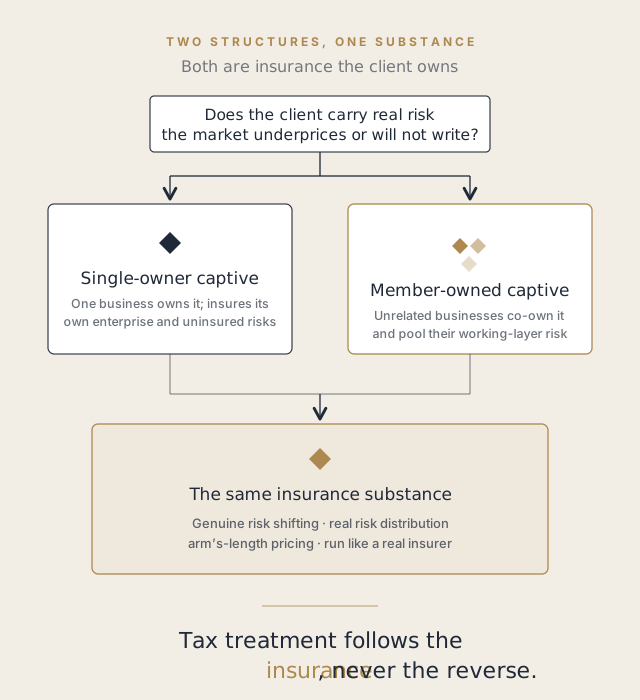
A single-owner micro-captive is owned by one business and is small enough to elect Section 831(b) tax treatment. It tends to insure a company’s enterprise and uninsured risks — the exposures the commercial market sublimits, excludes, or prices out of reach, which quietly leave the owner self-insured. Section 831(b) lets a qualifying small insurance company elect to be taxed only on its investment income rather than its underwriting income, provided its annual net written premiums stay at or below the statutory ceiling — $2.9 million for the 2026 tax year (Rev. Proc. 2025-32, indexed annually) — and it meets the diversification requirements added by the Protecting Americans from Tax Hikes (PATH) Act of 2015. The crucial point for an advisor is that the election follows the insurance: it only becomes available once the company already qualifies as a genuine insurer, and it is never a structure you run backward from a deduction. The depth on who fits, where these structures fail, and how to keep one defensible is in our cornerstone on 831(b) captives for advisors, and the micro-captives pillar covers the structure end to end.
A member-owned group captive is a licensed insurer co-owned by a number of unrelated businesses that pool their risk and share in the results. Group captives are usually built around predictable, high-frequency working lines — workers’ compensation, general liability, and commercial auto — where a quality pool can underwrite to its own loss experience. There is no special premium ceiling. The fit is strongest for a financially sound business with a better-than-average loss record that is, in effect, subsidizing weaker risks in the commercial market and wants ownership of its own results — but is comfortable sharing a measured layer of risk with vetted peers. Because a group has many genuinely unrelated members, its risk-distribution story is naturally stronger than a single owner’s, though that is a qualitative advantage, not a guarantee that any particular program is sound. The detail on candidate screening and how to vet a specific pool is in our cornerstone on group captives for advisors, with the group-captives pillar covering the structure itself.
The election, the premium ceiling, and the tax treatment described above are general educational information, not legal or tax advice — outcomes depend on the specific facts, and any election or position should be reviewed with the client’s qualified tax and legal advisors. See our disclosures.
The insurance substance that makes either one defensible
Whichever structure is on the table, both rest on the same foundation — and it is a foundation you, as the advisor, are well placed to test. For an arrangement to be insurance for federal tax purposes, it has to be insurance in substance. Federal law has no statutory definition of insurance; the controlling Supreme Court source holds that an arrangement is insurance only if it involves both risk shifting and risk distribution (Helvering v. Le Gierse, 312 U.S. 531 (1941)). The IRS and the Tax Court apply that through a working framework — as applied in Avrahami and Reserve Mechanical — usually stated as four elements:
- Insurance risk. A real, fortuitous risk of loss — not an investment or ordinary business risk wearing an insurance label.
- Risk shifting. The financial consequence of a loss genuinely moves from the insured to the captive; the risk actually leaves the operating business.
- Risk distribution. The captive pools enough independent, uncorrelated exposures that the law of large numbers lets predicted losses approximate actual losses — the many premiums pay the few claims.
- Insurance in its commonly accepted sense. It looks and operates like real insurance: arm’s-length pricing, real policies, claims actually handled, adequate capital, an entity run like an insurer.
Two of these are worth slowing down on, because they are where the substance is made or broken. Risk shifting is usually the straightforward half — a real loss falls on the captive instead of the operating business. Distribution is the harder half, and it is where the two structures differ most. A single-owner captive insuring only the owner’s related businesses has very few independent exposures, and a handful of correlated risks do not distribute; achieving distribution takes genuine, arm’s-length pooling of unrelated risk. A true multi-member group, by contrast, gets much of its distribution from the unrelated members themselves. Either way, the pool only counts if it is real — arm’s-length pricing, genuine claim exposure, counterparties that could actually pay. That distinction is exactly the kind of thing a careful advisor flags before a client signs anything.
A candid word on scrutiny — and why structure is the answer
You should not raise a captive with a client without being honest about the scrutiny history, particularly on the single-owner side. The lesson of the cases the IRS has won is not that captives are illegitimate — it is a precise diagnosis of what separates durable structures from the ones that collapsed. In Avrahami v. Commissioner, 149 T.C. 144 (2017), the first major Tax Court loss for a micro-captive, the arrangement failed for lack of risk distribution and because it was not insurance in the commonly accepted sense; the red flags included premiums that jumped roughly seven-fold and tracked the 831(b) ceiling rather than the risk, pricing that was not actuarially supported, and a reinsurance “pool” that operated as a circular flow of funds. In Reserve Mechanical Corp. v. Commissioner, T.C. Memo. 2018-86 (aff’d, 34 F.4th 881 (10th Cir. 2022)), the captive failed on two independent grounds — inadequate distribution and policies that were not insurance in the commonly accepted sense — and the Tenth Circuit’s affirmance confirmed the Avrahami principles hold up on appeal. A related case is frequently overstated: CIC Services, LLC v. IRS, 593 U.S. 209 (2021), was a unanimous procedural ruling that taxpayers could challenge an IRS reporting requirement in court before being penalized. It was not a ruling that micro-captives are legitimate, and it should never be read as the Supreme Court blessing captives.
The disclosure rules are themselves in motion, which is its own reason for care. The IRS finalized micro-captive disclosure regulations in 2025 (T.D. 10029), curing the procedural defect that had sunk an earlier attempt; then, in 2026, a federal court vacated the listed-transaction designation while leaving the transaction-of-interest designation in place, and both sides have appealed. The practical takeaway for an advisor is not to memorize a designation that may shift again — it is to treat the disclosure question as live and confirm the specific obligation for any client, in the relevant tax year, with current qualified tax counsel rather than freeze it from an article like this one. None of this is cause for either alarm or dismissiveness; it is the reason structure and documentation matter. This is general information, not legal or tax advice — see our disclosures and our compliance page for how legitimacy is established and tested.
How to spot whether a client is even a plausible fit
You can do real value before any specialist is involved, simply by screening. A captive — either structure — is worth a serious look only when the basics line up. Ask whether the client carries genuine, uninsured or underinsured risk that the commercial market underprices or will not write; whether there is a documented loss history to price against, rather than premiums reaching for a ceiling; whether there is a credible path to real risk distribution; and whether the client has the financial steadiness and the commitment to fund and operate an insurance company year after year — funding, filings, claims handling, and audits, every year, not once.
When those line up, a captive may genuinely fit, and the next step is a structured look at the actual numbers. When they do not, the most valuable thing you can tell a client is that a captive is the wrong tool — and saying so plainly is the job. A client who fails the screen is not someone you talk into a captive; they are someone you protect from one. The advisor who screens honestly is doing right by the client; the one who pitches a deduction is creating exposure for both of them.
That candor is also, in practice, good for the relationship you have with the client — the advisor who quarterbacks an honest, well-built solution earns durable trust. But that is a consequence of getting the risk decision right, never the reason to raise a captive in the first place. The reason is always the client’s risk.
Where to go from here
If a client looks like a plausible candidate, the honest next step is a feasibility study: a structured, independent look at their risk, loss history, and goals that tests whether a defensible captive can actually be built — and says so plainly when it cannot. From there, the path depends on the structure. For a single-owner business with enterprise and uninsured risks, read the advisor cornerstone on 831(b) micro-captives. For a quality mid-market business with meaningful working-layer premium and an appetite to pool with vetted peers, read the cornerstone on group captives. Either way, you keep the relationship and the full financial picture; the captive specialists handle the insurance company — and the work stays checkable, with independent actuaries, auditors, and your client’s own tax counsel each doing their own part. Insurance first, in writing, before anything is formed.
Frequently asked questions
What is a captive, in one sentence I can use with a client?
A captive is a licensed insurance company a business owns to insure its own risks — so instead of paying premiums to an outside carrier, the client pays them to an insurer they control, which writes real coverage, holds reserves, and pays its own claims. The plain way to say it: a captive is insurance you own. Whether it makes sense for a given client is a separate question that turns on whether they carry genuine risk the commercial market underprices or will not write. This is general information, not legal or tax advice.
Is captive insurance a tax shelter?
No — and framing it that way is the fastest route to trouble. A captive is a risk-financing tool first. Any tax treatment follows from operating as genuine insurance: real risk shifting, real risk distribution, arm’s-length pricing, an entity run like an insurer. When a structure is built backward from a desired deduction rather than from a real risk to finance, it fails — that is precisely the pattern the Tax Court rejected in Avrahami v. Commissioner, 149 T.C. 144 (2017) and Reserve Mechanical Corp. v. Commissioner, T.C. Memo. 2018-86 (aff’d, 10th Cir. 2022). The right posture for an advisor is to lead with the client’s risk and treat tax as a consequence, never the headline. This is general information, not legal or tax advice.
How is a captive different from self-insurance?
They sit next to each other on the risk-financing spectrum. Informal self-insurance means keeping a risk on your own books and paying losses out of pocket as they happen — no separate company, no formal reserve. A captive is the formalized, licensed version of that instinct: a real insurance company the client owns, issuing policies, holding reserves, regulated in its domicile, able to access reinsurance, and treated as insurance for tax purposes when it qualifies. It is structured self-financing, not going bare.
Are micro-captives a “listed transaction” my client has to disclose?
The disclosure regime is actively litigated and changing, so the honest answer is that it depends on the current state of the rules. The IRS finalized disclosure regulations in 2025 (T.D. 10029), but in 2026 a federal court vacated the listed-transaction designation while leaving the transaction-of-interest designation in place, and both sides have appealed. Because the precise current obligations are a moving target, confirm any specific reporting duty — what must be reported, by whom, and on which form, such as Form 8886 or a material-advisor obligation — with current qualified tax counsel for the relevant tax year rather than rely on an evergreen article. This is general information, not legal or tax advice.
Does recommending a captive mean handing my client off to someone else?
No. A captive is built on a separation of functions, and the client’s existing CPA, attorney, and risk manager stay in the picture — they hold the relationship and the full financial view. A captive manager runs the insurance company and the feasibility work, while an independent actuary prices, independent tax counsel advises on the tax position, and an independent auditor audits, so no single party grades its own work. You stay close to the client; the captive specialists handle the insurance company. That collaboration tends to deepen the client relationship — but that is a consequence of getting the risk decision right, not the reason to raise a captive.
Feasibility Study
See whether a captive fits your business.
Every engagement starts with a feasibility study — an honest read on whether a captive is right for you before anything is formed.