
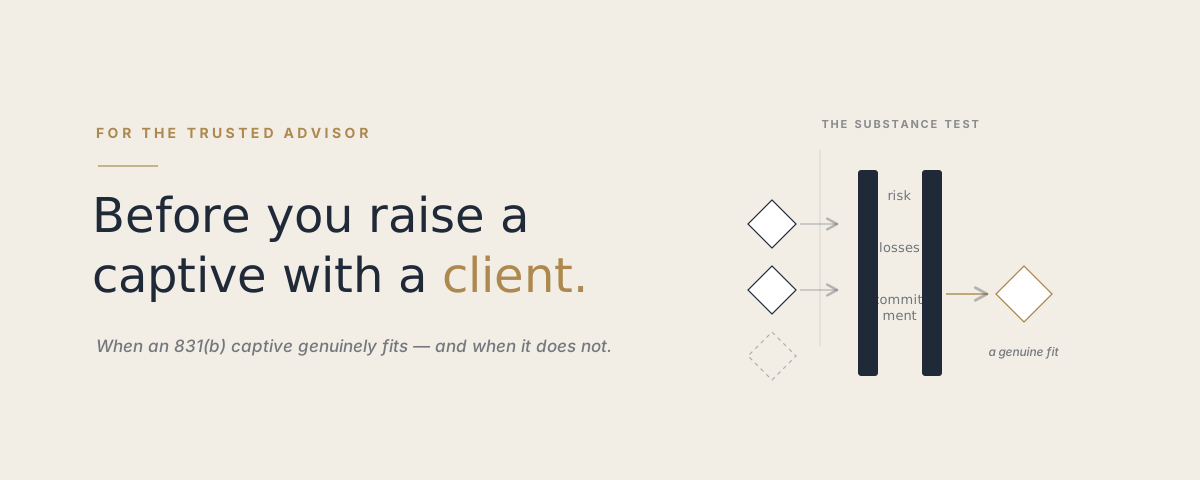
831(b) Captives: What Advisors Need to Know Before Recommending One to a Client
If you advise closely held business owners, the captive question will eventually land on your desk — raised by a client who heard about it at a conference, or by a promoter who has already done the selling. As the CPA, attorney, or financial advisor in the room, you are the person best positioned to tell the difference between a captive that genuinely serves the client and one that will create more problems than it solves. This piece is about how to make that call.
The short version: a micro-captive that elects under Section 831(b) of the Internal Revenue Code is real insurance first and a tax treatment second. When the order gets reversed — when the structure is built backward from a deduction — it fails, and the client is left holding the consequences. Your value here is the same discipline you bring to everything else: insisting on substance before form.
Start with the client’s risk, not the client’s tax bill
The reason a captive can ever make sense is a risk problem, not a tax problem. A profitable, closely held business often carries meaningful exposure that the commercial market underprices, sublimits, or simply will not write — non-damage business interruption, the loss of a concentrated customer, a thin cyber limit, an exclusion that quietly leaves the owner self-insured. A captive lets that owner finance those risks through a licensed insurer they control, write real policies, set arm’s-length premiums, and pay their own claims.
That is the lede, and it has to stay the lede. Section 831(b) lets a qualifying small insurance company elect to be taxed only on its investment income rather than its underwriting income, provided its annual net written premiums stay at or below the statutory ceiling — $2.9 million for the 2026 tax year (Rev. Proc. 2025-32, indexed annually) — and it meets the diversification requirements added by the Protecting Americans from Tax Hikes (PATH) Act of 2015. But the election is a consequence of operating genuine insurance, not a strategy you run in reverse. As the statute is built, the election only becomes available after the company already qualifies as an insurance company. If the underlying risk financing does not make sense on its own, the election does not rescue it.
This is general educational information, not legal or tax advice — outcomes depend on the specific facts, and any election should be reviewed with qualified tax and legal advisors. See our disclosures.
When a captive genuinely fits — and when it does not
The most useful thing you can do early is screen. Before any structure is on the table, four questions decide whether a captive is even worth studying.
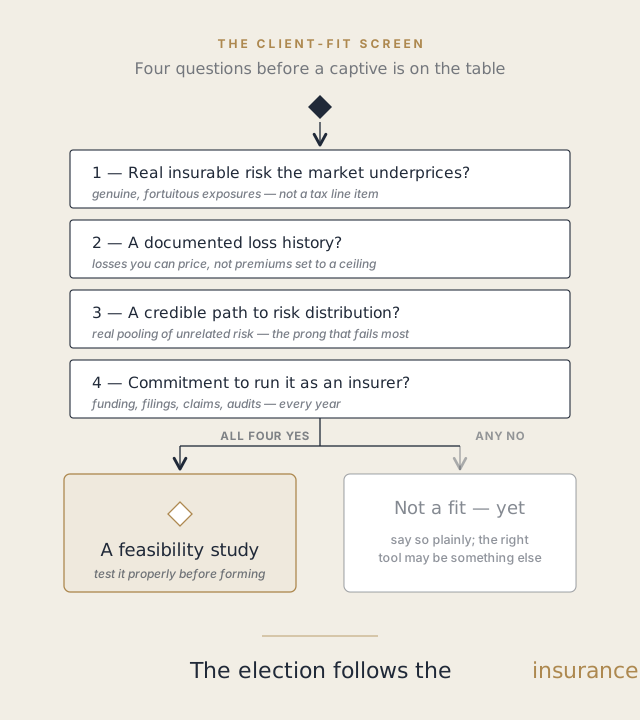
A captive tends to fit when the client has:
- Real insurable risk the market underprices. Genuine, fortuitous exposures that are uninsured or underinsured today — not a tax line item dressed up as a risk.
- A documented loss history. Losses you can actually price against, so premiums follow the exposure rather than reaching for a ceiling.
- A credible path to risk distribution. A way to pool enough genuinely independent risk that the arrangement distributes, not just shifts.
- The commitment to run it as an insurer. Steady funding, annual filings, claims handling, and audits — every year, not once.
It does not fit, and the honest answer is to say so, when the real motivation is a deduction rather than a risk to finance; when the business cannot fund premiums without strain; when there are no genuine uninsured exposures; or when no credible path to distribution exists. A client who fails the screen is not a client you talk into a captive — they are a client you protect from one. That candor is the advisor’s job, and it is also what keeps you out of the line of fire if the arrangement is later examined.
The insurance substance that makes it defensible
For a captive to be insurance for federal tax purposes, it has to be insurance in substance. Federal law has no statutory definition of insurance; the controlling Supreme Court source holds that an arrangement is insurance only if it involves both risk shifting and risk distribution (Helvering v. Le Gierse, 312 U.S. 531 (1941)). The IRS and the Tax Court apply that through a working framework of four elements — as applied in Avrahami and Reserve Mechanical:
- Insurance risk. A real, fortuitous risk of loss — not an investment or ordinary business risk wearing an insurance label.
- Risk shifting. The financial consequence of a loss genuinely moves from the insured to the captive; the risk actually leaves the operating business.
- Risk distribution. The captive pools enough independent, uncorrelated exposures that the law of large numbers lets predicted losses approximate actual losses — the many premiums pay the few claims.
- Insurance in its commonly accepted sense. It looks and operates like real insurance: arm’s-length pricing, real policies, claims actually handled, adequate capital, an entity run like an insurer.
For a single-owner captive, shifting is the easy half. Distribution is where micro-captives are made or broken. A captive insuring only the owner’s related businesses has very few independent exposures, and a handful of correlated risks do not distribute. Distribution is legitimately achieved by adding unrelated risk — typically by having the captive assume a measured slice of unrelated insureds’ losses through a genuine pool or reinsurance arrangement while ceding a slice of its own. The pool only counts if it is real: arm’s-length pricing, genuine claim exposure, and counterparties that could actually pay.
What the scrutiny history actually teaches
Micro-captives sit under active IRS scrutiny, and any advisor recommending one should understand why. The lesson of the cases the IRS has won is not that captives are illegitimate — it is a precise diagnosis of what separates durable structures from the ones that failed.
In Avrahami v. Commissioner, 149 T.C. 144 (2017) — the first major Tax Court loss for a micro-captive — the arrangement was held not to be insurance because it lacked risk distribution and was not insurance in the commonly accepted sense. The red flags read like a checklist of what to avoid: premiums that jumped roughly seven-fold once the captive appeared and tracked the 831(b) ceiling rather than the risk, pricing that was not actuarially supported, and a reinsurance “pool” that functioned as a circular flow of funds rather than a bona fide insurer. In Reserve Mechanical Corp. v. Commissioner, T.C. Memo. 2018-86 (aff’d, 34 F.4th 881 (10th Cir. 2022)), the captive failed on two independent grounds — inadequate risk distribution and policies that were not insurance in the commonly accepted sense — with a pooling arrangement the court again found to be a circular flow and premiums that were not arm’s length. The Tenth Circuit’s affirmance confirmed that the Avrahami principles hold up on appeal.
A related case is frequently overstated, so it is worth being precise. CIC Services, LLC v. IRS, 593 U.S. 209 (2021), was a unanimous procedural ruling: the Anti-Injunction Act did not bar a pre-enforcement challenge to an IRS reporting requirement. It was not a ruling that micro-captives are legitimate, and it should never be cited as the Supreme Court blessing captives. The substance of legitimacy still rests exactly where Le Gierse put it.
The takeaway for an advisor is clean: durable structures have genuine risk transfer, real distribution across enough independent exposures, premiums set by an independent actuary to the actual risk, adequate capital, and an entity operated like the insurer it claims to be. The ones that failed were engineered toward a number. The difference is not subtle, and it is the difference you are best placed to spot.
A word on the disclosure regime — confirm the current rule
The reporting rules around micro-captives are themselves being litigated, and the status has changed more than once. The IRS finalized disclosure regulations in 2025 (T.D. 10029, published January 14, 2025), curing the procedural defect that had sunk its earlier Notice 2016-66 — which a federal court vacated in 2022 for failing the Administrative Procedure Act’s notice-and-comment process. Then, in 2026, a federal court vacated the listed-transaction designation while leaving the transaction-of-interest designation in place, and both sides have appealed.
For an advisor, the practical point is not to memorize a designation that may shift again. It is this: micro-captives sit under active, changing scrutiny, and the specific disclosure obligation for any client — what must be reported, by whom, and on which form — should be confirmed with current qualified tax counsel for the relevant tax year rather than frozen from an article like this one. Treat the disclosure question as live, and verify it when it matters. This is general information, not legal or tax advice — see our disclosures.
The advisor’s role — and how Tessera works alongside you
Your job in a captive conversation is the same one you already do well: protect the client by insisting on substance. That means leading with the risk, screening honestly, and being willing to say no. When a captive does fit, it means making sure it is structured as insurance from the ground up — real risk transfer, genuine distribution, arm’s-length pricing, adequate capital, and clean ongoing operation — so that if the questions ever come, the answers are already on the table.
Tessera is built to work alongside the advisors a client already trusts, not to displace them. The single most important safeguard against the failures above is structural: the parties who validate a captive should be independent of the party who manages it. Tessera performs the underwriting, the feasibility study, and the ongoing management — and then submits that work for outside review. An independent actuary sets and validates pricing. Independent tax counsel advises on the tax position. An independent auditor performs the insurance-company audit. The client’s own CPA and attorney stay in the picture. No one marks their own homework, and that independence is itself part of what makes the arrangement defensible.
That collaboration is also, candidly, good for your relationship with the client — the advisor who quarterbacks an honest, well-built solution earns trust that lasts. But that is a consequence of getting it right, never the reason to raise a captive. The reason is always the client’s risk. If a captive genuinely fits, the right next step is a feasibility study that tests the structure before anything is formed. If it does not, the most valuable thing you can tell a client is that it is not the tool for them — and you will have done your job either way.
Frequently asked questions
My client mostly wants the tax treatment. Is that a problem?
It is the warning sign, not the goal. The Section 831(b) election is a tax treatment available to a small company that already qualifies as genuine insurance — the election follows the insurance, never the reverse. A captive built backward from a desired deduction is exactly the pattern the Tax Court rejected in Avrahami v. Commissioner, 149 T.C. 144 (2017) and Reserve Mechanical Corp. v. Commissioner, T.C. Memo. 2018-86 (aff’d, 10th Cir. 2022). If the risk financing does not stand on its own merits, the election has nothing legitimate to attach to. Your role is to redirect the conversation to the underlying risk. This is general information, not legal or tax advice.
Are micro-captives a “listed transaction” I have to disclose?
The disclosure regime is actively litigated and changing, so the honest answer is: it depends on the current state of the rules, and you should confirm specific obligations with current counsel rather than rely on an evergreen article. The IRS finalized disclosure regulations in 2025 (T.D. 10029), but in 2026 a federal court vacated the listed-transaction designation while leaving the transaction-of-interest designation in place, and both sides have appealed. Because the precise current obligations are a moving target, do not treat any single source — including this page — as settled; verify the specific Form 8886 or material-advisor obligation with qualified tax counsel for the relevant tax year. This is general information, not legal or tax advice.
Does Tessera replace me as the client’s advisor?
No. Tessera manages the captive and performs underwriting and feasibility work; it does not take over the relationships the client already trusts. The structure depends on independent professionals — an independent actuary to price, independent tax counsel to advise on the tax position, and an independent auditor to audit — precisely so that no single party grades its own work. Your client’s existing CPA and attorney remain part of that picture. You stay close to the client; we handle the insurance company.
What single factor most often sinks a micro-captive?
Inadequate risk distribution. Risk shifting — moving the financial consequence of a loss off the insured — is usually the easy half for a single owner. Distribution is the half that gets tested: a captive insuring only its owner’s related businesses has very few independent, uncorrelated exposures, and a handful of correlated risks do not distribute. Both Avrahami and Reserve Mechanical turned on this, including pooling arrangements the courts found were circular flows rather than genuine distribution. A credible, arm’s-length path to real distribution is the threshold question.
How should I frame this conversation with my client?
Lead with the risk, not the return. The right opening question is whether the client carries real, uninsured or underinsured exposure that the commercial market underprices or excludes — and whether they have the loss history, the financial steadiness, and the commitment to operate a real insurance company year after year. If yes, a feasibility study tests whether a defensible structure can actually be built. If no, the candid answer is that a captive is the wrong tool, and saying so protects the client. The advisor who screens honestly is doing the job; the one who pitches a deduction is creating exposure.
Feasibility Study
See whether a captive fits your business.
Every engagement starts with a feasibility study — an honest read on whether a captive is right for you before anything is formed.