

Group Captives: What Advisors Need to Know Before Recommending One to a Client
When a client asks whether a group captive makes sense, the question landing on your desk is rarely really about insurance mechanics. It is about judgment: is this a sound move for this business, and will it still look sound in three years when you are the advisor who blessed it? This piece is written for the CPA, attorney, financial advisor, or risk manager doing that evaluation. The goal is to give you enough of the structure, the fit criteria, and the failure modes to tell a genuinely good candidate from a poor one — and to know what to vet before you put your name behind a specific group.
The throughline is simple and it is the same one that runs through everything we publish: a group captive has to work as real insurance for your client first. The ownership economics that make it attractive are a consequence of that, not the reason to do it.
What a group captive actually is
A group captive is a licensed insurance company co-owned by a number of unrelated businesses that pool their risk and share in the results. Instead of renting coverage from the commercial market every year — handing over premium on good years and absorbing the risks the market underprices or will not write — the members own the mechanism that carries their risk.
Most group captives are built around the predictable, high-frequency working lines: workers’ compensation, general liability, and commercial auto. These are the lines where a quality pool can underwrite to its own loss experience and where a member’s investment in safety shows up fastest in results. Groups come in two broad shapes. A homogeneous group gathers a single industry, so members share exposures, benchmarks, and safety practices. A heterogeneous group spans industries to smooth the pool’s overall volatility. Either way, the defining trait is selectivity: members are chosen, not merely enrolled.
Which clients fit — and which do not
The clients who do well in a group share a recognizable profile. Before you take a specific group seriously for a client, it is worth confirming all of the following are genuinely true:
- A documented better-than-average loss record. Not a feeling that they run a tight ship — loss runs that show it. The group captive thesis only works for a business whose own results are better than the pricing the market hands it.
- A genuine, funded commitment to safety and risk control. Pooling rewards discipline and punishes its absence. A client unwilling to invest in active risk management will not enjoy a group, and the better groups will not keep them.
- Meaningful premium in the working lines. Enough workers’ comp, general liability, or auto premium to fund a worthwhile loss layer. Below a certain scale, the economics and the obligations do not justify the move.
- Financial soundness and a multi-year view. Joining means posting capital and collateral and engaging as an owner across years, not shopping a policy annually. A business that needs the lowest possible first-year premium above all else is not a candidate.
Just as important is recognizing the client who does not fit. A business with a poor or erratic loss history, one that treats safety as a cost to minimize, one that is financially fragile, or one that wants out the moment a renewal looks cheaper elsewhere — these are poor candidates, and recommending a captive to them does no one any favors. Part of your value here is being willing to say no. We hold the same line: we would rather tell an owner a captive is wrong for them than place them somewhere they will struggle.
How the structure works, in plain terms
You do not need to model a group captive to advise on one, but you should understand its shape, because the shape is what protects your client.
Premium inside a group is split. Each member funds an individual loss fund sized to its own expected losses — the layer where the member feels its own performance directly, year after year. Above those individual retentions sits a shared, pooled layer the membership mutualizes, so a single member’s larger loss does not fall entirely on that member. Above the pool, the captive buys reinsurance and excess protection to cap the rare catastrophic year, so one severe event does not destabilize the group. The practical effect: most of a member’s own good or bad experience stays with the member, while the group collectively absorbs the larger, less frequent losses, and the extremes are transferred out entirely.
This layered design is also why the arrangement holds up as insurance rather than as something dressed up to look like it. Courts treat an arrangement as insurance only when it genuinely shifts risk away from the insured and distributes that risk across a pool of independent exposures, and otherwise looks like real insurance in the commonly accepted sense (Helvering v. Le Gierse, 312 U.S. 531 (1941)). Risk distribution comes from pooling many unrelated risks so that, by the law of large numbers, predicted losses approximate actual ones. A true multi-member group has a naturally strong distribution story precisely because the unrelated members supply the pooling themselves — a qualitative advantage over a single-owner structure, not a guarantee that any particular program is sound.
That last caveat is the part advisors should sit with, because the legitimacy depends entirely on the pool being real.
The underwriting discipline that protects your client
The biggest risk to a client in a group captive is not a single large loss — the layering above handles that. It is a weak pool. Because members share a layer of risk, the quality of the other members is part of what your client is buying. If a group admits poorly run businesses to grow, or prices its loss funds to win members rather than to real loss experience, a disciplined client can end up subsidizing avoidable losses. That is exactly the outcome a captive is supposed to let your client escape.
The defense is underwriting discipline, and it is worth being concrete about what that means:
- Selective admission. Prospective members are underwritten on loss history, safety culture, and financial stability — not merely enrolled because they can pay.
- Actuarially sound loss funds. Each member’s funding is set by independent actuaries to that member’s real experience, not reverse-engineered from a desired result.
- Continuous accountability. Members who stop performing are held to their risk-control commitments and, if necessary, removed. The pool stays clean over time, not just at the sale.
The cautionary tax cases reinforce why this matters even though they arose in the single-owner micro-captive context. In Avrahami v. Commissioner, 149 T.C. 144 (2017), and in Reserve Mechanical Corp. v. Commissioner, T.C. Memo. 2018-86, aff’d 34 F.4th 881 (10th Cir. 2022), the arrangements failed in part because their risk-pooling was not genuine — the reinsurance “pools” functioned as circular flows of funds rather than as bona fide distribution among independent insureds, and the pricing was not arm’s length. The lesson generalizes cleanly to group captives: a pool only counts if it is real, selectively underwritten, and independently priced. A group whose membership and pricing would not survive that scrutiny is not one to put a client into. This is general information, not legal or tax advice — confirm any tax position with the client’s own counsel and see our disclosures.
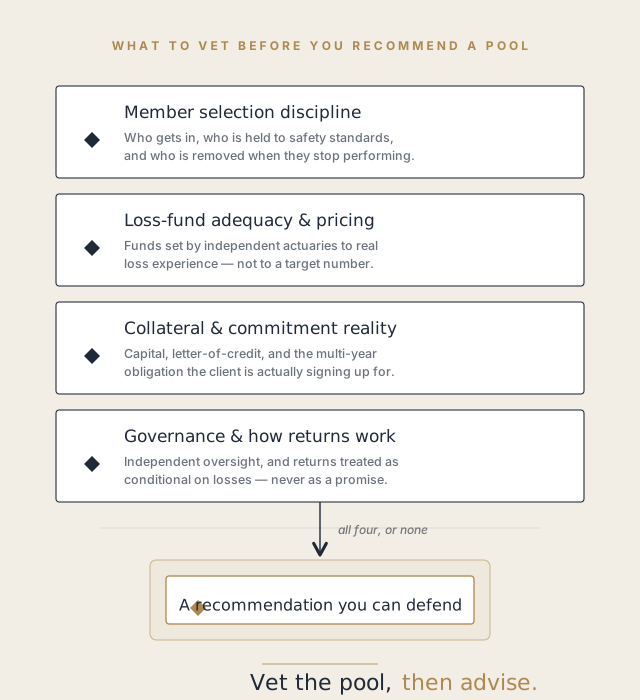
How you protect the client at the point of decision
Your role is to test the specific group against your client’s reality, and to make sure the client signs up understanding what they are signing up for. A few things deserve particular attention.
Vet the pool’s quality directly. Ask how members are selected, who prices the loss funds, how often members are removed, and what the group’s historical experience looks like. A confident, well-run group answers these readily. Evasiveness is a finding in itself.
Be honest about collateral and commitment. Members typically contribute capital and post collateral — often a letter of credit — to secure their loss-fund obligations. The amounts depend on the group’s structure, the client’s premium size, and the client’s risk profile, and they are set by the captive and its domicile regulator. Just as important, the commitment is multi-year: claims from a member’s years continue to develop after the member leaves, so collateral and final settlement are handled as those claims close. A client who hears “join” but not “for several years, with capital at stake” has not heard the whole deal.
Frame returns honestly — they are conditional. The chance to keep underwriting and investment results is a defining feature of a well-run group, and it is also where clients are most often mis-sold. When a member runs clean and the pool performs, the unused portion of its loss fund plus its share of investment income may be returned over time, subject to the captive’s rules, regulatory requirements, and how open claims develop. A poor loss year for the member or the pool reduces or eliminates any return. The structure rewards disciplined risk; it does not promise a payout. If anyone has pitched your client a guaranteed return, that alone is reason to slow down.
On domiciles and tax, briefly
Group captives are domiciled in a range of venues — U.S. states such as Vermont, Tennessee, Utah, Delaware, and North Carolina; the U.S. territory of Puerto Rico; and offshore venues such as the Cayman Islands. The right domicile depends on the client’s facts, and any domicile-specific statutory detail (capital and surplus minimums, premium tax, redomestication rules) is a factual question to confirm against that regulator rather than assert from memory. Puerto Rico in particular has a genuinely nuanced federal tax treatment and should never be lumped in with offshore venues.
On tax generally: a group captive is an insurance and risk-financing decision first. Its tax treatment follows from operating as genuine insurance — it is not the reason to form or join one, and it is not something any advisor should let a client treat as the headline. Tax positions belong with the client’s own tax counsel.
How Tessera works alongside the client’s existing advisors
We are built to advise before we manage, and to work with the professionals a client already trusts — not around them. You hold the relationship and the full financial picture; we bring the captive-specific feasibility and management work. In practice that means a feasibility study that models the client’s loss experience and working-layer premium against a pooled, layered structure, an honest assessment of the specific group on the table, and a clear answer when the fit is not there.
It also means we keep the work checkable. We rely on independent actuaries to price, independent auditors to audit, and the client’s own tax counsel to confirm tax positions — no one should grade their own homework. If you are the advisor who has to stand behind the recommendation, that independence is what lets you do it with confidence. And if a particular group is not worth joining, we will tell you and your client plainly, because a recommendation you can defend is worth more than a placement you cannot.
If a client looks like a candidate, the next step is the same one we apply to everyone: a feasibility study that weighs their numbers and the specific group on the merits — insurance first.
Frequently asked questions
Which clients are genuinely good candidates for a group captive?
Financially sound mid-market businesses with a documented better-than-average loss record, a real commitment to safety and risk control, and meaningful premium in the working lines — typically workers’ compensation, general liability, and commercial auto. The fit is strongest when the client is effectively subsidizing weaker risks in the commercial market and wants ownership of its results, but is comfortable sharing a measured layer of risk with peers rather than carrying it all alone. Clients with poor or erratic loss history, no appetite for risk-control investment, or a need for the lowest possible first-year premium are usually the wrong fit.
What is the single biggest risk to a client joining a group captive?
A weak pool. A group captive distributes risk across its members, so the quality of those other members is part of what your client is buying. If a group admits poorly run businesses or prices its loss funds to win business rather than to real loss experience, a disciplined client can end up absorbing a share of avoidable losses. The protection is underwriting discipline — selective member admission, actuarially sound loss-fund pricing, and the willingness to remove members who stop performing. Vetting that discipline is the heart of the advisor’s job before recommending any specific group.
Are member distributions guaranteed if the client runs a clean year?
No. Returns are conditional, not promised. When a member’s losses come in below what it funded and the pool performs, the unused portion of its loss fund — plus its share of investment income — may be returned over time, subject to the captive’s rules, regulatory requirements, and how open claims develop and close. A poor loss year for the member or the pool reduces or erases any distribution. The structure rewards disciplined risk; it does not guarantee a payout, and any client who hears it as a guaranteed return has been mis-sold. This is general information, not legal or tax advice — see our disclosures.
How does a group captive differ from a micro-captive for my client?
They solve different problems. A group captive lets a quality mid-market business pool predictable working-layer risk — workers’ comp, general liability, auto — with unrelated peers, and there is no special premium ceiling. A micro-captive is a single-owner structure for enterprise and uninsured risks that may elect §831(b) tax treatment if it qualifies as insurance and stays under the premium limit for the tax year. The group structure’s risk distribution is largely inherent in its many unrelated members; the single-owner structure has to work harder to establish it. Our micro-captives page covers that path in detail.
How does Tessera work alongside a client’s existing CPA, attorney, or risk manager?
As a collaborator, not a replacement. We bring the captive-specific feasibility and management work, and we keep the client’s existing advisors in the loop because they hold the relationship and the full financial picture. We expect tax positions to be confirmed by the client’s own tax counsel and we rely on independent actuaries and auditors rather than grading our own work. If a particular group is not worth joining, we will say so — and we would rather tell you and your client that than place them in a weak pool.
Feasibility Study
See whether a captive fits your business.
Every engagement starts with a feasibility study — an honest read on whether a captive is right for you before anything is formed.